

What do I, Britney Spears, Pippa Middleton and Bill Gates have in common? Aside from the fact that we're all ridiculously famous and successful (because that’s just plain obvious), we’re also all middle children.

A few weeks ago, I saw a post on social media commemorating
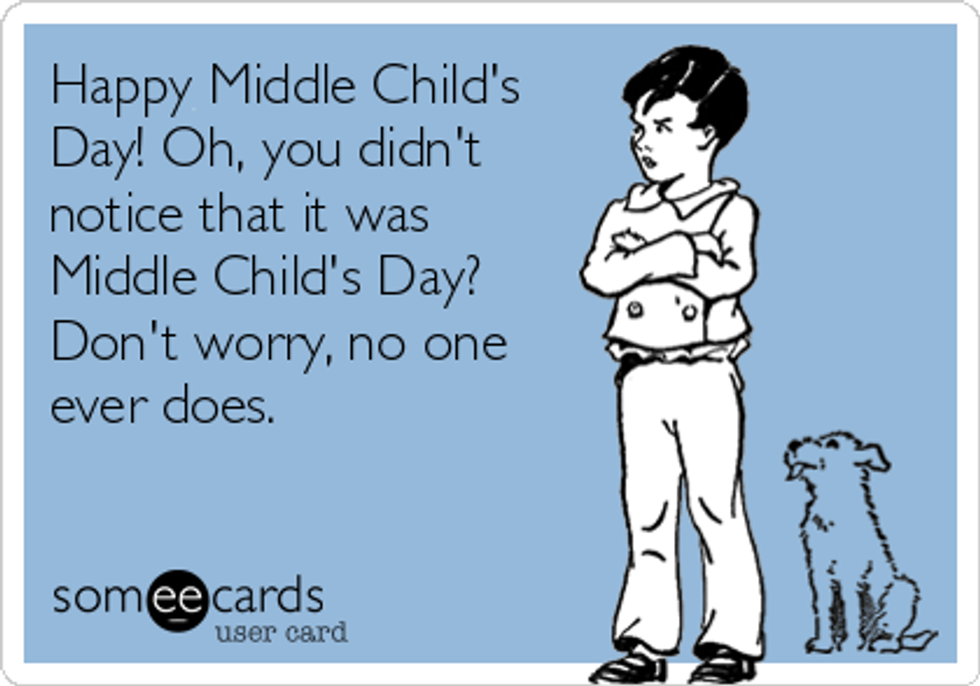
#NationalMiddleChildDay. But after thinking about it, I couldn’t quite figure out what exactly was being celebrated. Being a middle child isn’t particularly glorious or noteworthy. For some, it can actually be a negative thing. After experiencing the adversity firsthand from growing up with an older sister and a younger brother, I have listed some of the struggles that all middle children undergo.
You are never given the same freedom that the older sibling has.
This is the most obvious downfall of being a middle child. I’m less than two years younger than my older sister, but my parents treated me as if we were an entire decade apart while growing up. She was always the one that got to stay up later, eat more junk food, and watch all the PG-13 movies far before I was allowed to. When my sister is 50 years old and I’m checking in at a measly 49, I guarantee that I’ll still hear my parents lecturing me to “stop trying to catch up to her” because she’s still soooo much older than me.
Your wardrobe never consists of new clothes because you receive so many hand-me-downs.
My older sister is at least four inches shorter than me, and it’s been that way for as long as I can remember. But that doesn’t stop my parents from thinking that I’m the perfect recipient for all of her hand-me-downs. Why even go shopping when I can head over to her closet and find some nice clothes that are two sizes too small for me? I'm still trying to convince them that high waters aren’t (and will never be) in style.

You take it personally when you witness your parents spoiling your little sibling to no end.
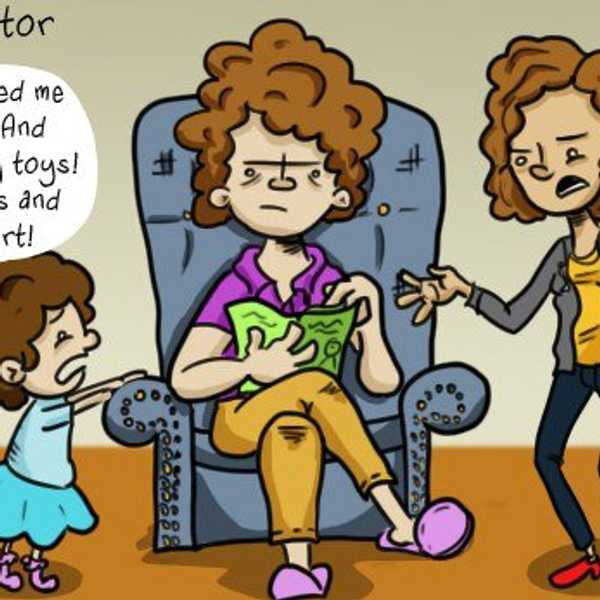
Although in reality this isn’t actually the case, it seems like my brother is the recipient of 99 percent of my parent’s attention. I think some unspoken rule exists that states that the baby of the family will always be treated like one, regardless of how old he or she actually is. My mom cannot stand to see her youngest child grow up, so she still continues to clean his room and do all of his laundry although he is completely capable of performing these actions himself. Cue the animosity from my brother for publicly exposing how easy he has it compared to the rest of us.
People automatically assume that you exhibit the traditional “middle-child” personality traits.
Middle children as a whole don’t have an overall great reputation. Although most of us don’t actually manifest these negative characteristics, we’re still typically associated with being temperamental, problematic and rebellious. Therefore, most people judge middle children and pin them for having these character flaws before even knowing them. Your spot in the family also immediately garners sympathy from others. You know this because after meeting someone, you always receive the smiling-through-the-pain-because-your-position-sucks type of pity grin in return.

Your distant family, friends and acquaintances are never actually aware of how old you are.
Since you’re not the firstborn or the baby of the household, you’re the child that often slips from everyone’s mind. I have found that when I catch up with people who I haven’t seen in a while, they struggle to remember details about me that they know about my siblings. Most of them uses the logic of “Well…. the oldest is in X grade and the youngest is in Y grade, so the middle one must be somewhere in between.” They use my sibling’s ages as markers to try and figure out how old I am, but they ultimately just make a estimate and agree that I’m some wishy-washy age that no one is really quite sure of.

All of these obstacles make it seem like all middle children
got a pretty tough break – especially because birth order is something
completely out of their control. But we learn to deal with the unlucky hand
that we were dealt, resulting in us being innovative thinkers and creative
problem-solvers. All of the feelings of disregard and inequity lead us to
become more independent and establish a stronger sense of self. I’ve fully accepted
my position and have learned to make the most of it. While I occasionally slip
through the cracks of my parent’s attention, I’ll just keep hanging out with my
entourage of Pippa, Bill and Britney in the meantime.