

What Is Anarchism?
Anarchism is often a misunderstood concept, especially in the realm of politics. Politicians and pundits often chide at anarchist philosophies and their thinkers. Though sometimes their criticisms are based on a legitimate objection to the practicality or effectiveness of anarchism, many of these also spring from a fear and lack of understanding of anarchism itself. For example, the definition of anarchism has nothing to do with “chaos” even though it’s used synonymously with anarchism today. The actual definition is simply “without rulers.” Many different philosophers and ideologies interpret anarchism. Some are very similar, and others are diametrically opposed. Many of the original anarchist thinkers espoused themes of anti-statism, anti-property, anti-capitalism and anti-private property, but there are many different interpretations of anarchism that often oppose these views. However, all have one core belief in common: the abolition of the state.
Anarcho Communism & Syndicalism

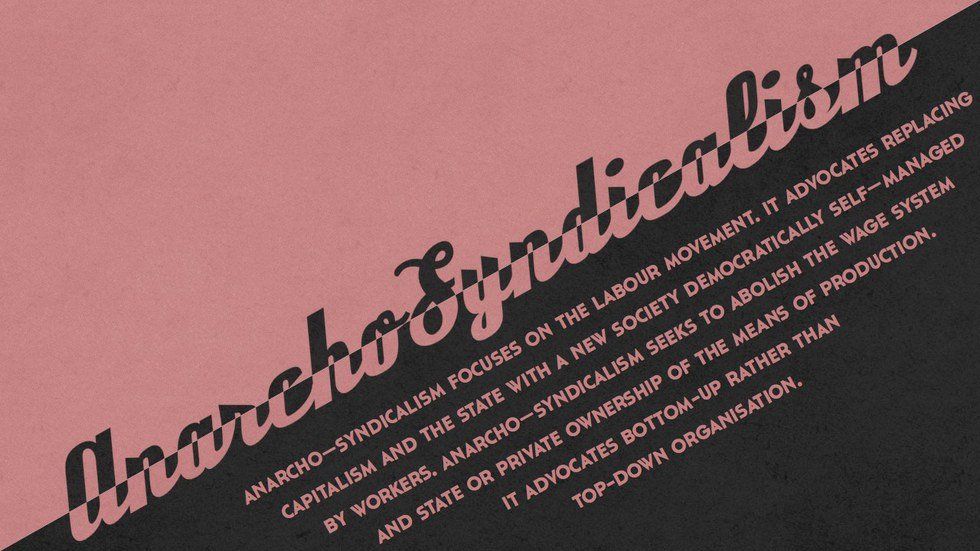
Anarcho Communism and Syndicalism is an interpretation of anarchism that is more in line with many of the beliefs of the original anarchists. It’s a theory of anarchism which advocates the abolition of the state, capitalism, wage labor, and private property. It does express support for personal property, such as personally owned hats, clothes, etc. They favor common ownership of the means of production, direct democracy, and a horizontal network of voluntary associations and workers' councils with production and consumption based on the guiding principle: "from each according to his ability, to each according to his need". Prominent thinkers of these movements include Peter Kropotkin (1842-1921), Emma Goldman (1869-1940) and Noam Chomsky (Born 1928).

Pictured: Noam Chomsky
Anarcho-Communists and Syndicalists view capitalism with contempt, believing it inevitably leads to the oppression of workers by the capitalist elite. They also see the hierarchical nature and acquisition of private property in capitalism to be a leading cause of enormous wealth distribution between the classes, and for the poor working conditions of the working class. Since they believe the government co-opts with capitalists and thus creates support for the capitalist system (such as protection of private property), they argue the government must be abolished to maximize justice, equality and freedom. Additionally, they view worker-owned co-operatives produce happier, more creative and more productive workers than a highly hierarchical, privately owned capitalist business carried out for profit. Anarcho-Communists and Syndicalists generally believe natural resources, land, machinery and other public utilities should be communally owned. They believe that this will more effectively guarantee access to the goods and services that people need, at an equal rate for all people. Interestingly enough, many Anarcho-Communists and Syndicalists reject Marxism, due to its belief in a “dictatorship of the proletariat” and its influence over State Communism. They instead favor horizontal co-operatives and associations as a more effective form of societal organization. Though Anarcho-Communists often divide between support for individualism and the support for the collective, they still believe this structure of society would both maximize the freedom of the individual and provide the most good for the collective.
Examples of Anarcho-Communist Experiments
The most prominent examples of Anarcho-Communist experiments came during the Spanish Civil War. Before Franco’s victory, Anarcho-Communism in Andalusia and Anarcho-Syndicalism in Catalonia and “pure” anarchism in Zaragoza took form. It produced a swelling of general strikes and a libertarian trade union called Confederacion Nacional del Trabajo (CNT). Its influence was sporadic, and ultimately failed to accomplish its goal of overthrowing the state and capitalism. It became, and still remains, an important example supporting anarchism’s potential validity.