

Chances are, if you grew up attending American schools, you learned about the Space Race, a time in history when the United States and the Soviet Union competed to achieve increasingly grander feats of spaceflight. Scientists in this era pioneered many new technologies, spurred by rivalry, until it became possible to send humans into space.
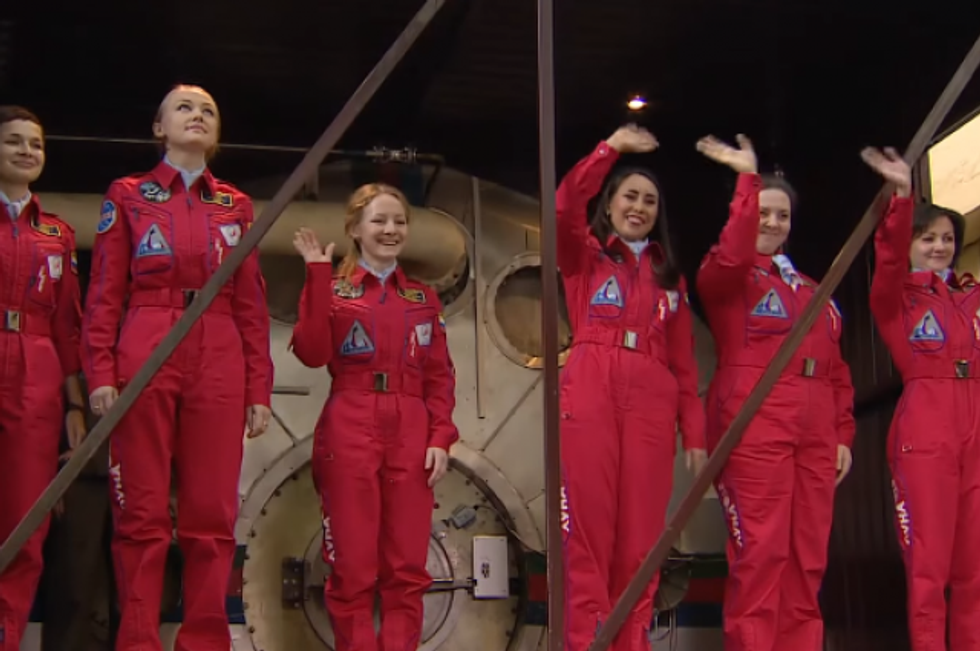
In 1961, Russian pilot and cosmonaut Yuri Gagarin became the first person to go up, spending all of 108 minutes in orbit. The first woman wasn’t far behind: another Russian, Valentina Tereshkova. But after Tereshkova’s flight, it took another 19 years for a woman to reach space again. According to NASA, of the hundreds of people since Gagarin to visit space, only 58 have been women. But a new initiative hopes to change that. On Oct. 28, 2015, six Russian women entered a mock spaceship to simulate how well an all-female crew would fare in space.
The six women, in their 20s and 30s, were selected carefully from a group of candidates. They all have backgrounds in scientific fields such as biophysics. Sergei Ponomaryov, the supervisor of the experiment, noted: “There’s never been an all-female crew on the ISS [International Space Station]. We consider the future of space belongs equally to men and women and unfortunately we need to catch up a bit after a period when unfortunately there haven’t been too many women in space.”
The institute’s director, Igor Ushakov, however, had less helpful remarks to add, telling the women that “I’d like to wish you a lack of conflicts, even though they say that in one kitchen, two housewives find it hard to live together.”
By comparing a group of brilliant women to a couple of squabbling housewives, Ushakov insinuates that despite being carefully selected, intelligent professionals, women will break down into catfighting as soon as they are left alone. Furthermore, he insults the intelligence of every woman who, by choice or by circumstance, has forgone a career in order to care for her family and her home.
In addition to the statement from their own boss, the women had to defend themselves at a press conference, answering questions along the lines of “How will you go for eight days without makeup?” and “How will you cope with not being around men for eight days?”
Darya Komissarova answered the first question with a tongue-in-cheek approach: “We’re very pretty without makeup,” while Anna Kussmaul replied eloquently to the second: “We are doing work. When you are doing your work, you don’t think about men and women.”
With the year 2015 is nearly at a close, one would like to think that maybe society as a whole, though still paying women (especially women of color) far less than their male counterparts, would have begrudgingly accepted that women are able to do the same work men are. But it seems that even in scientific fields, women still need to prove themselves capable. So, perhaps these six women deserve a round of applause for furthering science while having to deal with a whole load of sexist nonsense.