


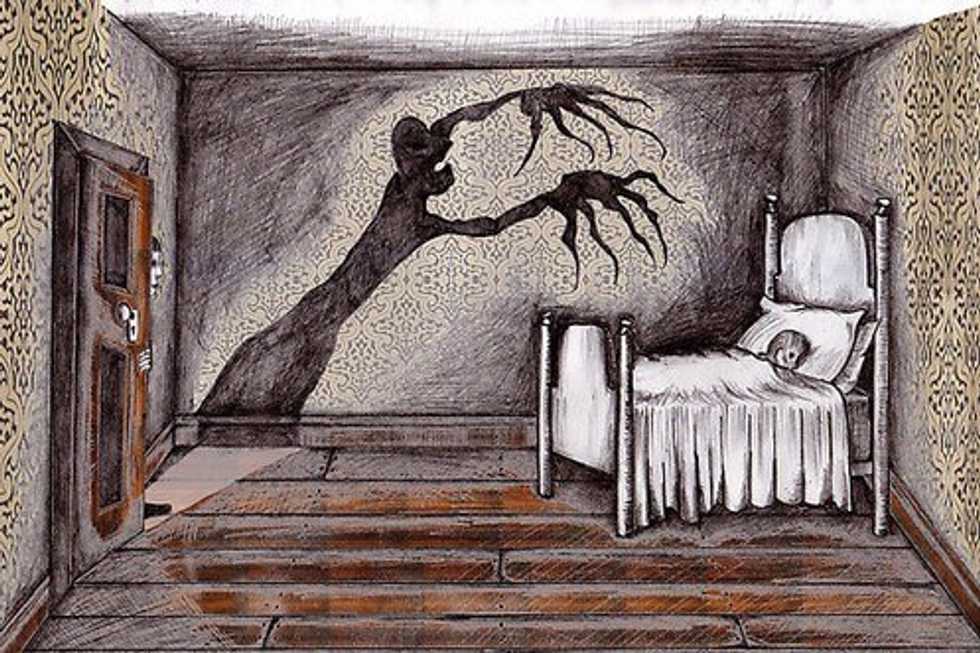
During the mid-1800’s, mental illness was greatly stigmatized by society. One was either deemed sane or not, with no grey area in between. Throughout Poe’s The Tell-Tale Heart, the sentence structure used mimics the manner in which someone not mentally competent would speak, which contrasts with his vehement denial of being “mad”. The introduction clearly shows that something is not quite right with the speaker, but what is wrong? Is he simply “insane”, or is there more to him?
Now, in the 21st century, the science community has come a far way in diagnosing mental illness and understanding the brain’s functions. While in the 1800’s people were condemned for having mental illness, nowadays those suffering can seek help. Based off the evidence provided in the short story, readers can determine whether the speaker is mentally ill or not.
“It is impossible to say how first the idea entered my brain; but once conceived, it haunted me day and night. Object there was none. Passion there was none. I loved the old man. He had never wronged me. He had never given me insult. For his gold I had no desire. I think it was his eye! yes, it was this! He had the eye of a vulture --a pale blue eye, with a film over it. Whenever it fell upon me, my blood ran cold; and so by degrees --very gradually --I made up my mind to take the life of the old man, and thus rid myself of the eye forever (193).”
This passage showcases the speaker’s obsessive nature. The idea, though a vague concept at this part of the short story, is personified and “haunts” the speaker constantly. The second sentence of the passage indicates that, while he at first personified the idea, it in fact is not a physical object and he also feels no “passion” or emotion behind the invasion of the idea. The stimulus simply causes him to react without much thought behind it. His clarity is sound; he understands that the man has done nothing to bother him; yet, the man is bothering him. Why? The reasoning the speaker comes up with is the old man’s eye. Its creepy appearance bothers the speaker so vehemently that he decides to get rid of it in the only way he deems feasible, murdering the old man. This thought process is not rational, which leads readers to believe that he does indeed possess a mental illness of some sort.
The fact that the speaker finds the old man’s eye so abhorrent gives readers insight into his mental illness. Clearly there are certain images that bother him, which allows readers to assume he can be distressed due to certain visual stimuli. Readers cannot determine the extent of damage the stimuli plays on the speaker’s mind at this point, but as one continues reading the short story, the impact the stimuli plays becomes clearer.
“Presently I heard a slight groan, and I knew it was the groan of mortal terror. It was not a groan of pain or of grief --oh, no! --it was the low stifled sound that arises from the bottom of the soul when overcharged with awe. I knew the sound well. Many a night, just at midnight, when all the world slept, it has welled up from my own bosom, deepening, with its dreadful echo, the terrors that distracted me. I say I knew it well. I knew what the old man felt, and pitied him, although I chuckled at heart. I knew that he had been lying awake ever since the first slight noise, when he had turned in the bed. His fears had been ever since growing upon him. He had been trying to fancy them causeless, but could not. He had been saying to himself --"It is nothing but the wind in the chimney --it is only a mouse crossing the floor," or "It is merely a cricket which has made a single chirp." Yes, he had been trying to comfort himself with these suppositions: but he had found all in vain. All in vain; because Death, in approaching him had stalked with his black shadow before him, and enveloped the victim. And it was the mournful influence of the unperceived shadow that caused him to feel --although he neither saw nor heard --to feel the presence of my head within the room (194-195).”
This passage allows readers to gain more insight into the speaker’s character, and therefore his mental illness, as one plagues the other. The beginning of the paragraph corresponds with the theme of sensory stimuli, in which the speaker can analyze the inflection and meaning in the groan. He goes into great detail about what the groan means, relates the groan to himself – as he too like the old man suffered from the same traumatic stress – , and exposes his malicious nature, as he gains enjoyment from the old man’s torment. The speaker goes into great detail how the fear of something lurking in the night is haunting the old man, so much detail that it’s clear he is seeking pleasure. While the speaker is clearly empathetic, as he relates to how the old man is feeling, he receives a great amount of joy from lurking in his bedroom and causing him anguish. This malevolent behavior allows readers to analyze his mental illness more in depth, and realize that it has a great hold on his rational thinking and moral compass.
Near the end of the passage, the speaker distances himself from the act he plans to carry out by personifying Death. He writes as though Death has responsibility over the old man’s passing rather than himself. This distancing is a survival mechanism, as the repercussions of taking someone’s life can take a horrendous toll on someone’s mental state, yet the reliance on this survival mechanism only validates his irrational reasoning and enhances his mental illness’s effects on him. Rather than taking ownership of being the cause of the old man’s fear, he believes its Death’s influence on the old man that’s making him distraught.
“And now – have I not told you that what you mistake for madness is but over-acuteness of the sense? --now, I say, there came to my ears a low, dull, quick sound, such as a watch makes when enveloped in cotton. I knew that sound well, too. It was the beating of the old man's heart. It increased my fury, as the beating of a drum stimulates the soldier into courage (195).”
In this passage, the speaker acknowledges his “over-acuteness” of senses. While he commemorates his hyper-awareness of visual and auditory stimuli, this is more so a survival instinct he adapted with years of suffering, when he had to rationalize his acuteness in order to come to grips with who he is. He states that he can hear the old man’s heart, which intensifies his anger and makes him more erratic. The sensory stimuli cause him to act irrationally, and as the stimuli intensify and his rational weakens, he becomes more and more irritable and thus more and more erratic.
The passages so far lead readers to believe that he suffers from a mental illness, one that incorporates his senses. One can propose that the speaker suffers from Sensory Processing Disorder (SPD), which is a condition where one’s sensory signals don't get organized into appropriate responses. There is a wide variation in how those suffering from SPD react. Some barely respond to sensory stimuli. They don’t react to visual, auditory, etc. triggers that would like typical people would; they barely take notice. Others, on the different extreme, are hyper-aware to these stimuli. They’re senses are constantly reacting to triggers around them, and this overwhelms the individual. The speaker seems to suffer from this. Many visual and auditory stimuli included in the short story, like the old man’s eye and his heart beat, plague the individual as his sensory neurons focus on the stimuli and only the stimuli. The survival instinct kicks in, and when the stimuli begin to bother the speaker, he wants to make the stimuli stop. As the stimuli cause him more and more annoyance, his rational diminishes and he acts erratically. Rather than being deemed “mad”, the speaker is plagued with a mental illness, and more specifically, Sensory Processing Disorder.
“No doubt I now grew very pale; --but I talked more fluently, and with a heightened voice. Yet the sound increased --and what could I do? It was a low, dull, quick sound --much such a sound as a watch makes when enveloped in cotton. I gasped for breath --and yet the officers heard it not. I talked more quickly --more vehemently; but the noise steadily increased. I arose and argued about trifles, in a high key and with violent gesticulations; but the noise steadily increased. Why would they not be gone? I paced the floor to and fro with heavy strides, as if excited to fury by the observations of the men --but the noise steadily increased. Oh God! what could I do? I foamed --I raved --I swore! I swung the chair upon which I had been sitting, and grated it upon the boards, but the noise arose over all and continually increased. It grew louder --louder --louder! And still the men chatted pleasantly, and smiled. Was it possible they heard not? Almighty God! --no, no! They heard! --they suspected! --they knew! --they were making a mockery of my horror!-this I thought, and this I think. But anything was better than this agony! Anything was more tolerable than this derision! I could bear those hypocritical smiles no longer! I felt that I must scream or die! and now --again! --hark! louder! louder! louder! Louder (196 – 197)!”
This final passage further supports the notion that the speaker suffers from a Sensory Processing Disorder. The speaker has suffered from the effects of the sensory stimuli for such an extensive period of time, with no relief or break due to the police officers’ company, that he finally suffers from a mental breakdown. He simply wishes to make the sound stop, yet nothing he does will make it cease. The rational part of him knows to be subtle and act calmly, as he doesn’t want the officers to realize that something is wrong with him; yet, the stimuli has too much influence over him, and he can’t help, but react to it.
Poe writes in a way that conveys the devolution to an unstable mental state. As one reads through the passage, the sentence structure becomes more disjointed, much like the speaker’s thought process had become. In this work, like many other of Poe’s work, the concept of madness is introduced. The prevailing question found in these works is: How do you determine madness, and do you simply disregard someone as “insane”, or do you psychoanalyze the characters? During the 1800’s, when Poe wrote the work, there was far less analyzation of mental illness than there is nowadays; so, should we look at the work like Poe would, or use modern knowledge to change our perception of the individuals in his work?
Rather than acquiring an answer to this question, one should relate The Tell-Tale Heart to society’s perception of the mentally ill. The speaker is clearly plagued by mental illness. This is close to indisputable. When one analyzes the speaker more in depth, he shares many similarities with those who suffer from Sensory Perception Disorder; however, one could spend many years analyzing this short story, trying to diagnose the speaker. Rather than focusing on what mental illness the speaker possesses, readers should focus on our reaction to the speaker’s actions. Does the speaker’s inner turmoil validate his compulsive actions? The act of murder is one hard to reckon with. It’s hard to change the popular belief that the act is an unethical one. Yet, clearly the speaker is suffering a great deal. How can one place the same amount of blame on him as one would a stable-minded person? And if one believes you shouldn’t, how do you distinguish a stable minded person from an unstable one?
The Tell-Tale Heart provides readers with more questions than answers. The concept of mental illness is prevalent throughout the story, yet Poe gives no inkling on how he believes mental illness should be regarded. Therefore, the interpretation is up to the reader. Poe makes readers think about mental illness in a way that differs from the accepted perception given from society.
















