


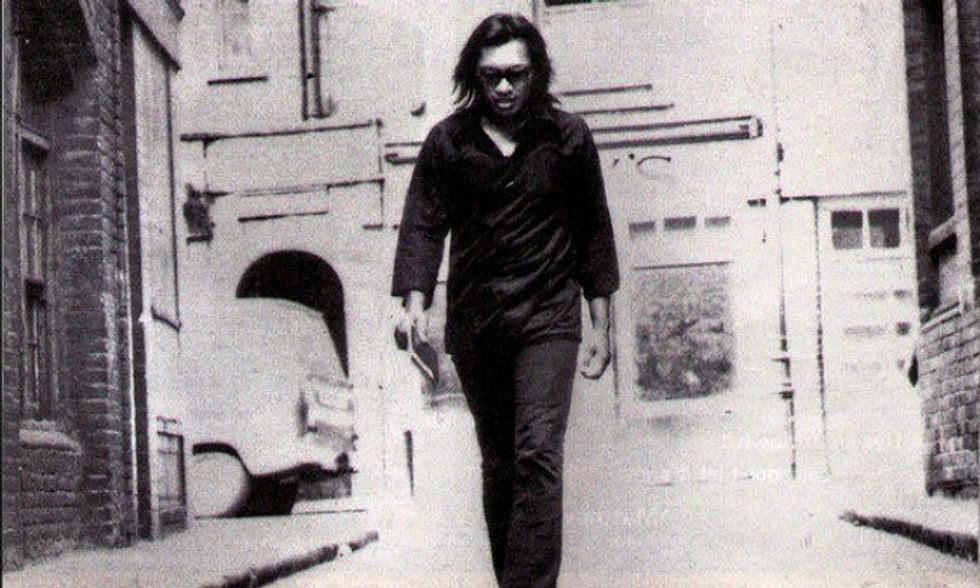
Malik Bendjelloul’s documentary Searching for Sugar Man tells the incredible story of Sixto Rodriguez, a mysterious and profound musician in search of his identity. After seeing little monetary gain from his artistic efforts in the United States, Rodriguez, as he went by, exchanges his guitar and microphone for the tools of more common trades like construction. Little does Rodriguez know that his music is wildly popular in South Africa. Some even go as far as to compare his successes in South Africa to those of Elvis Pressley’s in The United States. Rodriguez has an interesting personality that perplexes record companies and bar audiences, but everyone that knows him claims to have been lucky to meet him. Documentarians find out the truth behind the lyrics and the strange case of his alleged death. In the Academy Award-winning picture, the search for “Sugar Man” leads to the unraveling of a mystery like non other, and the quest for Rodriguez’s identity might have others rethinking who they are.
While compiling information for the documentary, researchers come to find that the initial impression most people have of Rodriguez is his incredible talent and meaning behind his lyrics. Practicing art far ahead of his time, Rodriguez often incorporates the ideas of drug use, perspective, and societal oppression into his music. Many of his listeners compare him to the iconic Bob Dylan, which may lead some to wonder why his music was unsuccessful in the United States. Many would argue that his outward appearance; dark skin, long hair, opaque glasses and Bohemian style of dress, perhaps made him unattractive to listeners. Next, his name, Rodriguez, is of Mexican descent. Many American listeners would find it offensive to compare a Mexican to the great Bob Dylan or Tom Petty. There is no arguing as to the power that his music has, however. In the early 1970’s, Rodriguez produced songs like “I Wonder”, “Inner City Blues” and perhaps his most popular, “Sugar Man”. These songs range in meaning from the effects of drug use to the oppressions of living under the cloud of an oppressive government. He continued to produce music even up into 2010. Rodriguez’s music was much like him; it went beyond what you may have seen or heard on the outside. His depth both artistically and personally will forever be a mystery to his fans.
One of the characteristics that makes Rodriguez unlike many is his appreciation for the simple things in life. It is when the truth behind his mysterious death is revealed that we find the modern Rodriguez. The most popular story is that at the end of a performance, he pulls out a gun and shoots himself on stage. What documentarians come to find is quite shocking. After publishing an ad and receiving a tip from one of Rodriguez’s daughters, they realize that not only is Rodriguez not dead, but he is healthy and living in the United States. A native of Detroit, Sixto Rodriguez lives in a modest home and still makes music. After discovering his incredible success in South Africa, Rodriguez is pleasantly surprised. While many would have been outraged at the record companies and demanding compensation, he is just happy to know that somebody enjoyed his music. He is remarkably content with his simple life, and needs no more than what he has. Even as a young performer, those that knew him described him as “prophetic” and “mysterious”. Maybe what made his personality so foreign is his genuine happiness. Many lessons can be taken from a man like Rodriguez, whose artistic abilities, thoughts, and simple possessions are all he needs to feel fulfilled in this life. He knows his identity, and even when he goes on tour in South Africa, he is still the same man. He remains gratified.
A final aspect of the complex Sixto Rodriguez that the audience comes to realize is his true love for music. Unlike many contemporary artists that play for fame alone, Rodriguez makes music for the sake of making music. He knows that he has ideas that could be expressed artistically, so he does so. He needs no compensation for his efforts, which is why he continues to make music even in his old age. It is almost if he needs no audience, and that playing for his ears alone is good enough. If people treated their lives like he treats music, and they lived for the sake of living, then maybe the quest for identity would not be such a difficult task.
The mysterious and influential story of Sixto Rodriguez is one that everybody can learn a lesson from. The depth of his music calls for the criticism of traditional social roles and the reevaluation of hierarchy. His content, simple lifestyle is evidence that happiness is the byproduct of a mindset. He shows that happiness is not a destination but a journey. Finally, his approach to his life and his music needs no audience, only his approval. He is happy working construction in his full suit and playing his incredible music at home. He continues to live and inspire in Detroit, Michigan, writing songs and poems. Most people would have given up, but he knew who he was all along. His story has influenced many individuals to pursue what they believe to be their destiny as well. The search for Sugar Man may have, in fact, been the search for ourselves.
















