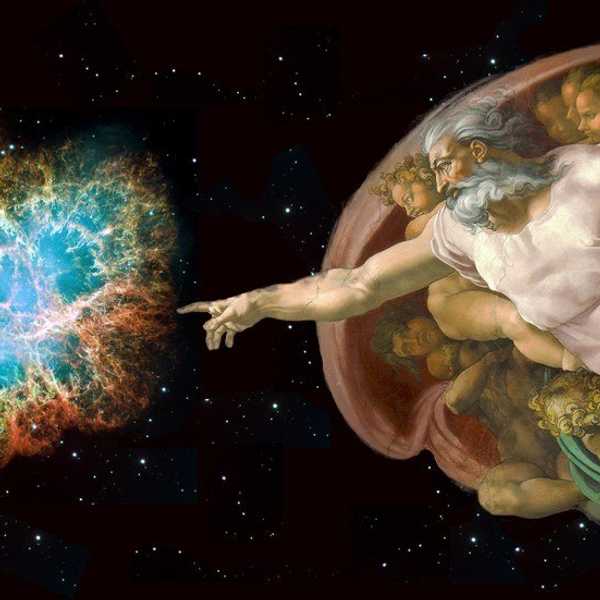

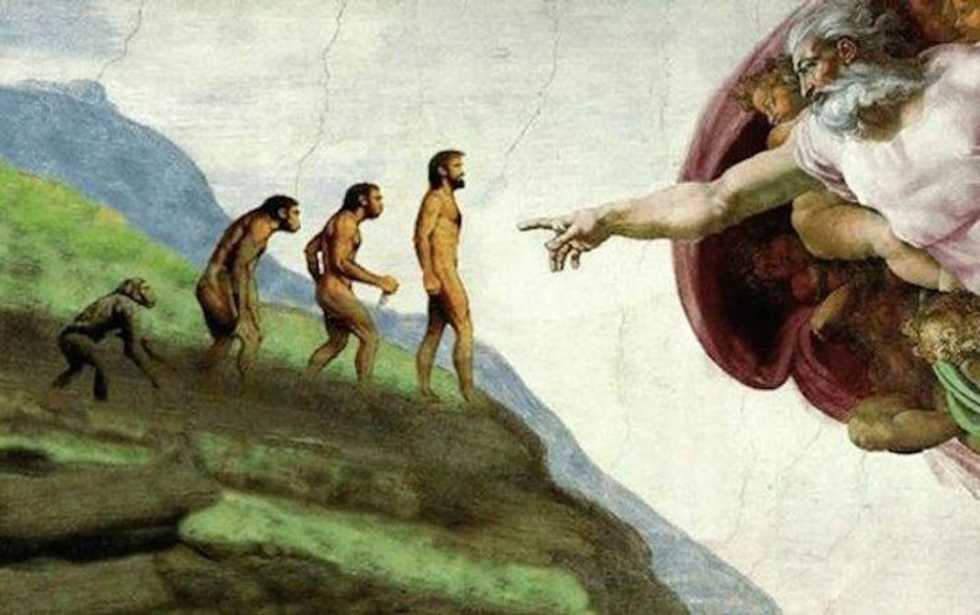
Have you ever been in a science class and wondered if what you were learning was against your religion? Maybe you’re a med student surrounded by other religions or by people who only believe in science. Possibly, you’re a healthcare professional who’s encountered people who deny treatment for religious reasons. I think it's important to get to know your own faith and other faiths and learn how they relate to science.
Personally, my major and my career choice challenge my faith the most. We're going to delve into what it's like to want to believe in everything you can physically see.
If you’re a bio nerd like me, your mind will be totally blown by the fact that literally every living organism shares common DNA with us, and what is found in your DNA makes up everything about you. Did you know that we are 98% similar to a monkey, and even weirder, 70% similar to a zebra fish? You can research almost any animal or living thing on the earth and find out that we share more than 65% of our genes with all of them. If you believe in macroevolution, you should get to know DNA so you can use it as an argument point. The facts are so clearly laid out to us logical-thinking science people. We share the same DNA, so we must have evolved from the same thing. But I could never teach that or believe it, for fear of being a hypocrite.
Personally, I believe that there is a God who created everything separately. Humans came from Adam and Eve and the Lord created the animals and livestock of the earth and gave us rule over them.
So I can only believe in microevolution if I want to avoid changing my entire faith. I have no problem believing that animals adapt, and over time those with the best characteristics survived and passed genes on until the animal evolved. But, as a bio major surrounded by scientists and books that say the universe was made in the Big Bang and we all came from the same thing, it's hard for me not to think about it, and it's hard for me to share my faith. Just like I’m dedicated to Christianity, scientists have faith in, and are dedicated to, “x” topic.
Science is a different kind of faith that we can all believe in at different levels. We all believe in gravity, photosynthesis and DNA. Religion does not challenge these concepts. Science is something that is concrete. Scientists take a theory, and work to prove that it is a fact, whereas in religion we have faith in ideas that we believe to be true.
Let's take a step back. Just from knowing one fact about my genome, I was able to construct a whole argument. Evolution is a controversial topic, just as religion is -- and it is controversial for the same reasons. No one can prove how we came to be humans, because no one can apply the scientific method to something we weren’t around to witness. We all have our beliefs; some of us choose to think that science shouldn't be mixed with our religion. Some people deny medical care and have faith in their higher power. Is that okay? I don't know. I would never do that myself because I do believe that science is the reason we have a greater life. That belief is not my sole source of faith, and I don't usually even use the word "faith" to describe my feelings about science. However, I believe that my God allowed me to have this scientific knowledge, and I'm going to use it. I’m not saying we should all pack up and move to the Church of Scientology. That’s extreme, and that’s not the way I believe in science. We have so many religions, and everyone is trying to prove why theirs is the right one. But science is always proven, and I will believe in it as long as it is.
Now, hold on -- is it sacrilegious to say that I believe in science? Am I potentially denying my faith in order to participate in scientific research? Well, my answer is no. My whole college education is going to be based on concrete facts, and I will continue to believe that these facts make the world go round. At the same time, though, I have an underlying thought that all this was made possible by my wonderful creator. I sometimes find myself overwhelmed and amazed by cells, for example. I think “Wow, our bodies and science are so cool!” At those moments, I should be thinking, “Wow, my God made my body so cool.” Science and Christianity overlap in my life, and I think it's okay that I believe in God and also have the desire to seek concrete details of medicine.
The question of mixing science and religion doesn't only apply to me though.
Hindus believe that the universe undergoes cycles of expansion and contraction, which means they don’t totally disagree with the Big Bang theory. India is home to 95% of the world's Hindu population, and is also one of the leading nations for advancing science and math.
Japan is ranked #3 globally in scientific impact by US News and World Report. Buddhism is the most popular religion in Japan, and it's also arguably the most science friendly. When religion and science intermix in a culture, it looks like the result is advancement.
Albert Einstein said, "Science without religion is lame, and religion without science is blind." It is imperative to acknowledge that science is like a religion that we all believe in. Science is something you must know about in order to further your life. It doesn’t have to be true that the further you get in science, the further you get from God. We have higher life expectancies, electricity and better technology thanks to science. That is why I believe it is OK to study science.
Although I choose Christianity, I can see why biologists rely so heavily on the universe as their higher power. We all want to believe in what we can physically see, and that’s OK. But we also want to believe in what we can’t see, and that’s faith. There would be no religions if we didn’t want this. It's possible to get the best of both worlds.