

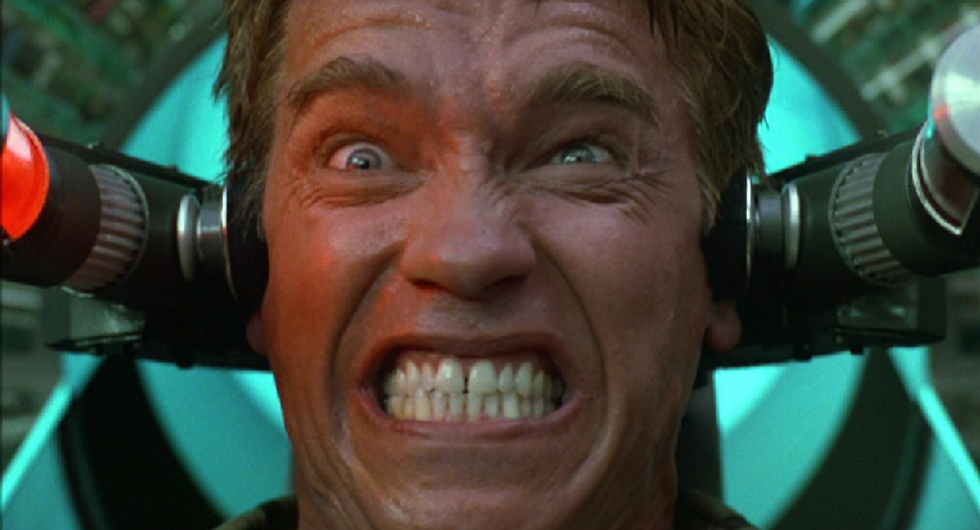
Maybe it's the future — grimy, industrial, and violent. Terrorists are employed by the government and allowed free reign to do what they please. Or maybe, it's night in the city as a dozen black-clad mooks armed with assault rifles approach a house. Someone opens fire and when the smoke clears, the door bursts open. John Cipher emerges. He's a former cop, former marine, spec ops, U.S. Marshal, spy, cyborg, or casual everyman. He'll smirk, slowly take off his shades, and say in an accent as thick as his biceps: "You forgot to knock."
Arnold Schwarzenegger was predictable and silly, but that made him fun.
Arnold was an unlikely action hero. He was an Austrian body builder who, during his one year in the army, went AWOL to model for Mr. Universe, and his father was technically a Nazi. Fortunately, becoming Mr. Universe brought Arnold to the states where he could try acting. His career started awkwardly. In his first film, "Hercules in New York," he had to dub over all his lines because of his accent. His next film he played a mute character. Eventually, he made the autobiographical documentary "Pumping Iron," which proved successful. That got him cast in his breakthrough film "Conan the Barbarian." From then on, Arnold went on to punch, shoot, and explode his way through Hollywood.
What distinguished Arnold? Unlike his fellow muscular, speech-impaired actor, Sylvester Stallone, Arnold embraced his silliness. He could be the ruthless killing machine and the wise-cracking buffoon. His propensity for quips is what people loved about him. He was cool, almost too cool — but he was also kind of awkward. His accent, that weird screaming sound he made when he got hurt, and his wooden acting should've stunted his success, but it became his brand. He was cool, powerful, and kind of weird. Our American hero was an Austrian bodybuilder, but as long as he defended truth and justice — and looked cool doing so — he was what people wanted.
I watched "Eraser" on Friday and I enjoyed it despite its predictable plot, poor characterization, awful CGI, and that bit where a plane tries to ram Arnold. The reason Arnold fascinates and amuses me is because he encapsulates what was fun about the '80s. It was an era he thrived in and one that he understood:
"I think it is important to know that the 1990s are going to be very different from the 1980s. In the '80s we made much more hardcore movies. 'Terminator,' for instance, was a true representation of the 80s . . . I think the '90s are different. Now they want to see a kinder and gentler type of an action hero."
The kinder and gentler action hero didn't last long. 2002's "Collateral Damage" had Arnold's character go from everyman to jungle-skulking commando. There are now a lot of reboots or sequels to '80s movies because our decade is more in line with '80s antiheroes, cynicism, and skepticism about big government and capitalism. The movie "Iron Man" has a plot that would've been perfect for the '80s: businessman unwittingly sells hi-tech weapons to terrorists, then goes back to fight the terrorists himself.
While '80s movies can make the leap to our decade, its heroes don't fit. Arnold is too exceptional to be a modern action hero. Nowadays, the heroes are leaner, meaner, handsomer, and better actors. These are the Colin Farrells and Adrien Brodys — actors who look more normal, but are still appealing as leading men. While Arnie let his biceps carry the scene, these actors have the gravitas and verisimilitude to immerse the viewer into the story.
It's the earnestness I appreciate about Arnold. He's predictable, but I appreciate that his movies were over-the-top, his characters were superhuman, and his one-liners were wonderfully dumb. He was a living action figure. He was fun.
















