

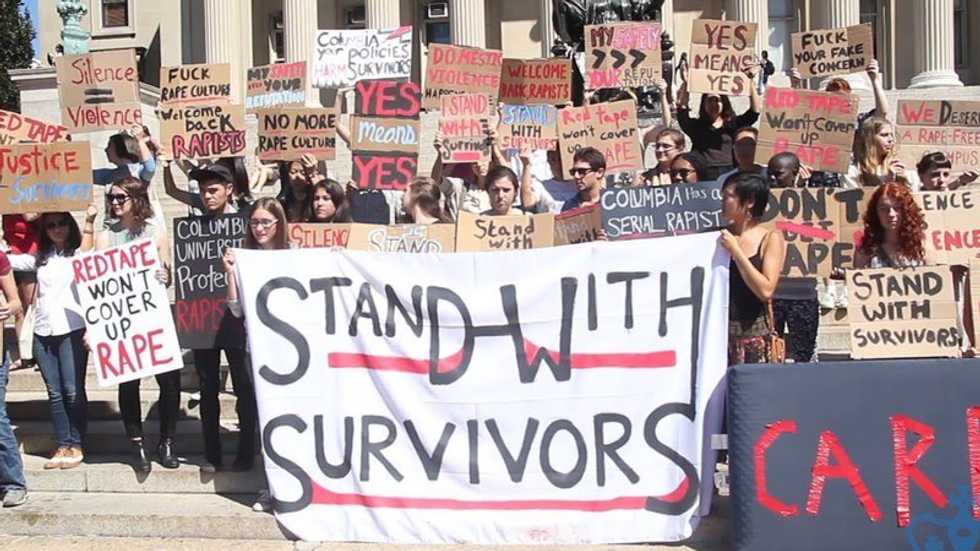
Let’s face it: for us college students, rape is not a foreign concept. We hear about it all of the time on campuses, and for Greek students, it is sensitive topic due to a lot of media attention on fraternities and their treatment of women. If you have been keeping up with the news, you probably have heard of campus rape gaining the attention of our government, and recently, attempts at change have begun. Moreover, you have probably read about the protests held at UVA and the students at Stanford (and other schools) who are trying to raise awareness about this issue and about the most recent proposed legislation: The Safe Campus Act.
Matt Salmon, Pete Sessions, and Key Granger introduced the bill to congress months ago with the purpose of implementing fair and more reliable procedures on how colleges and universities should handle rape cases. Their biggest concern about how the government was handling these cases was that defendants were not provided adequate due process.
According to the Bureau of Justice Statistics, 80% of rape victims are raped by people that know them. Of those that are raped, only a few will actually report it to law enforcement due to the fact that most of them feel like it is a ‘personal matter.’ For students, 80% of rape cases will go unreported as opposed to 67% of unreported rape cases for non-students. Under Title IX, the gender equality law, discrimination based upon sex is prohibited at any college or university, and schools should take any measures necessary to give their students an equal and safe campus environment. Moreover, President Obama signed a bill in 2013 (Campus SaVE Act) to require colleges and universities to provide students with assistance, such as counseling and forgiveness when a student needs to change classes or leave school for some time, to complement the standards upheld in Title IX.
So, what is so fancy about the Safe Campus Act?
Colleges and universities are not allowed to investigate sexual assault cases unless the victim of the case reports it to law enforcement first.
How It Will Help
It will help the accused. By implementing this idea into our legal system, no longer will we see universities holding students accused of rape accountable on such little evidence. No longer will we see students accused going to disciplinary hearings, or worst-case scenario, having to be expelled and only discovering later that they were innocent after all or that the case was never reported to law enforcement. Also, lawmakers will believe that it will lead to an increase in offenders that are imprisoned since the reporting party will be the victim rather than someone else.
How It Can Hinder
A friend of the victim can report it, but the university is no longer allowed to investigate the case unless it is reported by the victim and to the police. Thus, counseling services cannot be provided and the university won’t be able to be more empathetic and understanding towards victims if they need to withdraw or even switch around their class schedule. As mentioned earlier, about 80% of cases are not reported in the first place. Some of the ones that are reported are because a bystander stepped up to do so. One would think that it could lead to an increase, but ensuring that law enforcement is involved might lead to an increase in the number of unreported cases since many students try to brush it off as a 'personal matter.'
So there you have it: the two sides to this bill. Whether it helps or harms is up to you. In the end, we are all students who just want the best for our peers and our schools.