


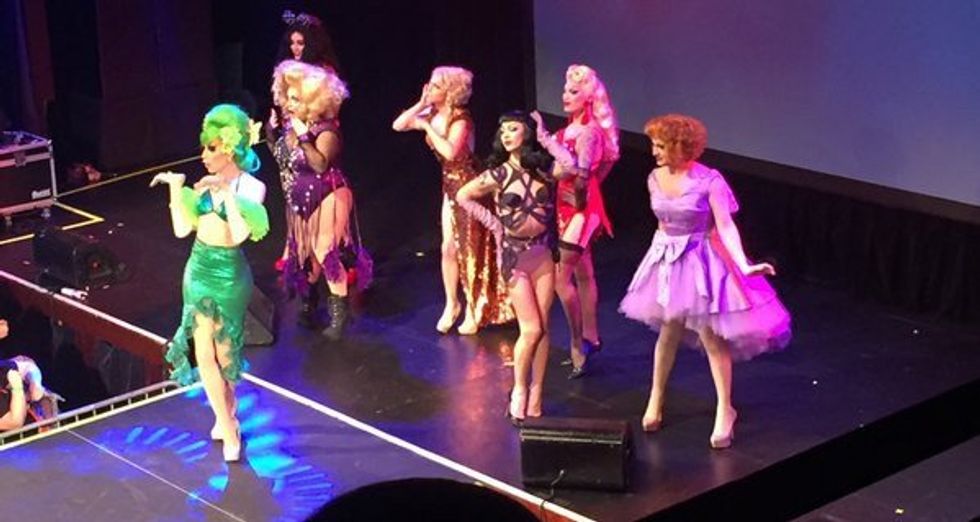
This past Wednesday night, I went to my first drag show. It featured favorites from Seasons 1-8 of RuPaul’s Drag Race, many of whom I knew all about because my sister is a vehement follower of the show. I went in expecting something fun and lighthearted and yes, cheesy. That was the sense I had gotten from the TV show’s tone, and that was what the opening number gave – a silly parody of "Under the Sea" and "Poor Unfortunate Souls," full of drag references. As the show went on, I enjoyed all the lip syncing and comedy routines and impersonations and shade. However, I soon realized that there was so much more depth to this show than I had realized. A few moments, in particular, stood out to me.
One of these moments, in particular, was Sharon Needles’ tribute to David Bowie. She sang "Space Oddity" and dressed in a red wig and a colorful star-covered costume, mimicking Bowie’s Aladdin Sane look. It felt quite fitting, considering Bowie’s passing earlier this year. However, I also felt that it was especially relevant at a drag show. Bowie was a pioneer in bending gender and sexuality, one of the earliest pop figures who achieved mainstream recognition even with his androgynous style. Bowie helped pave the way for a show like RuPaul’s Drag Race to even be possible, and this performance stood out for that reason. A nice touch was that Sharon Needles ended the number not only with a picture of Bowie projected onto the stage, but also a picture of her cat Cerrone, who had passed in March. The performance’s dedications were both public and personal.
One of the most resonant moments was midway through the show, during the Snatch Game, a segment in which drag queens impersonate celebrities and answer fill-in-the-blank questions. This particular Snatch Game also featured two audience participants. During the segment, an uncostumed Jaremi Carey (better known by drag name Phi Phi O’Hara) was called on to the stage to ask the final question. He used the opportunity to propose to his boyfriend Michael, who was one of the audience participants. He had prepared a speech about how the years he had spent in the relationship were some of the happiest of his life, and he had even flown Michael’s mother to New York to see the performance. It was a moment so full of love, and the entire audience, including myself, got a little bit choked up.
What tied everything together was the hostess, Michelle Visage, who is also the co-host of RuPaul’s Drag Race. A cisgender woman, she is a strong supporter and activist for the LGBT community. Throughout the show, she reminded us what drag was really all about. Many of these queens had experienced unspeakable trauma in their pasts, expelled from their families and communities for being who they are. Visage’s opening monologue emphasized how important it was for these drag queens to support each other and to create their own communities. She talked about how remarkable it is that in this day and age, a show like RuPaul’s Drag Race could run on mainstream TV for nine seasons and have as large a fanbase as it does. Her closing number, just before the grand finale, was performed against a backdrop of historic photographs – of Stonewall, pride marches, posters, rainbow flags and open expressions of love.
Overall, I found the show an even more enjoyable experience than I had expected with the silliness and comedy, the genuine moments and the abundance of pure talent on the stage all balanced each other out, and I’m looking forward to going back next year.
















