
Sunday, October 30th is a day that changed the public’s view of radio forever. A young man by the name of Orson Welles preformed a radio drama that was adapted from the novel, The War of the Worlds by H.G. Wells. Orson Welles managed to cause a great deal of panic in this horror broadcast by turning it into a series of news broadcasts rather than read the book as is. Welles would once again shock the public by announcing and exploring the death of one of the most famous newspaper publishers of all time
Welles’ film, Citizen Kane, is a film that centers on the resounding effect of the death of newspaper publisher, Charles Foster Kane, and the meaning behind Kane's last word, Rosebud. The film was based on the life of newspaper publisher, William Randolph Hearst, and some of the things he did in life. In the film many of the scenes are visual metaphors for some of the people in Kane's life.
In the scene where Kane is finishing the review that Mr. Leland started he is shown in the top right hand corner of the shot. Kane is writing the damaging review that will weaken his wife's career, but he is just trying to prove a point that he can keep his personal and professional lives seperate. Along with the narration by Mr. Leland; Kane was sitting alone in the corner frustrated that the dramatic critic for his newspaper did not give his wife a favorable review even though her preformance was not at all favorable.
Kane is trying to prove the point that although he started a war with his newspaper he can still maintain a sense of ethics. He gave his wife the review that she earned from the Chicago Inquirer, not the review that she thought she deserved from her husband.
The person that is searching for what Kane's last word, Rosebud, meant is never completely shown. The man, like Rosebud, is meant to remain a mystery and the darkness that covers him represents that large shadow that Charles Foster Kane left in his life. The shadow over the man’s face is also a symbol of the many mysteries and loose ends that the word Rosebud has undone in the life of Charles Foster Kane.
His second wife, Susan Alexander Kane, got singing lessons, but after a while did not want to sing any more. While Kane pushes her on and on; a light bulb is shown flickering on and off. The light is meant to represent the stress that Kane put her under.
To make matters worse for her he consistently gave her bad reviews after his friend, Mr. Leland, gave her a bad review the first time she sang in public. As the bad reviews keep growing and Susan Alexander keeps singing to impress the "Kane Newspapers". In the end the light is shown to black out and in the next scene it shows Susan lying on a couch sick from stress.
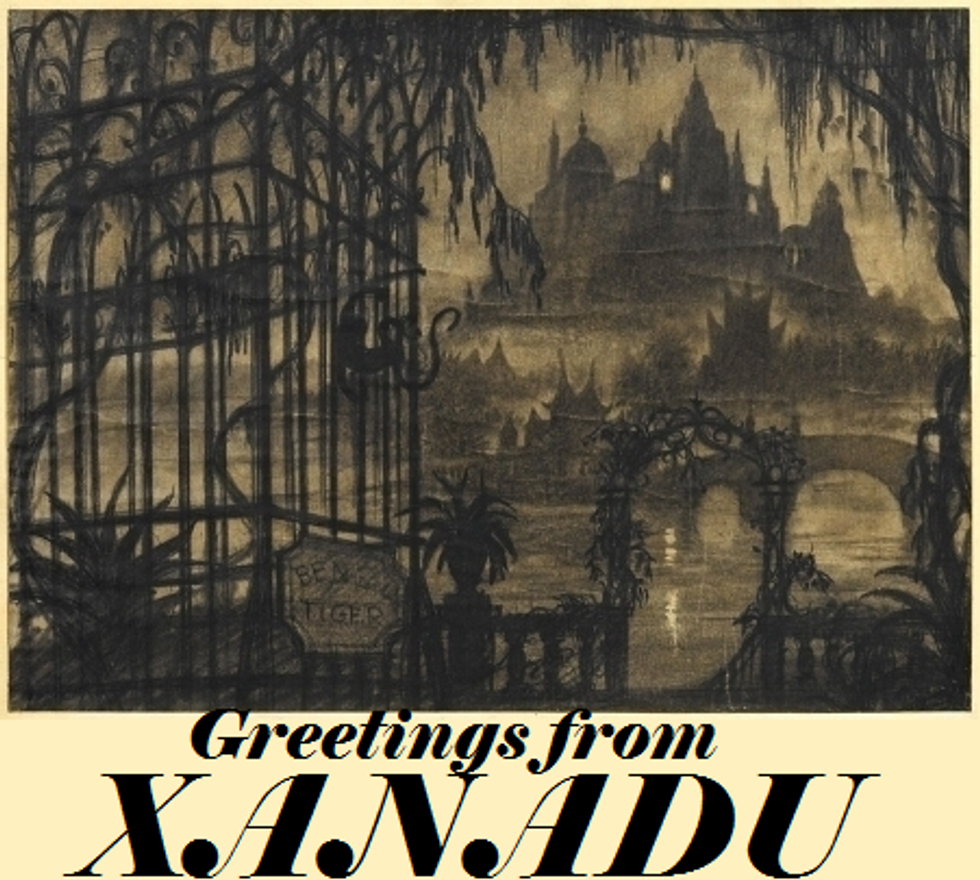
Another visual metaphor is in the end of the film when the camera rises above the crowd of people and then the crates that Kane collected is a representation that while Charles Foster Kane is dead he still roams the grounds of Xanadu searching for Rosebud. The camera continues to fly over the crates and finally, it lands on a man holding Rosebud, the sled from his childhood. Then it shows a man pick up the sled and he tosses the sled into the fire.
This is when viewers finally learn what Rosebud is and what Rosebud meant. Rosebud is a symbol in itself because it represents the life that Kane had before he became Charles Foster Kane. In the final scene the camera goes back to a sign that says "No Trespassing" which then pans to a shot of the front gate for Xanadu which bears a large "K" on it. Both of these signs show that no one will live in Xanadu because this was the home of Charles Foster Kane. He leaves the home finally to leave the purgatory of Earth and finally he can go into heaven and possibly live the life he never got to.
Citizen Kane is Orson Welles most defining film, and it set the bar for many films, and inspired a few others. One film that takes some of its plot elements from Citizen Kane is the 1945 film, Mildred Pierce starring Joan Crawford and Ann Blyth. The film is set as murder confession from the eponymous Mildred about the murder of her second husband, Monty Beragon.
The movie, Citizen Kane, also set the bar for Orson Welles' final and still unfinished film, "The Other Side of the Wind". The film is about the 70th birthday party of movie director Jake Hannaford’s death and focuses on the night prior to the death. Similar to the film, Citizen Kane, The Other Side of the Wind focuses on trying to discover who was Jake Hannaford, and what led to the car crash that killed him. Orson Welles was a master of film and someday when his last film is completed will once again shock people by revealing an astounding life.
The War of the Worlds - Recorded by Orson Welles