Finals week is over and my first night back home is only slightly different than streaming some show or movie from my family's Netlfix account. Instead there is a physical blu-ray via Netflix just waiting to be watched. I had heard of Rashomon because of the famous director Akira Kurosawa, but I had never seen the film. It was originally released in 1951.
The black and white visual, tinny sound quality, and Japanese to English translated subtitles should not turn anyone off from this masterpiece that Kurosawa wrote the screen play for as well as directed. Besides intense acting, beautiful shots, and complimentary music, this film explores the demons that lurk in nearly all of humanity. I strongly encourage anyone who hasn't yet watched this movie to first watch it and then come back to this article, because I will be spoiling the ending while offering my interpretation of the meaning behind the film. You have been warned.
I try not to discriminate when I notice how old a film must have been made and produced (M, Twelve Angry Men, Abott and Costello, and The Great Escape, are only a few of the quality movies I love that fall under this category). Rashomon is no different when it comes to the stark style that can be almost immediately picked up from the long, drawn-out opening credits of a film of this generation.
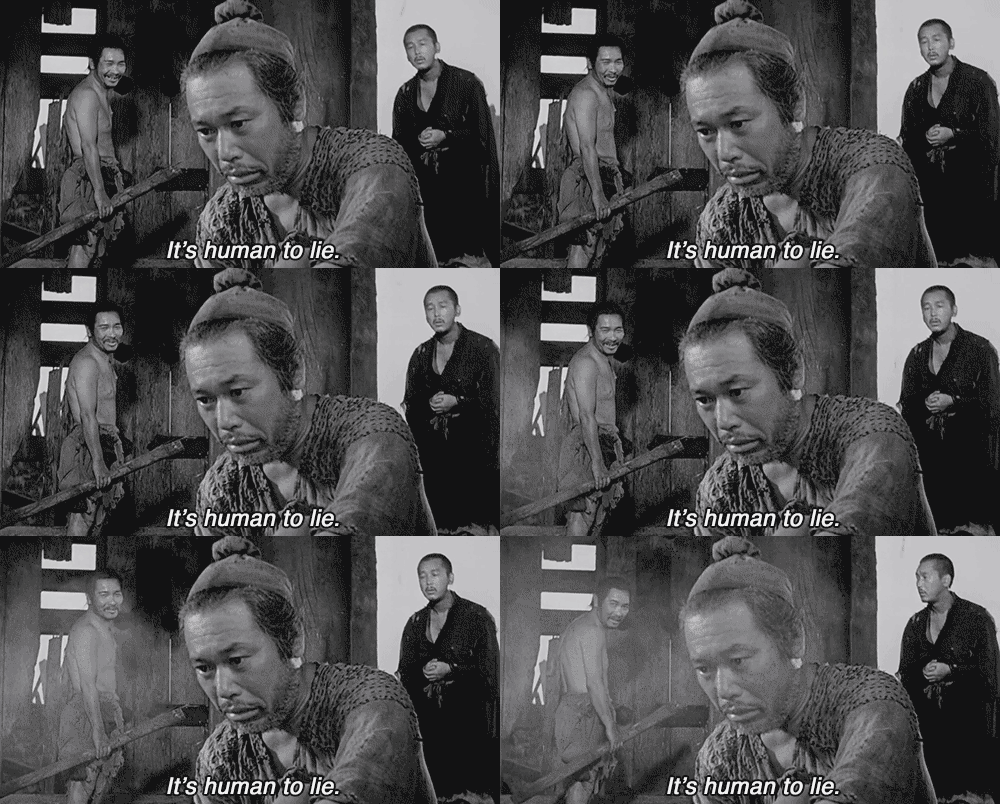
This movie's story is that of a framework. Three men who have taken shelter from an unrelenting downpour begin talking. Two of these men are baffled at the horrors humans are capable of and begin telling the third man of an incident involving a husband, wife, and a bandit in a forest. The stories that the third man hears are the testimonies of the bandit first, then the wife, and then the husband who has died after the incident but is able to give his version of the story via a spiritual medium (suspend your disbelief and go with it, it's good). After these three stories, which are represented by three separate scenes acted out, a fourth is introduced by one of the two men who turns out saw what actually happened.
What doesn't change from the three narratives and can be gathered as true is that the bandit thought of a ruse to get the husband away from his wife and in doing so he tied him up and led the wife back to where her husband lay helpless against a tree stump. From there the three narratives wildly diverge.
In a word the bandit, Tajomaru, is menacing. He is constantly flaring his teeth like he is ripping threw a chewy steak while he talks, slapping or scratching bugs from his body, and laughing maniacally every so often whether he is fighting or talking. To quickly summarize his tale, after he "had" the wife, he convinced her to come with him but only after dueling his husband for her. There was a courageous battle as the two crossed swords, leaped over foliage, ducked under each other's swings, and finally the bandit impaled the husband. He claimed the wife must have run off because she was scared of the fight and "was like all other women".
The following testimony was the woman's who claims that she never made such fierce attacks or gazes onto Tajomaru and that after he had raped her, he left. She untied her husband and was crying until she saw an expression on his face that surprised and horrified her because it was neither "anger nor sorrow" but a cold, loathsomeness that she could not endure. She goes into a fit and claims that she eventually regained consciousness and saw the dagger in his chest. She doesn't remember how she left the forest but remembers trying to kill herself, unsuccessfully, in a number of ways.
The medium performs an eerie dance and a speaks with a transmuted voice, resembling the husband's. The husband, in an afterlife filed with suffering darkness, tells the police that after the bandit raped his wife, the bandit was cunning and convincing her to leave with him. She consented, but not before they left, and in front of the husband, she requested that the bandit kill her husband. The bandit placed her on the ground and asked the husband his choice whether to kill his wife or let her go. The husband was almost ready to forgive the bandit for his previous crime because of what he now offered. However, hearing this, the wife made an escape and hours later the bandit returned to tell the husband that she was gone. The husband then committed suicide with the dagger.
This movie does a phenomenal job at keeping the audience guessing at what actually is the truth. Before the bandit gives his testimony, he prefaces it with that he will be honest because he acknowledges that his outcome as a captured criminal with the police is assured no matter if he lies or is honest. Instead of rhetorical logos strategy, the widow makes a plea via pathos and is crying and very emotional while giving her account of what transpired in the forest. The medium that is relaying the dead man's version of the story is even more dramatic but also bears a similar reasoning to the bandit; lying bears no consequence when delivering his testimony because he is deceased. Keep in mind that watching the versions of the truth is hard to discern from what is not true; the "seeing is believing" is a hard innate quality to separate from our human nature, and Kurosawa exploits this brilliantly.
This movie can roughly be broken up into five parts: the three unreliable narratives of the incident, the fourth testimony of one of the two men who were telling these stories to the third man also taking shelter, and the ending. After hearing the three narratives, one of the two men that testified kept telling the others that it was all lies. Eventually his story was revealed, even though he never wanted to get involved. His story shows the audience the true nature of the couple and bandit.
After the bandit raped the wife and tried to make some ridiculous case for himself as a provider and future loving husband, she was inconsolable and crying on the ground with her face hidden. She untied her husband and threw herself in front of them, crying. The husband made it clear that he thought of her as less valuable than his horse and that the bandit could have her. After lying on the ground the wife's crying gradually became crazy, sinister laughing. She began yelling and rebuking both her husband and the thief for not being men themselves and fighting for her. The duel that ensued shared none of the grace that the bandit told but the result was in fact the same. In fact the fight was pathetic to watch and the fear that all three felt looked real and made an intense climax for the movie.
Watching these three narratives shown in near immediate succession, only to be followed by the actual first-person account that entirely shatters the tales told before is almost like watching the alternate endings that precede the actual ending of the movie Clue. However, logic, rationalization, clever antics, and secret passageways don't support nor debunk the stories that these three individuals crafted. What drives them is how they wish they had appeared, how they wish things had happened. They lied to themselves, they don't understand who they are as people, and they don't understand their own souls as the one witness proclaims sadly for himself at the end of the story.
The reason the witness is downtrodden is not entirely from the retelling of the evil he has witnessed but what comes next. The three of them taking shelter hear a baby crying. The man who was listening the entire time begins taking the kimono and amulet that were bundled up with the baby. The witness claims what he is doing is evil and thievery but the man points out that he is not fooled like the court was, and that this man must have taken the expensive dagger that went missing from the forest.
Thunderstruck by being caught in a hypocritical, paralyzing state, he does not try to stop the thief again. The second man who testified is taking care of the baby and when the witness attempts to comfort him he thinks he is also going to try and take the little clothes the innocent baby has left. But the witness explains he already has six children and "one more won't make a difference."
This compassion for humanity is enough to restore the faith that that man had previously lost. This movie does a lot in exploring the depths humans will travel in exploiting others, quenching their own selfish needs and desires, and disregarding their integrity and human life. But, like the last scene vividly points out, there is always some who inspire hope.