
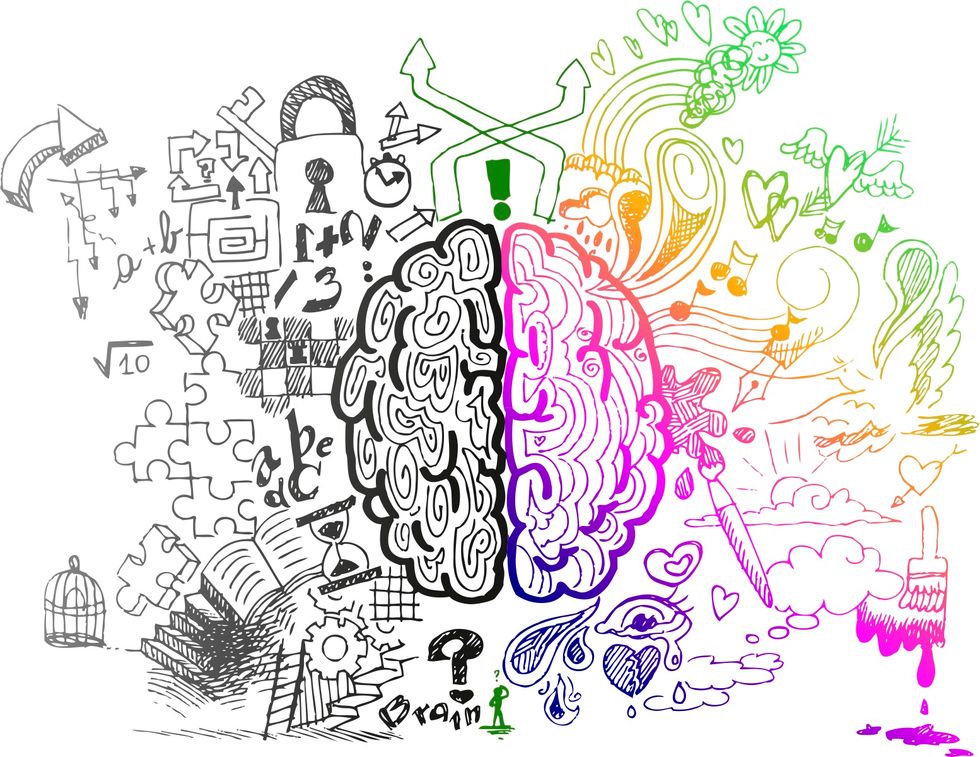
It's a debate that all college students are familiar with: STEM (Science, Technology, Engineering, & Math) vs. The Humanities. Who has more work? Who can get better jobs? Whose education is harder to obtain? These questions have been a long-standing debate among friends, siblings, and families since the beginning of time. But who really has it harder in college?
Well, fasten your seat belts, kids, because I've been doing a lot of research on the topic, and I finally have the answer for you.
Are you ready for it?
No, seriously, are you really ready?
Here it comes:
Both STEM and Humanities students work just as hard.
Bet you weren't expecting that one, huh?
Now, I myself am an English major, which slips me right into the Humanities category. And I have plenty of pre-med, engineering, and even computer science friends. So I've seen the workloads from both perspectives, and what I've noticed is that both sides seem to think that they're better and have more work. I've heard STEM majors complain about their Humanities counterparts, crying about the fact that we don't have to take as many science courses, labs, and do as many dissections as they do. And I've heard some of my own English major friends (myself included) whining that the STEM majors are so lucky because they don't have to take language courses or write as many papers. Basically, no matter which side you're on, there is some sort of excuse that makes it seem like you're the tougher, more resilient group of students than your counterparts. But all of that kind of gets negated when we're all crammed in a study room at the library doing just as much work for the same amount of time.
If you stop and think about it, the idea that one side has more work than the other isn't necessarily true. An English major such as myself may be able to churn out 15-paged papers in under an hour, but I may be severely struggling in my calculus class. STEM majors may be able to do Hardy Weinberg equations (*cue intense flashbacks to AP Biology*), but they may be struggling with proper grammar in their history papers. Everybody has their strengths and weaknesses, which is a pretty admirable thing. I may personally feel that I can write a more developed textual analysis of a fiction piece than some of my counterparts, but they can run circles around me with their chemistry formulas and mathematical equations any day. And honestly? Power to them.
Who's to say that your chemistry course is more challenging than my early modern literature class? We're both being challenged in the areas we excel in. For you, it's formulas. For me, it's a work of Shakespeare. Just because we are utilizing different areas of our brain doesn't mean that we aren't working them just as hard. Creative ideas cannot be executed without logical means, and scientific equations would never come to fruition if a scientist hadn't tried to think outside of the box.
And as for the question of who will have a better time getting jobs, there are two issues I have with this debate: One is that the cycle of what kind of jobs the economy needs is always fluctuating, and the other is that you can't create STEM majors without educating them in the Humanities, and you can't create Humanities majors without educating them in the STEM fields. It's a symbiotic relationship that we both need. Think about it: Pretty much every guidance counselor in America is pushing students to pursue STEM degrees. So in four years, what will happen when we have a massive influx of students with STEM degrees? Areas hiring in the Humanities will be eager to take the smaller batch of students with Humanities degrees, which may be few and far between. So then there's a push for Humanities degrees, but then those students graduate, and the Humanities field is flooded while the STEM field is floundering...and so on and so forth. It's a cycle, guys. It's never going to stop. And it'll bite all of us in the butt at some point.
Second, scientists aren't able to write their research reports if they don't have basic grammar and syntax skills. And, well, if us poets never learned how to count, we'd be writing some pretty terrible haikus. This is why schools having a core curriculum and introducing students to both areas of study is vital, because you can't excel in one without having at least some experience in the other.
So what's the lesson to be learned from all of this? The deep, philosophical answer is that you always will think the grass is greener on the other side (and by greener, I mean the grass has less homework and studying on the other side).
But the real, honest answer is that we are all in this never-ending whirlwind of papers and tests and studying via all-nighters together. So you rock on with your computer science coding labs, and I'll keep writing lengthy papers. We'll all do what we do best, and we will give 110% of ourselves to whatever area that may be. After all, 110% is 110% no matter what, regardless of what subject we're talking about.














