The sky was cloudy, the air was cold, the wind whipped, and at certain points a sleet mixture pelted us as we walked around the camp. The road was comprised of mostly dirt and small rocks, and the buildings that rose up around us were all uniform and made out of dull brick. Being there was a miserable experience, but I knew that my time at Auschwitz-Birkenau was not nearly as bad as those who had been there before me. Most students throughout the United States and Europe have learned about the Holocaust during their high school history classes; even others go on to study history in college. However, until you visit the site, the history lesson seems simply like a story. This is because nothing distinguishes it from any other fictional book we’ve read. But once you get there, everything changes.
The tour began at Auschwitz I, the smaller of the two camps. We walked around the barracks many of which contained recreations of how the accommodations looked during the time the camp was in use. Pictures hung on the walls illustrated the process that people went through when they arrived, and it was difficult to comprehend that I stood where they were processed. The most chilling part of the tour, occurred at the end of the Auschwitz I, when we walked into the last gas chamber remaining in the camp. I was overcome with the most surreal feeling; I was standing where thousands upon thousands of people died. I felt overwhelmed and could not handle to be in the room very long. As we exited the gas chamber, snow began to fall, and it seemed absurd to me that something as pure as snow could fall on such on dirty and disgusting place.
We continued our tour at Auschwitz II, more commonly known as Birkenau. This camp handled many more people than first camp and was physically much bigger. Something had happened to me though in bus ride over from the Auschwitz I. I was already emotionally drained, and when I got out of the bus the weather was miserable as was I. I was wearing jeans, a jacket, a scarf, gloves, a hat, fuzzy socks, and boots and I was absolutely freezing; the wind made my eyes water, and my toes started going numb. I recognized that when the camp was in use, the people kept here wore thin pajamas and sometimes did not even have shoes. We then took the long walk to the back of the camp where four gas chambers had previously stood (they were destroyed by the Nazis in an attempt to disguise any evidence of their wrongdoings). The tour finished there at the gas chambers, and we had to walk back through the camp in order to get to the bus. I was once again reminded that very few people had the opportunity to walk back out of the camp after walking to the gas chambers.
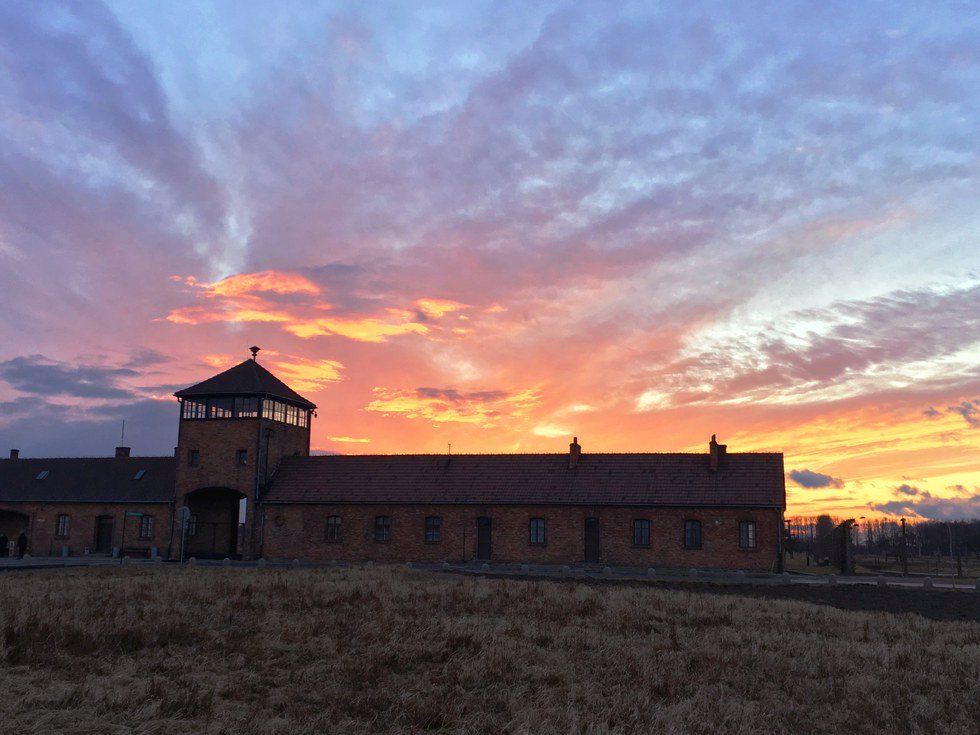
During this walk back, the clouds broke apart and a beautiful sunset appeared. When I got outside the camp I took a picture of the entry to Birkenau covered by a beautiful sunset, pictured above. It felt ridiculous to appreciate anything as beautiful in such a wretched place. I did not leave Auschwitz with a deeper understanding of life or its value; I left with many questions. I have been blessed in life with so many amazing opportunities throughout my life, such as going to college, having a caring family, and even being able to study abroad for a semester. I did nothing to deserve the life that I have, and the people who died at Auschwitz-Birkenau did nothing to deserve the life that they got. I don’t know why this occurs. As I contemplated the sunset, I also questioned how God could create such beautiful things—like the sunset—while simultaneously allowing such atrocities to happen. I don’t have answers to the questions, but after visiting Auschwitz-Birkenau I feel more grateful for the life that I have been given.