


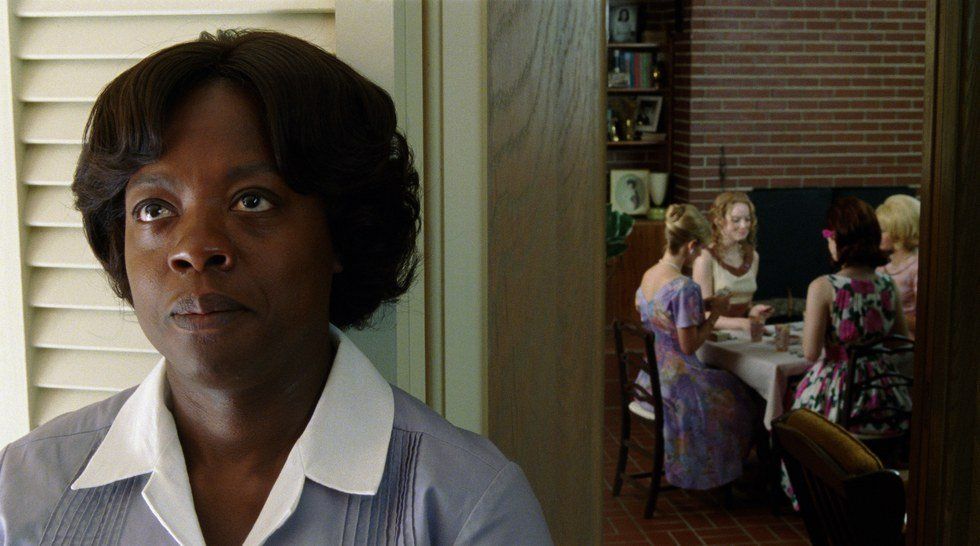
Do you see anything wrong with this photo?
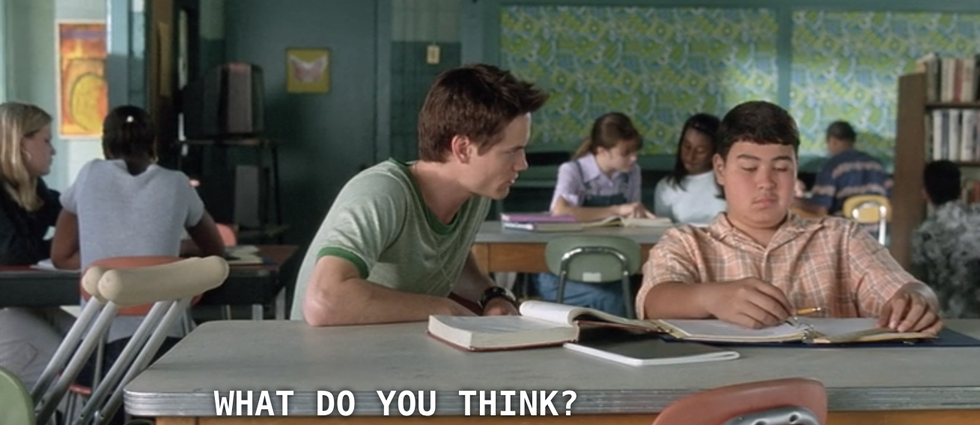
It's a screenshot from the movie "A Walk to Remember," one of those popular romance movies based on a Nicholas Sparks' novel. Seems pretty innocent, right? Just some people sitting in a classroom. If you've seen this movie, you'll know that this is one of the introductory scenes between the main character (green shirt) and the love interest (brunette girl in overalls). However, if you look closely at this film, you'll find that this scene happens to be the only one in the entire movie with multiple people of color in it -- and they're all portrayed as one-dimensional "disadvantaged kids."
This is a classic example of subtle ways movies can reinforce racist ideas. The assumption made here is that kids who are disadvantaged are all either African-American or Latino. Although this scene probably didn't seem terribly important to the movie, it is important because it reiterates the idea that POC are less intelligent whereas white people are more intelligent; if this movie were to portray this scene in a less racist way, there would be both tutors of color and white disadvantaged kids, both of which exist in the real world. By choosing to show only POC as disadvantaged, this movie made a choice to reinforce negative stereotypes about African-American and Latino people.
"A Walk to Remember" is not the only movie guilty of putting POC in roles that reinforce negative stereotypes. Often, movies featuring white main characters will insert people of color side and minor characters to try and seem "diverse." However, these characters are often given little thought or dimension, and are rarely developed into well-rounded, popular characters. Many are simply plot devices with no story of their own. For example, in the 2013 movie "Her," people of color talk for a mere 46 seconds. Total. In a movie that is over two hours long. Not only that, but those characters can be found in the credits as "Letter Writer #2", "Pizza Vendor", and "Uncomfortable Waitress". They don't even have real names, which indicates that their characters are obviously not of any real importance to the story. Another example is "500 Days of Summer," released in 2009. This time, POC take up a grand 30 seconds out of nearly two hours, and are credited as "Bus Driver", "New Secretary", and "Minister." In modern media, all people of color are ever given is little screen time and stereotypical, flat roles.
The lack of POC in film is another example of subtle racism. Heroes, villains, love interests, best friends, and more are almost always played by white performers. They are three dimensional and well developed, interesting and intriguing, related and well loved by audiences. People of color are rarely, if ever, granted those same privileges. To put it in a nutshell, white people in media are portrayed as people; people of color are portrayed as stereotypes.















