

*Disclaimer: I am not writing this under the influence of psychedelic mushrooms.*
But someone without Synesthesia might have to be in order to write this.
I am hardly the first person to write about this fascinating psychological phenomenon, but I'm going to try to do my best to explain what it is in simpler terms that everyone understands because there seems to be a lot of confusion about what Synesthesia really means.
Shouldn't be too hard since I've been blessed with this "condition."
The Quick Explanation
Synesthesia (also sometimes spelled "Synaesthesia") is a crossing of senses, essentially, or more accurately, when the brain receives stimuli for one sense, a receptor for another sense is activated at the same time.
This results in a diverse range of effects to those that have the condition (synesthetes). Those with the sound-color synesthesia can "hear" colors when they hear a sound. Another type of synesthetes have associations for graphemes (shapes that hold meaning like letters and numbers) that assign colors and even genders to them. Some can taste and smell colors and textures. There are a number of types, and most people that have one have at least another.
Below: My synesthetic alphabet, drawn up around age 12 or 13. (Some graphemes have changed a little).
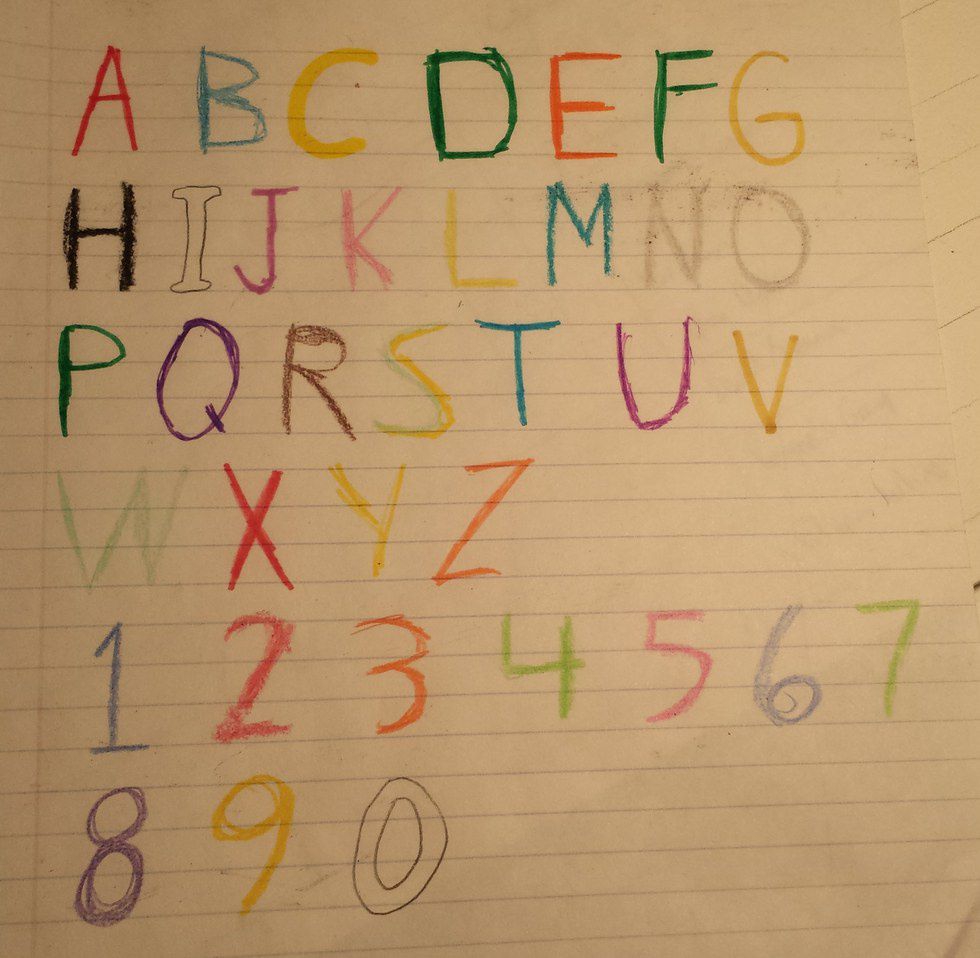
I know this sounds crazy, but, you ask me, without thinking, I can tell you that my A is red, B is blue, C is yellow, and I could go on. I can tell you that 2 is red and a warm, mother-like figure, mother to 3 and 5, and 4 is the kids' uncle. I can also tell you that I love the purple hues of the "Man Who Sold the World" cover by Nirvana, but David Bowie's version is too blue and bumpy.

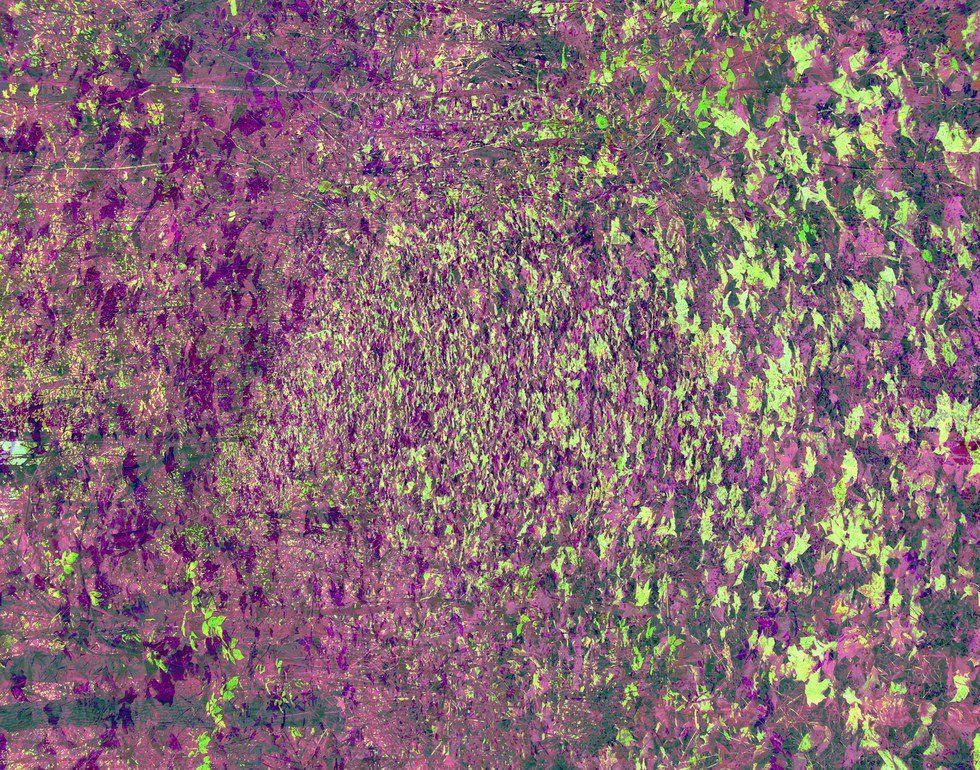
Above: How the song "Vasoline" by Stone Temple Pilots "looks" to me.
Sounds insane, right? To me, it sounds silky and blue.
All joking aside, I didn't have to even think about those answers, and that's because Synesthesia is instantaneous, involuntary and consistent over time. A has always been red to me, always will.
Are They Hallucinations?
No. No no no. Synesthetes never really "see" colors in sounds. I don't see thin blue lines in my field of vision when I hear an acoustic guitar, but rather, my brain thinks of them when I hear the notes. Synesthetes are fully aware that the extra sensory activity is just that, extra.
The most common question people have upon hearing this is "Wow, that must be a lot to process at once, right?" It's actually not. As I said before, it's involuntary and instantaneous. It's such a part of a synesthete's daily life that they really only notice it when they pay attention, like blinking.
I apologize if you're now going to be thinking about your blinks for the next minute or two.
I notice the colors in sounds more if I focus in on them. I like to call it "zooming in," because that's the easiest way to describe this incredibly indescribable process. Like everyone's brain, all kinds of stimuli are constantly flying into mine, so unless I'm "zooming into" the colors I "hear," it doesn't really bother or distract me.
I've read many cases from synesthetes online stating that their "hearing" colors distracts them, but if I had to theorize, I'd guess that these people instead also probably suffer from ADD or ADHD. I've never had the issue of Synesthesia being distracting. It'd be like feeling distracted by your own breathing, doesn't work that way.
Is Synesthesia a "Bad" Thing?
22 years of having Synesthesia, I'd have to say it's a bonus. To be honest, I feel sorry for everyone listening to music without having a light show.
It does not classify as a disease or disorder. It is not destructive in any way, and contrary to a few more ignorant synesthetes' testimonies, it is not distracting. It is not overwhelming, not hallucinatory.
It actually has benefits for memory, since multiple senses are being stimulated. A study by Simner et al. (2009) found that time-space-type synesthetes had a stronger recall of certain dates and times than non-synesthetes had taking the same test. Which makes sense, since they visualize time and space often as circles. The more senses attached to a memory, the more potent it becomes.
It's just a little weird to the majority of the world, but don't be too quick to judge. Approximately 30% of people actually exhibit occasional symptoms of Synesthesia, even if they may not have the full condition.
So, if in any of my articles you read about fuzzy guitar riffs or how oranges taste like slime green, it will make a lot more sense.
Or maybe just a little more sense.

















