I recently watched the 2017 film “The Circle” which, despite its impressive cast, was decidedly average. However, it got me thinking about privacy again. Since Edward Snowden’s exploits in 2013, privacy has been a hot topic for debate. Threats to privacy have grown even since then. Personalized online advertising grows more sophisticated daily, and with the widespread adoption of “smart speakers” like the Google Home and Amazon Echo, companies have even more data at hand. The war on net neutrality threatens online privacy even further. If things continue in the direction they’re heading, your internet service provider will soon be able to happily sell your browsing data to the highest bidder (which is not to say that sites like Google, Facebook, and Amazon aren’t already doing that).
In addition to corporate pressures, social pressures on privacy have grown since 2013. Social media now permeates every facet of society. Politicians recognize its power and use it to garner favor. Hashtags fuel movements, and news spreads like wildfire—whether its true or not. Entertainers must maintain their online presence, lest they lose their following or viewership. Even my roommate’s textbook asked him to tweet a photo of himself entering the activation code and to include a hashtag they so conveniently provided.
Government and corporate abuse of citizens’ privacy are very serious threats. But the rapid shrinking of our bubbles of privacy affect us on a different, more personal level. Because of the omnipresence of social media, not participating has become less of an option. Social gatherings, public events, and parties are often scheduled on Facebook. Trends are born, news breaks, and drama flares on social media, and not participating can leave a person feeling left out.
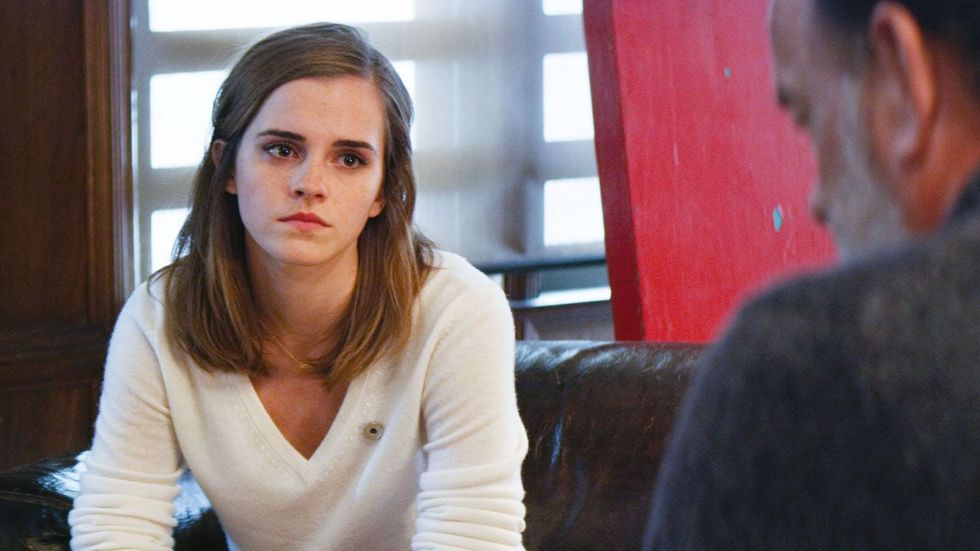
In “The Circle,” Emma Watson’s character attaches a miniature camera to her person as part of a social experiment in constant streaming. It’s a bit of an extreme, but it reflects how it has become more and more normal to record everything. Whether it’s a passerby or a government CCTV, surveillance is everywhere, and it becomes harder and harder to feel alone.
No matter how social you are, everyone needs privacy. Because no matter how normal you think you are, there is probably something about you that society doesn’t like. Having a private place to be yourself is imperative, because not having an outlet can have dire mental, physical, and emotional consequences. You might not think about it much now, but if you had no privacy, you’d notice. This is part of the attempted tragedy arc in “The Circle.”
Emma Watson’s character’s initial enthusiasm dwindles as she realizes how little real expression she is allowed with the camera. She stifles tears, fakes friendships and lies to conform to the expectations of her viewers. While nobody in real life displays this level of exposure, more and more online entertainers, specifically ones putting out regular daily content, are beginning to speak out about burnout.
Popular Twitch streamer Lirik said, “I just don’t feel entertaining anymore and don’t really know why people continue to watch. It’s like going on stage every fucking day and not knowing what to say anymore because you are out of material.” Without breaks from social interaction, one begins to wear down.
Sidney M. Jourard, psychologist, professor, and author had this figured out in 1966. In his paper “Some Psychological Aspects of Privacy,” Jourard writes,
“When a person continues to live his life in ways inimical to the needs of his physical organism, signals are emitted to the person (and to an observer who is perceptive or knowledgeable) that ‘all is not well’ with the organism. If these signals are not acknowledged and acted upon in some ameliorative way, the person may experience pain, depression, anxiety, hopelessness, or vague malaise and not know why. The direct reason for these effects is to be found in the way the person so afflicted has been living his life. But if that way of life has been socially or morally exemplary, the person may be puzzled as to why he is not happy.”
We need time away. From social media, from other people, from the public eye. Only then can we truly be ourselves. This is why anonymous social media sites like reddit and 4chan are so popular. On these sites, your words are not linked to your real identity, so you don't need to filter yourself to conform.
If you don’t feel comfortable in a role society has set for you, pretending you are is an emotionally exhausting endeavor. This could be anything from society’s expectation for you to wear pants to society’s expectation for you to “be a man” or “act like a lady.” While we haven’t reached “The Circle” levels of sharing, it's never too early to examine the effects of oversharing, breaches of privacy and public burnout.