
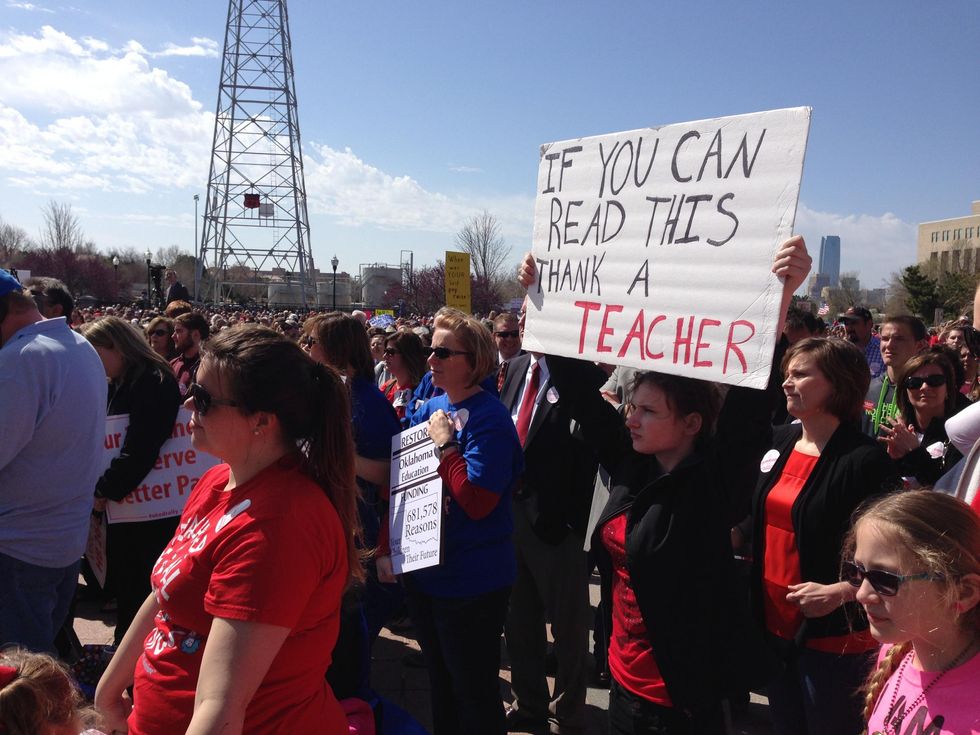
Although our waving wheat may smell sweet, it might not be enough to keep our teachers in Oklahoma to stay. Oklahoma has continuously ranked next-to-last in education. As a matter of fact, the state has shown negligence in school funding, teacher salaries, and student achievement (no wonder people think we're a bunch of hicks!). Until Oklahoma legislators and governor, Mary Fallin, take education seriously, this will ultimately collapse the state's economy because of the lack of progression. We can not invest in the success of Oklahoma if we can not invest in Oklahomans.
Oklahoma has cut 26.9% of their funding since 2008. This has put a noticeable impact on teachers, students, and parents. Teachers have made the biggest contributions to this backlash. Oklahoma teachers have put in their own paychecks to keep their classrooms running smoothly. Many spend their grocery money constantly buying the demand of supplies for their classroom and students; buying things as simple as enough paper to print out worksheets. Last August, Oklahoma City Public School didn't have the funds for appropriate air conditioning. Teachers dismissed class to let their students leave early due to overheating and uncomfortable conditions. The lack of money has also neglected extracurricular activities and de-prioritized art and music programs. In addition, this has prevented students who are involved from traveling to competitions, events, and shows. Because of that fact, PTA, alumni associations, and booster clubs have been raising money in hopes to give equal opportunity to students as others have in presiding states. A few school districts have responded by opting for a 4-day school week to lessen the blow of their financial crisis.
Most Oklahoma teachers can agree that they are not valued. Teachers like Mrs. Poole, a fifth grade math teacher at Del City Elementary School, reiterated, "just look at recent budget cuts and the lack of any type of pay raise for us." Other teachers like Ms. Evans, a biology teacher at Moore High School explains, "lawmakers [who] put profit and policy before people have caused these problems." She elaborates how hard teachers work like dealing with students from all types of backgrounds, putting in extra duties like coaching and sponsoring, and being trained constantly to keep up with education standards. Ms. Evans credits the school's success to teacher unions fighting for better quality education. Teachers, like Ms. Dina, an environmental teacher at Moore High School, have brought in another income by working as a Homebound instructor, tutoring college students, and working various jobs to keep some stability in her lifestyle. Underpaid and undervalued, teachers have been forced to move out of state in refusal of being taken advantage of by the poor school systems. Mr. Sheehan, an algebra teacher at Norman High School and Oklahoma's Teacher of The Year, has recently announced his relocation to Texas due to Oklahoma's budget deficiency. Many career fairs have been organized specifically targeting Oklahoma to encourage our extremely qualified educators to teach elsewhere for a more respectable wage -- a wage that can pay the bills, a wage that can cover health costs, a wage that keeps teachers happy. Oklahoma's starting salary is at $31,000 while cities like Dallas is offering $51,000. North Carolina's Guilford County Schools is even offering a $1,200 incentive and a starting salary of $43,000 for teachers with no work experience. There are so many opportunities out of state, no wonder Oklahoma is having a teacher shortage!
Nevertheless, one of the biggest reasons for Oklahoma teachers sticking with their career is the satisfaction of being an educator. Mrs. Poole explains, "for me, it's the light bulb moment. When the bulb goes off in a child's head that they get what you are talking about...that's a huge accomplishment for us both. That's why I keep teaching in Oklahoma!" Although without a fair wage it has affected teachers' lifestyle whether it's making ends meet, raising a family, or sending their own children off to college. Oklahomans aren't asking for extravagance; they are hopeful that the state will consider education to be Oklahoma's top priority. Improving our education and the budget will also keep Oklahoma-raised college grads to commit to a future teaching here. Precedence in education can create a way to facilitate success within our state. It all goes full circle once we invest in our teachers and students.