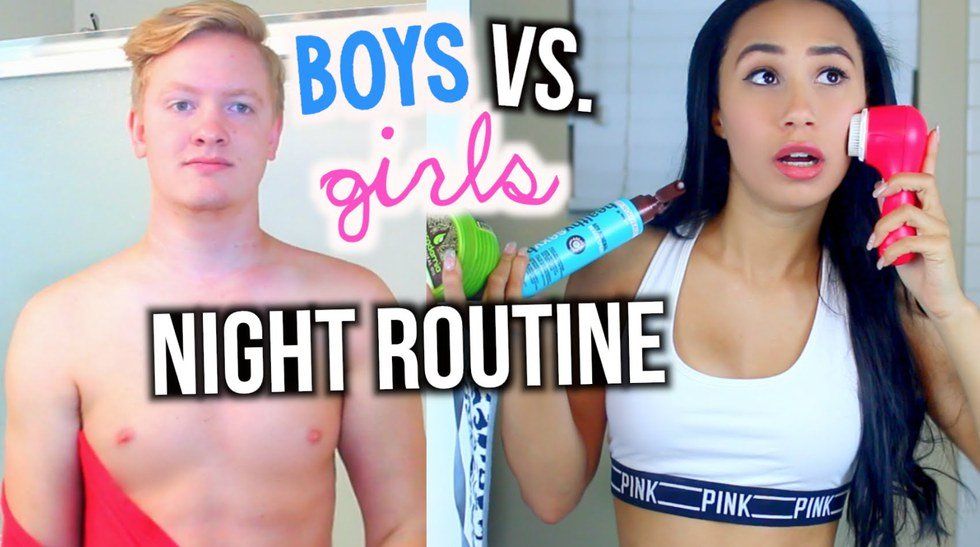
Most of us have encountered them at one point or another: those colorful, happy lifestyle videos in which cute, chatty YouTubers demonstrate how fun it is to make healthy snacks or how easy it is to DIY your old shirts for the summer (side note: it’s not--I ruined two shirts) or how hilarious the differences between boys and girls are.
For several years now, watching videos like these has been a guilty pleasure for me. To be honest, it’s often due to less to my interest in the videos themselves and more to my desire to procrastinate on school work, but hey--I think we can all agree that regardless of original motivations, it’s hard not to get sucked into this vibrant, peppy YouTube world. This is especially true when these lifestyle videos are incorporated into the channels of YouTubers, like Bethany Mota, who also make beauty and fashion videos—it’s like the whole shebang! Get outfit inspiration, handy makeup and hair looks, and ways to brighten up your life in general! Who wouldn’t be reeled in?
To be clear, I'm not trying to disparage these types of channels. They provide a wonderful medley of videos to peruse when I need some downtime or a spark in my mood. Most of them legitimately make me happy and inspired. But some of the videos in the lifestyle genre have underlying gender issues that I believe warrant discussion. As a straight, cisgender, white female, I never really noticed these issues, because my identity was almost universally reflected in the YouTubers who made the videos. But at some point, I began to notice an unsettling trend: aside from mainly being straight, cisgender, white females themselves, the YouTubers perpetuate that dominant narrative. This mainly comes in the form of videos that compare females to males in a specific way—how guys drive vs. how girls drive, for instance. I can’t remember how many videos I’ve watched with the headline “Guys vs. Girls,” accompanied by some subject like “Morning Routine” or “Prom.” Usually, these videos reinforce the stereotype of girls being more high-maintenance with more material concerns, and guys being more chill, macho, etc.—basically, the cookie cutter versions of gender.
I understand that a lot of young people do in fact fulfill these stereotypes to a certain extent and, therefore, identify with these videos (myself included). I get that. I also get that these videos are pretty entertaining. What we need to consider, though, is that when these YouTubers continually churn out these types of videos, they assume that the gender binary they present is the only one that exists and that people can identify with. They assume that gender is binary. But it isn’t, and these types of videos alienate those who don't fit into one of society's traditional binary roles, and/or those who don’t identify with the stereotypical versions of each gender.
What frustrates me the most about these videos is that not many people seem to be remotely bothered by them, or even talking about them at all. And yes, this whole post might seem to some like more nitpicking liberal bullshit—why can’t we just watch fun videos, right? But here’s the thing: the reason so many young people who do not fit into society’s prescribed gender roles feel isolated, often enough to commit suicide, is that too many people don’t bother to consider or care about their perspectives. And though these videos are meant to be funny and not be taken seriously, they still present narratives that impact viewers. Those that present the dominant narrative—with the dominant identity and traditional social constructs—without self-awareness remind people who don't fit this narrative of their alienation from their own society. Just because something is meant to be funny or fun does not mean that it doesn’t influence people and that we shouldn’t critique it.
While I don’t expect these YouTubers to suddenly become experts in every contemporary issue (who is?), I do expect that they recognize their position as public figures who have a mass audience of young, impressionable people, and that they make an effort to educate themselves on the society in which they’re interacting—on the potential various identities of their millions of viewers. Putting this education into practice could simply involve qualifying their videos or anytime they discuss “girls” and “guys,” with an explicit recognition of the traditional social constructs their videos work around and the various possible gender identities. Or they could just have an open discussion with their subscribers. It wouldn’t take that much extra effort.
Obviously, these YouTube creators have the right to do whatever they want with their videos and their channels. And I get that they have a specific audience—not everyone who goes on YouTube watches their genre of video. But if they continue to ignore people who don't fit society's traditional, comfortable identities, these YouTubers perpetuate their division and isolation. The world is slowly progressing in terms of accepting different gender norms and identities, and since YouTube is already a huge aspect of our daily lives, I would love to see some of these lifestyle YouTubers progress too—by recognizing the issues at hand and making an effort to push themselves out of their own familiar, heteronormative mindsets.