
Think about your favorite movie, book or song. Why is it your favorite? Because it has, on some level, caused you to feel genuine, honest emotions. Every time you laugh at a joke in "Anchorman," every time you got choked up watching "The Notebook," or filled with patriotism from "Saving Private Ryan," you are doing something the world is in desperate need of: honest emotional expression.
Okay, I know you're probably thinking: What on earth do movies have to do with making the world a better place? I can't say I blame you for having that thought. However, allow me to explain:
I'm an actor, a theatre performance major. I'm also a writer, if you couldn't tell.Telling stories is what I do, it's what I love doing. But if you'd asked me a year ago to tell you what I wanted to do with my life, you would have been met with a slightly awkward pause and a bad joke about how "I may not know what I want to do, but I certainly know what I don't want to do!" It wasn't until I realized what kind of impact a compelling story can have within people who are willing to listen that I knew this was what I was supposed to contribute to the world.
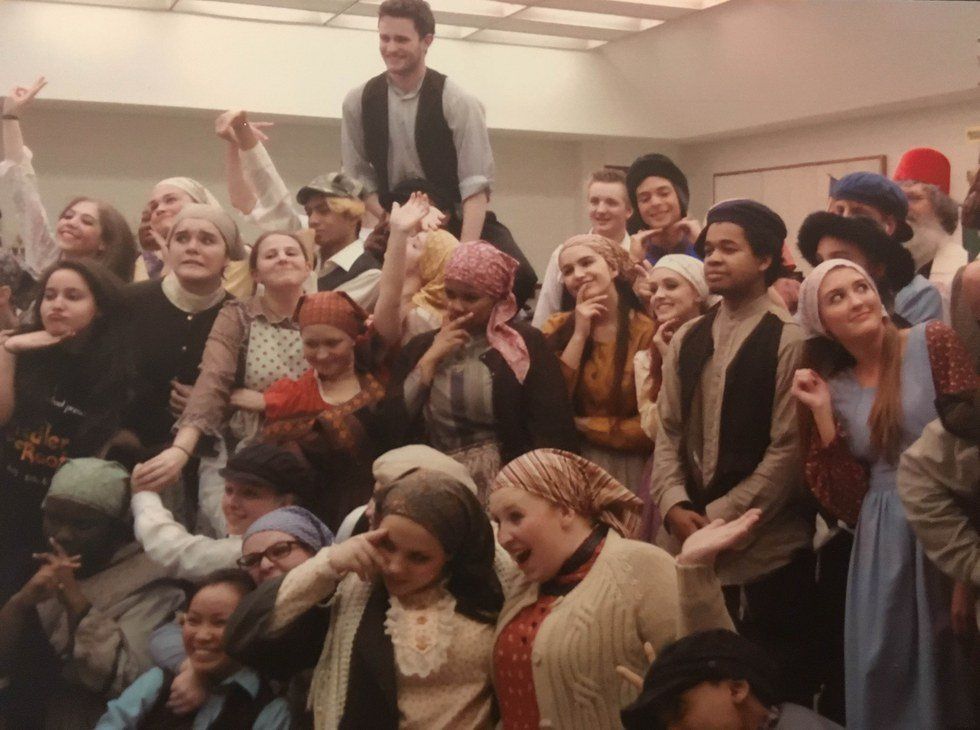
During my senior year of high school, I had already established myself as an actor. I was the president of the drama club, I'd been cast as a lead in all the shows and I had a genuine connection with everyone in the drama department. However, at that point I still saw it as a hobby. I hadn't yet told a story that moved me. That changed when we performed our competition one-act "Stroke Static" by Canadian playwright Lindsay Price.
I starred as an 83-year-old dementia patient whose realities constantly fluctuated between the real world and an 18-year-old version of himself during World War II. My character, Russ, had suffered three strokes (hence the title), and I had to show this through a constant spasm in my right hand. I actually developed carpal tunnel from doing this so intensely. The story was a tragic look into the decay of a man who had gone from spunky mechanic with a soft spot for the girl next door, to someone who could no longer recognize his own children.
I won our region's "Best Actor" award for that performance, but that medal was not what I'll remember about that day. What I will always cherish about that performance was coming out of the auditorium to greet the audience after the show had ended and seeing all the people with tears in their eyes. Dazed and humbled by the overwhelming show of emotion, I had never experienced this before. For the first time in my life, I had moved people to the point of tears. I was so entranced, so captivated by the scene that I almost didn't even notice the middle-aged woman approaching me. The first of the audience to come speak to me, her eyes were flooded. Tissue in one hand, and the other wrapping around me in embrace. As she sniffled and wiped her eyes, the only words that managed to escape was a choked "thank you for that." That one moment, that simple gesture, encapsulated perfectly what I'll never forget about that day.
So, now that I've bombarded you with a long winded anecdote, let me now actually try to make my point.
We live in a world of people who don't like each other. Almost from birth, we are conditioned to categorize one another. Then, we're made to believe that certain people are our friends or enemies based on which category they fall into. I believe that this vicious cycle has stemmed from humanity collectively losing touch with what is beautiful about each and every one of us. Each and every person on this earth has a spark of goodness in them. But that spark won't turn into a fire without being kindled.
Okay, everyone still with me? Cause here's where I really start to ramble (in case I haven't done so enough already).
This beautiful little spark must be nurtured and built upon if we are to achieve any sort of contentment in life. I firmly believe that nobody can be truly happy without being kind to those around them. You can't be a happy person without having empathy for your fellow man. I understand that not everyone may see things from my heavily Aristotelian worldview, but I think that most of us believe something along these lines in one way or another. But the problem is that we live in a world of boundaries. Empathy is far from encouraged. This is because emotional depth is being uprooted.
Now you're all saying "Alright, John. I can see your point about the world not being very nice to each other, but what the hell does this have to do with movies?"
Here's the thing. The path to a better world starts with us being able to see beyond the factions that we have created and look at our fellow man for what he is on the inside.
But we can't do that with those around us until we can do it with ourselves.
It all starts with being honest with ourselves, allowing ourselves to freely feel and express genuinely the emotions that the good things in the world invoke within us. And is that not what all those people in the audience of Stroke Static were doing? This is why I believe in the power of storytelling. Because for that one hour of that one day, I witnessed the truly beautiful sight of people from all walks of live collectively accepting and embracing something together.
So what I would encourage all of us to do more is to listen. Pay less attention to the distractions in our lives and pay more attention to ourselves, and each other. Put down the phone, and pick up a book. Or maybe use that phone to invite your friends over for a movie night. You don't have to actively seek out the good in this world, because it will find its way to you if you open yourself up to it. In addition, learning how to be honest with ourselves about how we feel is a crucial part in being more open. And what better way to practice being more emotionally vulnerable than to let yourself cry during a movie?
Little stories are being told around you every day. So listen. 'Cause you never know when one of them is going to change your life.