
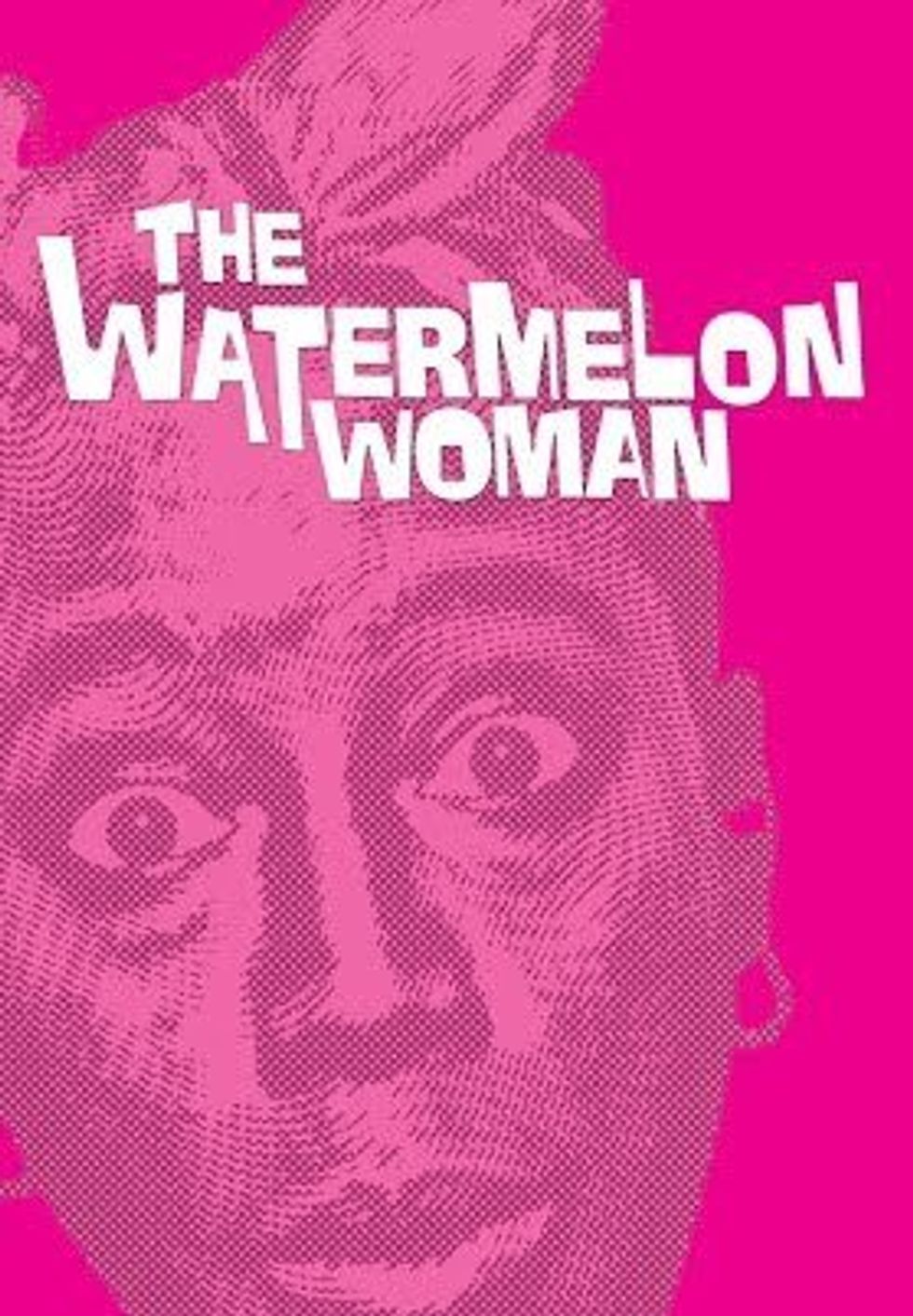
Cheryl Duyne’s 1997 film "The Watermelon Woman" was, in many ways, the first of its kind. It had an openly lesbian black director, but it also focused on the stories of black lesbians and the culture and history that they were a part of. Yet for all that it was something brand new, it also relied on several of the core beliefs and practices that characterize postmodernism. It connects the postmodern outlook to several of the questions it attempts to address, and postmodern teachings serve as foundational touchstones for several of its storytelling techniques. "The Watermelon Woman" beautifully weaves in postmodernism through its meta storytelling, unreliable narration, and reconceptualization of traditional narratives to emphasizes its theme of black lesbian life.
The film immediately lends itself to a postmodern analysis because it is a movie about making a movie, without being a documentary. This meta approach to storytelling is a common theme within postmodernist works (Pollard). Following the approach of If On a Winter’s Night a Traveller and other famous postmodernist novels, The Watermelon Woman is simultaneously the title of the film, the name of a movie the protagonist is working on, playing with the levels of reality in the piece. Continuing off of this theme, Cheryl Duyne, the film’s Black lesbian director and writer, plays the lead, who is also a Black lesbian filmmaker named Cheryl. The film is clearly trying to blur the lines between what is real and what is not—so much so that it eventually has to give a disclaimer at the end that the events and people are in it are fictional.
This meta form of storytelling gives the film unique relationship with the audience that has its foundations in postmodernism. According to Marita Sturken and Lisa Cartwright:
Postmodern texts generally speak to viewers as subjects who are in the know about codes and conversations of representation and simulation. The dominant mode of address in these texts takes the viewer to be someone who will not be fooled by techniques of propaganda and illusionism, someone who will get the reference, who is media and image savvy.
Many times, Cheryl speaks directly into the camera and addresses the audience directly. This is one of the film’s primary narrative devices; not only are viewers informed of important plot points during these segments, they also get to see more of Cheryl’s thought process as if they are having a conversation with her. As Sturken and Cartwright alluded to, Cheryl always assumes the audience is “in the know” when she talks to the camera. She doesn’t pause to explain terms like Mammy or discuss the lack of roles offered to Black female actresses during the 20s and 30s, but instead speaks as if these are ideas that they would already be familiar with.
Having an unreliable narrator is another common trait found in postmodernist works (Pollard). In many ways, this functions as an extension of the postmodernist belief that every assumption should be questioned—why do we assume the narrator of a piece should automatically be trusted? So instead, the unreliable narrator gives the audience his or her own personal version of events, usually with clues given to indicate they are not being entirely honest or objective. In "The Watermelon Woman", Cheryl, the protagonist, also functions as the narrator of the story; the audience hears her take on everything in her frequent discussions with the camera, and she also films several scenes in the movie or directs someone else doing the camerawork, meaning she determines the focus. Cheryl chooses to portray herself as someone with goals and a mission, while comments from her friends reveal that they think of her more as a drifter and someone who can’t settle. She chooses to code her as romantic, at least initially, while Tamara and her girlfriend clearly find the relationship exploitive and based on some kind of “jungle fever”, or fetishizing of Black bodies on Diana’s end. The audience is encouraged to question what Cheryl says and not instantly assume what she says is objective or true, even when she speaks directly to them.
Cheryl also deals with several unreliable narrators of her own as she tries to piece together the story of Fae Richards, the Watermelon Woman. When Cheryl interviews the sister of Martha Page, a white director who collaborated with Fae, she is outraged by insinuations that Martha was a lesbian or that she might have had a relationship with Fae. Her desire to totally dismiss the topic causes her to end the interview with Cheryl quite abruptly. Yet Cheryl faces a curiously similar reaction when she talks to June Walker, an open lesbian and a former partner of Fae’s. “I was so mad that you mentioned the name of Martha Page,” June writes in her letter to Cheryl. “Why do you even want to include a white woman in a movie on Fae's life? Don't you know she had how people should remember Fae?” June is just as eager to dismiss parts of Fae’s life that she finds unsavory as Ms. Page was with her sister Martha, even implying that Cheryl is not a true “sister” for broaching the topic.
Both women choose how they want to remember their loved ones, even if it doesn’t end up being the most accurate picture. Cheryl has to confront this reality as she tries to take on the role of biographer, and she ultimately realizes she has to make her own choices about how she wants to view Fae. Fae means something different to her than to anybody else, and Cheryl admits that this how she chooses to view and present Fae’s life has more to do with her than anybody else (Sullivan 453). This seems to be clearly linked to the postmodern idea that there is no “ultimate truth”—everything is subjective, even one’s memories of someone. For a biographer like Cheryl, she must choose the narrative she wants to present, even as the real person remains unknowable, according to this philosophy.
Postmodernism also deals with “reconceptualizations of society and history” (Pollard). It questions master narratives and social institutions and often tries to make people re-examine their beliefs, even ones that seem natural (Sturken and Cartwright 313). This is a theme that is at the heart of "The Watermelon Woman". And it’s not hard to see why; as a film about Black lesbians by a Black lesbian its very existence questions the typical movie formula. Seeing a film that is not centered on heterosexual White males would automatically catch most people off-guard, and then perhaps make them question why this surprises them or why these types of stories aren’t often told. The movie never tries to justify why it is not about people who are heterosexual White males either; it operates off the assumption that Black lesbians exist and that they have stories to tell, which for many people is a revolutionary notion all by itself.
Within the story of the film, there is also a questioning of the master narrative of film history. When Cheryl interviews a cultural critic, she finds that even someone well-versed in the subject is quite taken aback to imagine that there were lesbian filmmakers at the time, especially ones who engaged in interracial relationships. It simply isn’t the kind of story that fits into the dominant film narrative. Cheryl also conducts several street interviews for her film, and at one point stops to talk with some White students, who some have argued were lesbian coded (Sullivan 459). One girl responds that she has heard of Martha Page, but not Fae Richards. The other jokingly says that they haven’t gotten to the Blaxploitation era in their class yet. This side comment gives an unspoken commentary on how Black women are presented in film and gender studies classes; how they are relegated to certain time periods and categories, when they were always around and working. It’s not just the dominant White male culture that is guilty of this, but also women and LGBT studies that put an unnatural focus on Whiteness. Black women’s stories are simplified so they can fit into the overarching narrative that is being fed to the masses, even from sources that seem subversive. And these are just a few examples, the film has many small, seemingly throw-away lines that seem intended to spark discussion on these topics.
Of course, the main way "The Watermelon Woman" re-examines master narratives is by creating a figure like Fae Richards and trying to work her back into history. This is not a technique unique to . Today, current Broadway smash-hit "Hamilton: An American Musicl" also shares this concept of re-imagining history. The show does so by portraying the Founding Fathers as people of color who speak AAVE and utilize contemporary forms of music like rap and hip-hop. During show’s final number, the line “I put myself back in the narrative” is emphasized (Miranda); while it has a surface meaning within the plot of the show, it’s not hard to see the deeper significance behind the line. The musical colorfully rewrites history to put men and women of color in the center of American history, an area that has been traditionally dominated by White men. They’ve “put themselves back in the narrative” of the founding of America.
"The Watermelon Woman" attempts to do the same. “Sometimes you have to create your own history. The Watermelon Woman is fiction.” These are the film’s parting words given as the credits roll. What Duyne has done is to rewrite the past to put Black lesbians “back in the narrative” of cinematic history. Because of society’s prejudices, Black lesbians were rarely seen, let alone documented until fairly recently. This means for Black lesbians in film that they have very few people like them who they can look up to.
Duyne’s answer to the idol she wished she had into existence. Or, as Laura Sullivan put it her essay “Chasing Fae”, “she [Duyne] had to create her own hope, inspiration and possibility through the creation of a history that was not, but could have been, in some ways should have been, there (459).” Even the name Fae, a term often used to describe fairies or other magical creatures, hints that this character is a little too good to be true, as if she has come out of a fairy tale; the fact that her full name is Faith speaks to how she is an inspiring figure to Cheryl and how she inspires hope for her as a Black lesbian filmmaker. This postmodern strategy of reconceptualizing establishments and their dominant narratives allows for an empowering fiction to be put on the same level as history, giving marginalized groups like Black lesbians the idols they have been denied in real life.
Although postmodernism first came into the world after World War II (Pollard), its effects are still being felt in the modern era. Relatively recent pictures like "The Watermelon Woman" prove that its beliefs and techniques can still be used to connect and explore ideas and points of view that have been erased or ignored. "The Watermelon Woman" takes core postmodern tenants and uses them to tell a unique and poignant story that have helped to establish it as progressive landmark of filmmaking.
Works Cited
Manuel, Lin-Miranda. “Who Lives, Who Dies, Who Tells Your Story.” Hamilton: An American Musical. Perf. Original Broadway Cast. 25 Sep. 2015.
Pollard, Deborah Smith. “Postmodernism.” 23 Mar., 2015.
Sturken, Marita and Lisa Cartwright. Practices of Looking: An Introduction to Visual Culture. New York: Oxford University Press, 2009. Print.
Sullivan, Laura L. “Chasing Fae: "The Watermelon Woman" and Black Lesbian Possibility”. Callaloo 23.1 (2000): 448–460. Web. 17 Dec., 2015.

















