
Since the Great Recession, recent college graduates have taken a huge hit in job prospects after graduation. Even years after the Great Recession, college graduates are still struggling. Stagnation in job prospects are an alarming reality for students who are entering college, about to graduate, or have recently graduated. Even the graduates who find jobs may find themselves working part-time jobs because they cannot find full time employment; in other words, they many find themselves underemployed. Underemployment is simply when one finds oneself jobless or looking for work.The most common form of underemployment is when recent graduates are overqualified for the position they are filling. According to an article by Slate, a report by the Federal Reserve Bank of New York recorded that 44 percent of graduates with a bachelor's degree, between the ages of 22 to 27, were performing in a job that did not qualify for a degree.
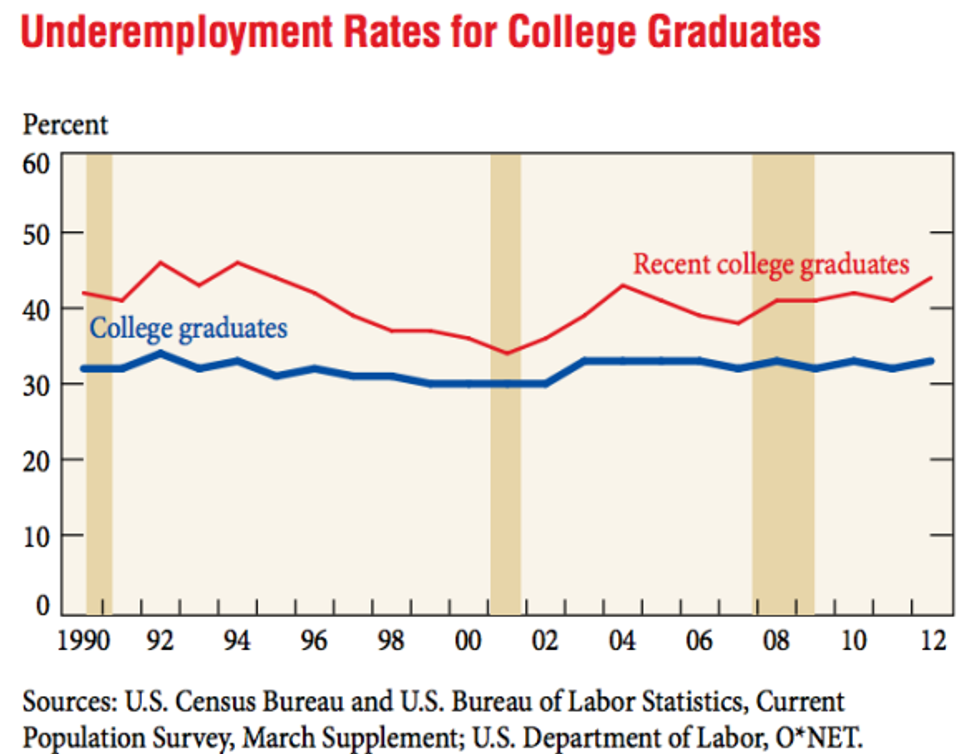
Underemployment for recent graduates is not an unusual aspect. It is typical for recent grads to experience prolonged periods of job searching after graduation to get to a job that puts them on a career path. The unemployment and underemployment for recent grads have been traumatic since the Great Recession because “young workers always experience disproportionate increases in unemployment during periods of labor market weakness—and the Great Recession and its aftermath is the longest, most severe period of economic weakness in more than seven decades,” according to the Economic Policy Institute.
As a reaction to the poor economy, many people went to college to increase their chances of getting a good job with a good wage. While getting a college degree made those who elected to go more qualified, the job market still was not in the same condition it was before 2007. This leads to the numerous cases of underemployment.
There are a couple of things students can do to rise themselves to the cream of the crop:
1. Network! Network! Network!
"It’s not just what you know, it’s who you know" is more than a cliché. Talk to alumni from your university that works within your field. Get ahold of your alumni association and try to get the necessary contacts you need. Be vigilant in your search for connections. Nothing in life comes easy, especially on the journey to a successful, high-powered career.
2. Intern! Intern! Intern!
Many scholarships search engines, such as Fastweb, not only have hundreds of scholarship offerings, but they also have internship offerings. It is as simple as creating an account and updating your profile, so that the search engine can narrow down the options to your interests. Many employers are looking for prospects with experience. So find the internships that best suit your career goals, even if it is for free. Sometimes, you have to pay your dues, and this is a great way to gain experience.
Through networking, you can make connections that’ll last the entirety of your career. The connections you make can help advance your career to the next level. By getting ahead and starting to build those connections now, you’d highlight why you're the more viable candidate. With the aforementioned attributes combined with high academic merits and hard work, you’ll be the crème de la crème.