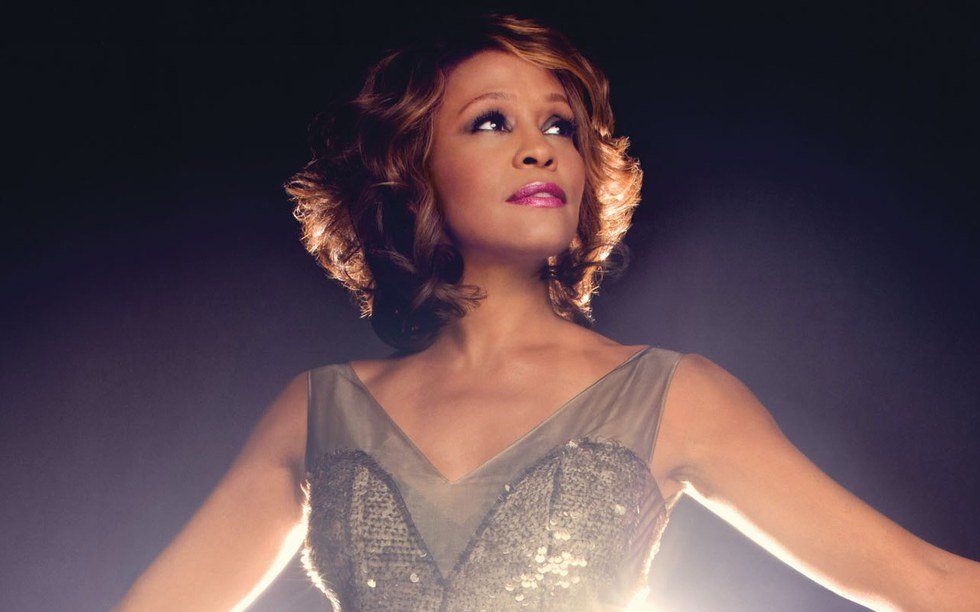
Recently, it was announced that one of the greatest divas of all time, Whitney Houston, would be getting a digital hologram. For those that don't know, a hologram is a photographic image or a video recording that diffused through light (usually lasers) and then projected onto a solid surface. Holograms use light and projection screens to create a 3D image. A holographic image will make it appear that the object projected is right there in front of you in 3-dimensional space, even though it is only a mere projection.
Holograms are an innovation in technology that have only recently started to become an inextricable piece of popular culture. Other famous singers of long past are getting a hologram of their image that would perform on stage, such as Queen's Freddie Mercury, and Lisa "Left Eye" Lopes from TLC. However, what is the line between respectful and distasteful regarding holograms of performers of the past?
The electronic virtuosos of Japan have been using this technology for concerts before it was introduced to the west. Vocaloids, which are born from voice synthesizer software and given personas, are the most widely-known of the use of holograms in concerts. Hatsune Miku, the world's most famous Vocaloid, has had several concerts throughout Japan and other countries around the world. She (yes, she) has even performed for David Letterman. At this point in time, holographic technology can open up a world of creativity and imagination. This will be the platform where holographic science can thrive and continue to evolve. By creating virtual, fictional pop-stars, the possibilities are endless, and the only limitations are what programs are capable of.
When it deals with real celebrities, however, it gets to be a lot more complicated. Before holographic technology, a death of a performer was changeless. A beloved icon's death was a fixed point, with no way of experiencing a singer's soul except for through the music. Now, someone can go to a concert to see a virtual facsimile of a beloved performer.
For example, when Tupac's hologram appeared at Coachella 2012, there were some mixed opinions. On one hand, many got to experience "Tupac" perform live, which some would have never had the opportunity to do before, if not for holograms. But, on the other hand, it becomes disconcerting when you think about a virtual image miming a deceased icon. It just doesn't feel quite the same, almost like watching a marionette. You, the viewer, see it acting out a singer's mannerisms and movements, but you know its not really there. It becomes part of the "uncanny valley" effect, where a human-like figure, whether robotic, digital, etc.., bears an alikeness to a human being, but causes a sense of unease and repulsion. It is a psychological circumstance that makes most people feel extremely uncomfortable. Just seeing something that looks and acts like someone you know is dead would be unsettling; a digital zombie, if you will.
There is also the issue of capitalizing off of someone's image after their death that is perturbing. Nonetheless, that is to be expected at this point in the music industry, if I may say so cynically. It makes me wonder why Whitney Houston will be getting a hologram, especially so soon after Bobbi Kristina's accident, and subsequent death. Whitney Houston's death was only three years ago, and it shocked the world to hear of her passing. Is it too soon? Some might say the same for Michael Jackson and his hologram as well. While I can understand there is a market for holographic performances of previous singers, when does a hologram cross the digital line?
I'm not entirely sure myself, but I can't help but think of the words of renowned performer and upcoming hologram, Freddie Mercury, and wonder how he would feel. "This world has only one sweet moment set aside for us/Who wants to live forever..." Truer words have never been spoken, Freddie.






 man running in forestPhoto by