


My obsession with personality types began towards the end of my senior year of high school. I was driving up to Fresno to compete in the state track and field meet, and I was in the school van next to my coach, one of the most interesting people I've ever met. Coach Schultz was reading "Presidential Temperament: The Unfolding of Character in the Forty Presidents of the United States," and I was intrigued. My cousin Johnny and I borrowed the book overnight in the hotel and proceeded to read and discuss it in depth, a conversation which we later continued with coach on the drive back. He also recommended "Please Understand Me II: Temperament, Character, Intelligence" to us, which I promptly ordered off Amazon.
For the next two years (not constantly, but every once in a while), Johnny and I have been talking and thinking about the Myers-Briggs personality test and what its results entail. I've taken the test multiple times, and at one point tried to get all my friends to take it as well. My goal was to create a comprehensive personality map that would help me understand how and why I interacted with the people I knew (an idea I got from Coach Schultz as well). This map never was completed (yet?), but I still keep track of my own progression by taking the test every six months. (see below)
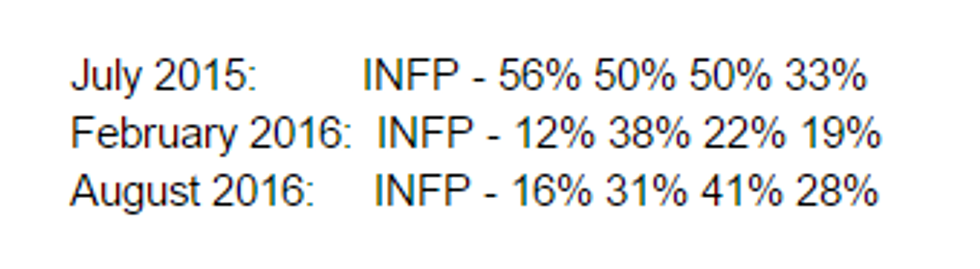
As you can see, the overall type did not change, although the percentages (how much I prefer one letter over another) fluctuated a great deal.
Let me briefly show you what the letters mean, as explained by the Human Metrics website.
The first criterion, Extraversion – Introversion, signifies the source and direction of a person’s energy expression. An extravert’s source and direction of energy expression is mainly in the external world, while an introvert has a source of energy mainly in their own internal world.
The second criterion, Sensing – Intuition, represents the method by which someone perceives information. Sensing means that a person mainly believes information he or she receives directly from the external world. Intuition means that a person believes mainly information he or she receives from the internal or imaginative world.
The third criterion, Thinking – Feeling, represents how a person processes information. Thinking means that a person makes a decision mainly through logic. Feeling means that, as a rule, he or she makes a decision based on emotion, i.e. based on what they feel they should do.
The fourth criterion, Judging – Perceiving, reflects how a person implements the information he or she has processed. Judging means that a person organizes all of his life events and, as a rule, sticks to his plans. Perceiving means that he or she is inclined to improvise and explore alternative options.
Before I started attending Biola, I was very introverted and introspective. After my first semester, there was a drastic drop in the percentage of all four of my letters, which I attribute to the independence and responsibilities of beginning college. Once second semester ended, my percentages had begun to stabilize once again. I find it fascinating that I can observe how my personality continues to adapt as the months go by, and how I can try to determine why it is doing so.
There are four general categories in the Myers-Briggs scale, each with four more personalized sub-categories, which you can see below.

While people are far too nuanced and intricate to be simplified down to sixteen different personalities, I have found that the system is reasonably accurate, at least for myself and the friends who I've talked to about it.
My goal is to make this a two-part series about personality, so next week I will explore the idea about temperament in much more depth, including topics like type dynamics, the eight functions that are a result of the different relationships between the letters, and how we as human beings are ultimately more complex and valuable than a four-letter combination. Until then, I hope you are intrigued, just I was on that afternoon two years ago!

















