
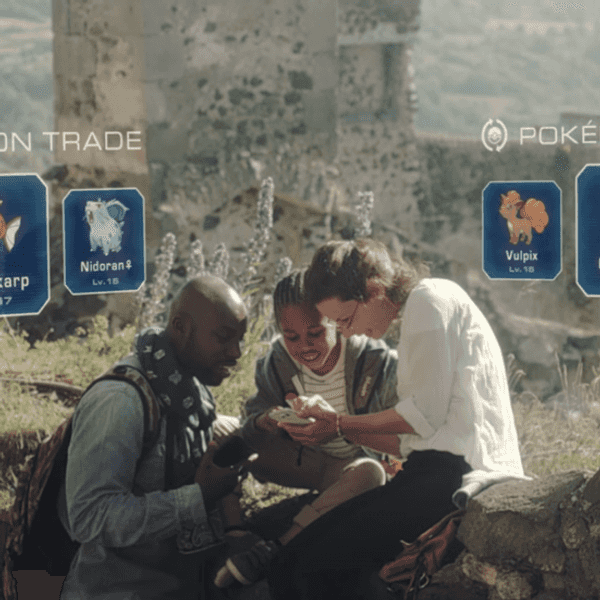


Nintendo has been playing around with the idea of augmented reality in games for a few years now, and finally seems to have found success in Pokemon Go.
In 2011, with the release of the Nintendo 3DS, they included a series of augmented reality mini-games, which made use of the device's rear-facing 3D camera. The device came with six paper cards that the 3D camera could scan, and overlay real-time graphics upon the live camera footage. Although this was a neat little toy, the mini-games included on the device were hardly fun to play.
Here is a video demo of the included Archery game, courtesy of LooneyTek on YouTube:
That's essentially what these mini-games were: demos. Today, we have Pokemon Go, which by default, utilizes your smartphone's rear-facing camera in a similar way when you throw Poke Balls at Pokemon to catch them (without the need for paper cards).
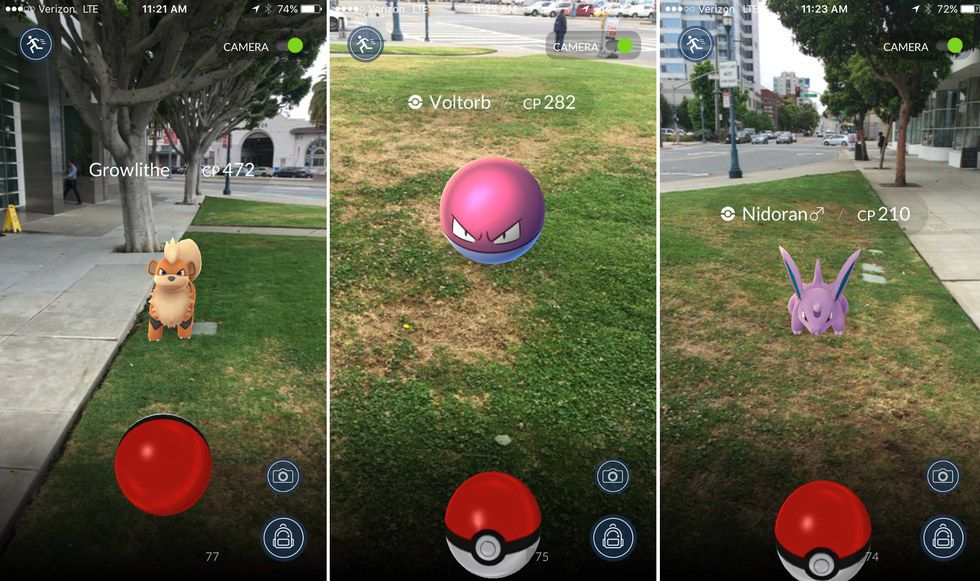
Image Credit: Nick Statt/The Verge
This feature can optionally be turned off, though, and it seems like that's exactly what a lot of users are doing in hopes of conserving precious battery power. Although this feature is fun and unique, it is not the feature that made the game the huge success that it is today.
For, it's not only visual reality being augmented. In the back-end of the game, the part you can't see, location data is being augmented as well. The player's location data is sent to the Pokemon Go cloud, and the cloud sends the (globally synchronized) location data of Pokemon to the player.
But this massively multi-player game doesn't attempt to connect players together in real time, like other massively multi-player games do. Pokemon Go only relies on your GPS data. In fact, it doesn't even require you to play with other players. Currently, there is no in-game benefit to playing with others. So why are people playing together?
Perhaps it's because the game doesn't take place in a fictional galaxy, far, far away. It takes place on Earth. If players want to catch Pokemon with friends, they meet up on Earth, not Azeroth. And when players do meet up with friends (usually at Poke Stops,) they find other players and occasionally make new friends. This makes the game very real and, alongside the fact that Pokemon is a very popular franchise, makes the game very familiar.
People are playing the game together in the real world, which is what I believe to what has made the game so appealing to the masses. From what I've observed as a life-long gamer, the most successful games are multi-player games, and the more players playing simultaneously, the more successful the game. Pokemon Go is made on a platform that allows nearly everybody in the world with a smartphone to play simultaneously, and allows anybody to play together.
This is the first game of its kind (aside from its big brother, Ingress), and I truly cannot wait to see what is in store for the future of Pokemon Go and augmented reality games in general.














