
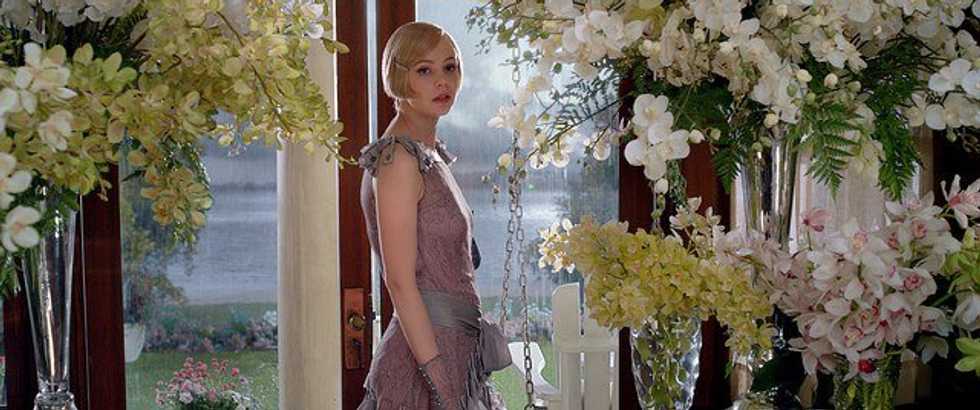
I would like to begin this article with a disclaimer stating that I am not one to endorse hateful thoughts or actions. However, as an English major, I have learned to justify loathing certain fictional characters, and let me tell you that in all of the literary realms, across genres, periods, and writers, there is no character I hate more deeply than Daisy Fay Buchanan in F. Scott Fitzgerald’s "The Great Gatsby."
That’s right. Sauron, President Snow, and The White Witch have a better chance of winning me over than this pathetic pseudo-flapper. Daisy Buchanan wears the fashion of female advancement but not the ideology. If I were ever so lucky to stumble upon Mrs. Buchanan at one of Gatsby’s parties, I would gladly rip the pearls off of her neck and shove them down her skinny little throat. But what really roars my '20s about Daisy is a particular quote of hers that has been contaminating Facebook feeds, Twitter timelines, and Tumblr posts everywhere: “I hope she’ll be a fool -- that’s the best thing a girl can be in this world, a beautiful little fool.”

So, Daisy, in a world on the verge of taking leaps toward gender equality, you think the pinnacle of female existence is ignorance? Despite its inclusion in various Tinder bios and the About Me section of social media profiles, this quote is not a testimony to female empowerment; it is glorifying passivity over autonomy. Fitz would roll over in his grave if he knew young women were viewing Daisy Buchanan as a visionary instead of a conformist.
What is most disturbing about Daisy is that she is quite possibly the most hyper-aware character in the entire novel. She knows that Tom’s an unfaithful bastard, Gatsby’s obsessed with her, and that the rest of the world will bend to her every will. Her popularity gives her the potential to be just as influential as she is intelligent. Still, Daisy represents herself as the “beautiful little fool” she wishes to be to all characters except Nick—the one character that couldn’t possibly trample on her plastic reality.
Even during the novel’s most intense scene, when Daisy’s affair surfaces, and Gatsby and Tom are fighting for her affections, Daisy sits quietly while two opposing voices speak for her; two men are telling each other what Daisy thinks, all while Daisy keeps her thoughts to herself. She’s silently manipulative, which not only makes her a willfully dependent gold-digger, but literature’s queen of passive cowards. Daisy Buchanan is no beautiful little fool. She simply wears the label to disguise her rotten core.
So please, for the love of all things holy, stop quoting Daisy Buchanan. If you honestly believe that she was an early progressive speaking actively against society and not a spineless woman conforming to oppressive ideals for the sake of luxury and comfort, then you’re just as disillusioned as Mr. Jay Gatsby.