
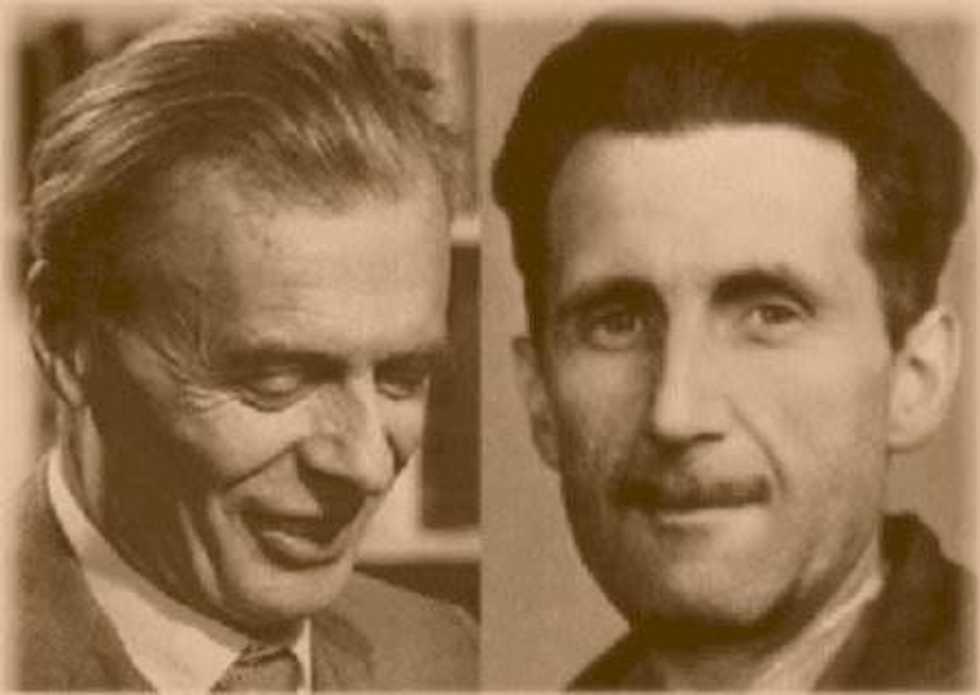
Aldous Huxley, author of Brave New World, wrote to George Orwell, author of 1984, in a paper titled My Hellish Vision of the Future is Better Than Yours: "Within the next generation I believe that the world’s rulers will discover that infant conditioning and narco-hypnosis are more efficient, as instruments of government, than clubs and prisons, and that the lust for power can be just as completely satisfied by suggesting people into loving their servitude as by flogging and kicking them into obedience. In other words, I feel that the nightmare of 1984 is destined to modulate into the nightmare of a world having more resemblance to that which I imagined in Brave New World. The change will be brought about as a result of a felt need for increased efficiency. Meanwhile, of course, there may be a large scale biological and atomic war — in which case we shall have nightmares of other and scarcely imaginable kinds." The significance of this interaction is that Orwell had sent a copy of his novel to Huxley, who might I add was known for his linguistic flair and briefly taught Orwell French for a time, to gain an experienced opinion.
Orwell’s 1984, on the one hand, is written as a future dominated by a repressive surveillance and a security state that uses crude and violent forms of control. It is characterized by control through surveillance, fear, and forced compliance. The overall theme of the novel is controlling the fulfillment of our needs. Huxley’s Brave New World, on the other hand, is written in a setting within a future where we are entranced by entertainment, captivated by technology, and seduced to embrace our own oppression. It is characterized by control through perceptions, images, and desires. The overall theme of the novel is controlling the fulfillment of our wants.
Differentiations between the two are important in distinguishing the kind of dystopia created – one of appeasement and one of totalitarian control. In Huxley’s response to Orwell’s dystopian novel, he states that his is more validated. I would have to agree with him. Our current society is interested in being entertained with our consumerism, individualism, and instant-gratification culture. This sounds more like the foundation of the Brave New World society than the possibility of the 1984 society. The people of our western society are concerned with fighting any indication of an overly oppressive government or of government officials breaking the very laws they enact and vow to uphold. We have an inclination towards technology and scientific discovery that systemize our world to be more efficient and convenient. Because of this fact, the totalitarian system Orwell proposes is outdated, less plausible, and difficult to imagine as a response to, or result of, our current time.
Dystopia is only as relevant and impactful so far as it applies to problems related to our current society or encourages us to think deeply of the implications of it – to provide a warning of what our future could look like if one theme or trend of our culture is stretched to its limit or expanded to envelop our society as a whole. By stating that his dystopia is better than Orwell’s, Huxley claims that his own has more of an impact and is more applicable to the future. And as such, it is frightening to see that this letter, written in 1949 to advocate Brave New World, does in fact seem to be the more reasonable future beyond this year of 2015. Even reaching back 66 years ago, Huxley’s accuracy is astounding and creepily foreboding.