

Literature's influence on our culture has unarguably diminished in recent memory. The novel is not nearly as referenced as film, — a medium that has, for better or worse, replaced the novel in the mainstream — but literature still has a few moments of apricity in the dark storm cloud holding acid rain that is American culture. Book-to-film adaptations have exposed book, again, for better or worse. A current trend, in a world devoid of tangibility, is the comeback of several vintage pastimes like record players, typewriters, and, yes, books. And a specific trend I've found, something that has just come up recently, is the augmented referencing of a novel that I think is a must-read for all Americans: "The Great Gatsby."
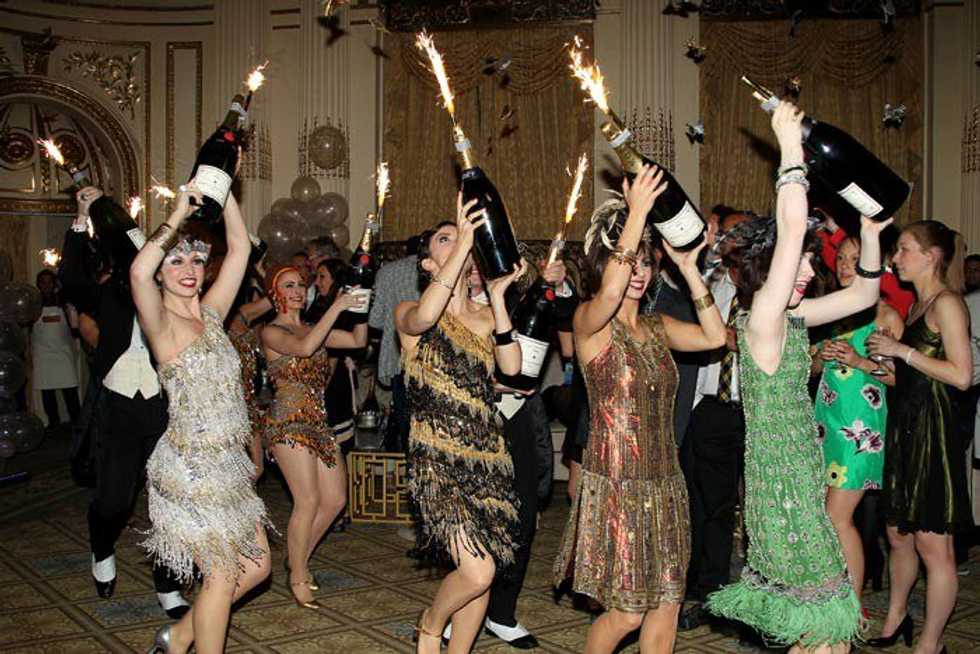
However, F. Scott Fitzgerald's magnum opus isn't in reference of the myth-busting of the ubiquitous fallacy of the American Dream, especially if you consider Donald Trump — the Meyer Wolfsheim-esque caricature that he is— is the leading Republican candidate. What I do see is the growing popularity of the 20s, prohibition-era, bombastic, Gastby-themed party, in reference to the parties Jay threw. These can go by the names of the awkwardly titled "Gatsby Party" and the more alliterate and more popular "Gastby Gala."
These themed parties are difficult to achieve due to its outdated trademarks, and if it is pulled, off, in the paraphrased words of Ron Burgundy, I wouldn't be mad, I'd actually be impressed. Here's why, via a list of about everything you need for a "Gatsby Gala."
1. A live band playing music from the 1920s.
2. A gross amount of sociable, enthusiastic partiers in a decadent area.
3. Men with tweed suits and hats and women with gold sequin dresses.
4. A lot of alcohol (this is the prohibition, isn't it?), especially champagne.
5. Streamers
I probably shouldn't have ended this list with streamers, but "forgive and forget," right? Anyway, more often than not, though, this is what is what a "Gatsby Gala" is more likely than not to behold:
1. A Spotify playlist playing Trap Rap and EDM.
2. A decent crowd of eclectic energy and enthusiasm at a cramped suburban basement with a carpeted floor.
3. Girls wearing tighter-than-skin dresses and guys wearing two-pieces with bow ties. Don't worry, though! Mardi-gras beads courtesy of Party City will be handed out!
4. A full 2-liter bottle of Sprite and empty 2-liter bottle of Coke along with your parents alcohol.
5. Streamers! We got one!
And you thought I put streamers at the bottom for no reason. Again, I would be impressed if the former options were pulled off, and I could actually kind of dig these things. I probably share the opinion with many millennials in that I don't enjoy the dark, disgusting, strobe light, modern club-derivative parties with sophomoric music and sophomoric conversations that seniors throw now in 2016, and I would enjoy, in a world that's going a million miles a minute, to experience the simpler past, but I'm actually turned away from these Gatsby parties even more than traditional millennial parties due to the biggest influence that led me away from them: "The Great Gatsby."
The partying is an important part of the novel, one of the many symbols in it. And that's where I think people go wrong: the parties are supposed to be a symbol. Jay threw these parties not to have fun; he wasn't even a part of these parties. He threw these parties to be with his star-crossed love, Daisy. But, as we know, Daisy didn't like these parties; she went once and was not impressed. In fact, she does not care about material things. She will cry at the tragedy of a beautiful shirt. She will rip off a necklace of pearls because she can't imagine the thought of marrying someone other than Jay because the material doesn't matter in the end.
And throughout the book, there are other hints of the danger of the materialist, desensitized lifestyle, like the in Chapter 2, my personal favorite, when Nick Carraway was tired of the trivial conversations of dogs and dresses. I twas during this book that I realized that parties — the adrenaline-filled, no-reason-to-party-but-to-party parties — exist not to have unadulterated funny but subliminally to avoid you personal demons and indulge in socially consensual narcissism.
Just think of those kinds of parties, nothing has really happened to spur these parties, and nothing really happens during them (maybe that's why they need themes). No one really gets to know each other better except for the occasional hook-up, and people are obsessed with themselves that whole time. It's about getting drunk, having a good time for yourself, finding someone to pleasure you, and everyone is doing this alone in a big room, all with the common goal and a common understanding, but doing it alone, the festivial equivalent to taking a cramped bus across campus.
And out of this comes the "Gatsby Party" not out of disgust for the traditional party system but instead, as proven by the minimal effort, as just another theme, no different from Hawaiian Night and the classic America theme. So why has the "Gatsby Party" become so culturally prevalent as of recently? To do that, we'd have to look further than the 2013 Baz Luhrmann film adaptation of "The Great Gatsby."
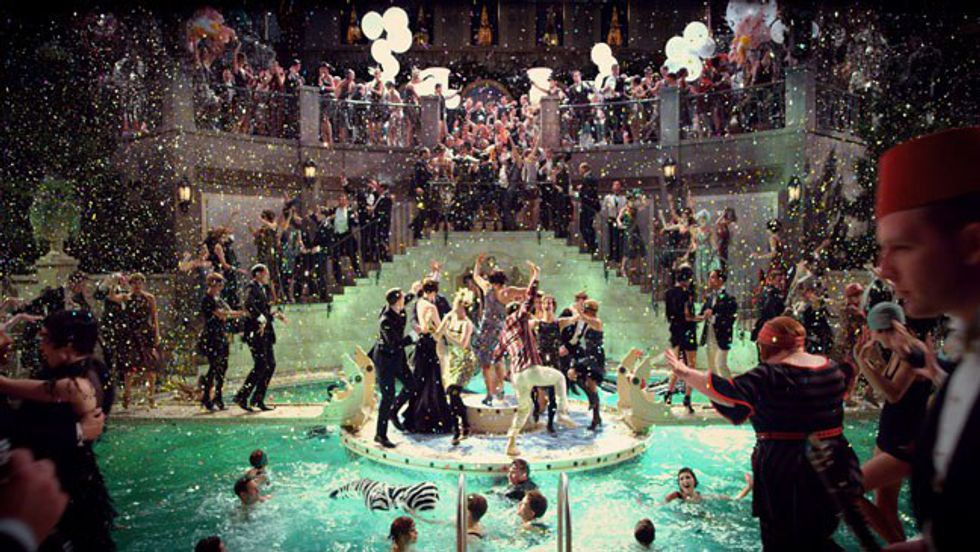
This film was a big success at the box office for a film without capes, earning a whopping $144 million at the box office, according to IMDb.com. Despite this success, however, critics weren't particularly favorable with the film, with Rotten Tomatoes giving it a 48 percent rating, though critics seem to become more and more irrelevant when it comes to the box office (am I right, "Batman v. Superman?") And most of the unfavorable reviews have to do with Lurhmann's insistence on keeping the visual spectacle as the centerpiece, a fun time, while all symbolism is thrown to the back and done as if it were a requirement like items on a to-do list. To be more adequately and professionally put, critic Mara Reinstein says "Just because a film looks like it was dipped in 18-karat gold doesn't mean it's rich in quality."
But going back to the partying, the film really does treat it as a genuine spectacle, with no true sense of showing the consequences to this spectacle like recent films like "The Wolf of Wall Street" and, to a greater extent, "The Big Short" has. And, tragically, many millennials have skipped the novel in favor of the film and have been seduced by this spectacle. The combination of this altered interpretation of jazzy partying along with the gained popularity of the story has resulted in the rise of the unironic "Gatsby party."
This isn't the first time a novel has been misinterpreted, too. J.D. Salinger famously denounced the "Catcher in the Rye cults", real-life disciples of Holden Caufield, because this book, among other things, is a warning. Yes, most of it does revolve around the criticism of "phonies," but Salinger believes that an unregulated behavior like this can send people to dark places, like it sent Holden. Salinger intervenes late in the novel as Mr. Antolini, Holden's old teacher, who warns that continued behavior like this can only lead him to depression. Despite this, millions have strived to be like Holden.
Also, "Fight Club," a satire of counterculture, has had its own counterculture following, sprouting up in the 21st century with actual fight clubs around the nation as well as the hacking team "Anonymous", a carbon copy of the uprising team in the latter half of the novel "Project Mayhem." Granted, I did enjoy the book's note on our biological urbanization, but I'd like to take the opinion, and I think author Chuck Palahniuk would, too, that I fear a world in which people saunter around mumbling the words "his name was Robert Paulson."
But for novels, it does seem inevitable that they will be misinterpreted, sometimes just a personal mistake, but sometimes on a grand, cultural scale. And all we can do is embrace it all because it's the work that is responded to with the most falsity that actually has the most truth.
















