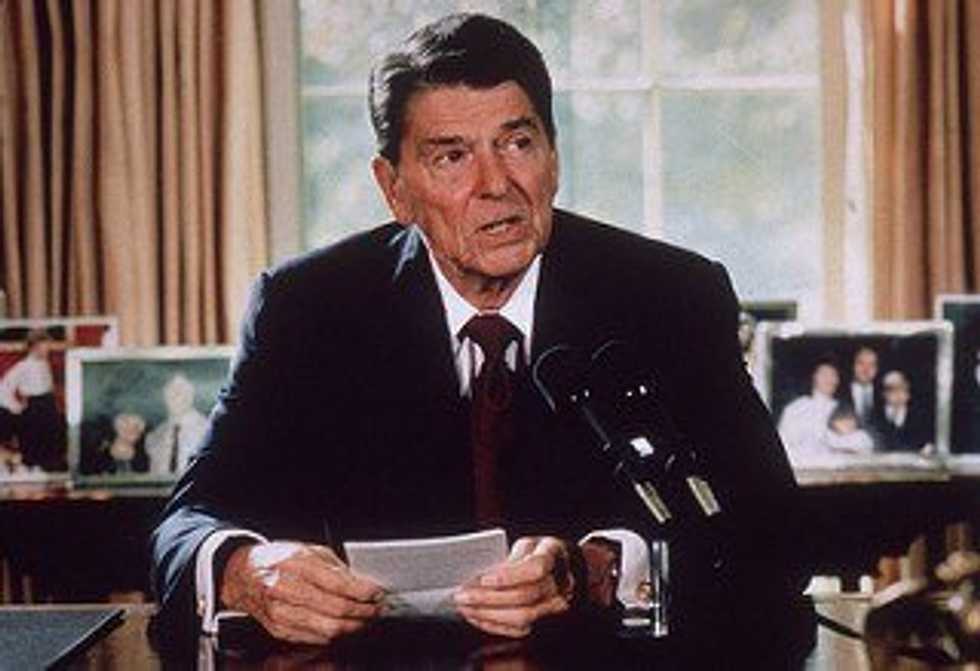
Many conservatives and Republicans have and continue to champion The Ronald Reagan administration for the being the model of a perfect, conservative presidency. They paint a picture that shows Ronald Reagan as a beacon of hope for prosperity and success within the Republican party, as evidenced by the ever-present "Reagan Bush '84." However, the reality of his administration is much darker in certain aspects as he made many controversial decisions that continue to have a negative impact on American citizens today. The following are examples of those controversial decisions that had the greatest impact on America today.
The Environment
Although, the Reagan administration didn't cause the blatant disregard of environmental protection, the level of this protection would have been much lower during the administration had it not been for public consensus and legislative action, which controlled Reagan's ability to make drastic decisions about the environment. However, he took every opportunity he could to benefit the private manufacturers and industrialists. For example, he appointed James Watt and Anne Gorsuch, both strict industrialists, as the leaders of the Department of Interior and the Environmental Protection Agency (EPA). Furthermore, Reagan didn't see acid rain and many other environmental issues associated with manufacturing and coal burning as serious issues, which is part of the reason that we see Global Warming as such an important issue in modern-day America. Also, the administration was able to roll back on some of its environmental policies and funds for environmental agencies, such as the EPA, even though a vast majority of the elected Congress was pro-environmental protection.
This poses one question: If Reagan and many conservatives were against "big government", then how could Reagan justify his blatant disregard of the common people's desires, as expressed through the legislative body's views on the environment? Is he not hypocritically using his power in the government to impose his views on industry and the environment onto the country?
War on Drugs
One of Ronald Reagan's best known policies was his "War on Drugs", which became especially popular since the former first lady, Nancy Reagan chose it as the policy area that she tried to focus her media attention on. In theory, the "War on Drugs" is a good idea to reduce the amount of harmful drugs that are present in the country, but like many other theoretical solutions to problems, this was just too good to be true.
The reality of the war on drugs was seemingly worse. Although not directly Reagan's fault, from just before Reagan took office to 1997, the amount of people incarcerated for nonviolent drug charges increased by around three-hundred and fifty thousand, which has resulted in the use of $1 trillion to fund this war while defunding other important programs. Furthermore, the policy, although unintended to be done in such a way, create a racial disparity within the country. Many of the task forces designated by this war targeted urban, underdeveloped and impoverished areas, that largely consisted of Latinos and African-Americans. In fact, white and black people use drugs at roughly the same rate, yet African-Americans are imprisoned at a rate that is just over thirteen times greater than that of white Americans. This has caused adverse effects on many communities around the country as hundreds of thousands of people have been imprisoned as a result of this policy, which has not only been costly but ineffective as well.
Foreign Policy
In terms of foreign policy, Reagan made several questionable decisions as he attempted to deal with Cold War politics. He was well known as being an aggressive opponent to the Soviet Union and he didn't practice many of the "detente" policies of arms reduction, that many previous presidents had, in order to reduce the risk of nuclear war, at the beginning of his term. Furthermore, Reagan largely increased the defense budget from before his first term to around $457 billion. These policies were seen as far too aggressive by the Soviet Union and they helped to prolong the Cold War, which eventually ended after Reagan left office.
On top of this Reagan circumnavigated the legislation, which opposed the sanction of funds to support the Nicaraguan Contra's against the communists in the country, by selling weapons to Iran even though it was illegal due to a trade embargo. Although Reagan denied wrongdoing, it seemed clear that the National Security Adviser made the decision to siphon funds from the arms trade to funding the Contras with Reagan's approval.
Ultimately the legacy of the Reagan administration will perpetually be in conflict between Republicans and Democrats, with conservatives claiming he was one of the greatest presidents and while liberals think the opposite, but there will never be a definitive resolution to the argument.