
After several days at sea, the ship docked in Southampton. When the gangplank was in place and the gangway door was opened, a British officer marched on board and gave us a briefing on what was happening in the war and what our itinerary entailed. The following six months were to be spent training to fly, and once we passed a test after that time, we were supposedly ready to fight the enemy. After the officer left, we were driven to an airbase somewhere not far from Southampton in southern England where we began our long and tedious training.
After almost a month of flight training, we were allowed to make our first flight. Mine was one of the better ones. I took the airplane up, flew around a while and touched back down. It was a simple routine, but it proved quite a challenge for some. In fact, the very first man to go up - Malcolm Peterson was his name - took off without a problem, but on his approach, not only did he come in too fast, he also engaged his landing gear too late and ended up snapping off both of the forward gears when he touched down. After that aircraft was moved off the runway, the rest of us got our chance to fly around. Soon after, we were granted permission to go up in an aircraft with live ammunition. With 2,150 caliber rounds, we were instructed to strafe “dumb” ground targets; this was probably one of my favorite parts in the entirety of my training.
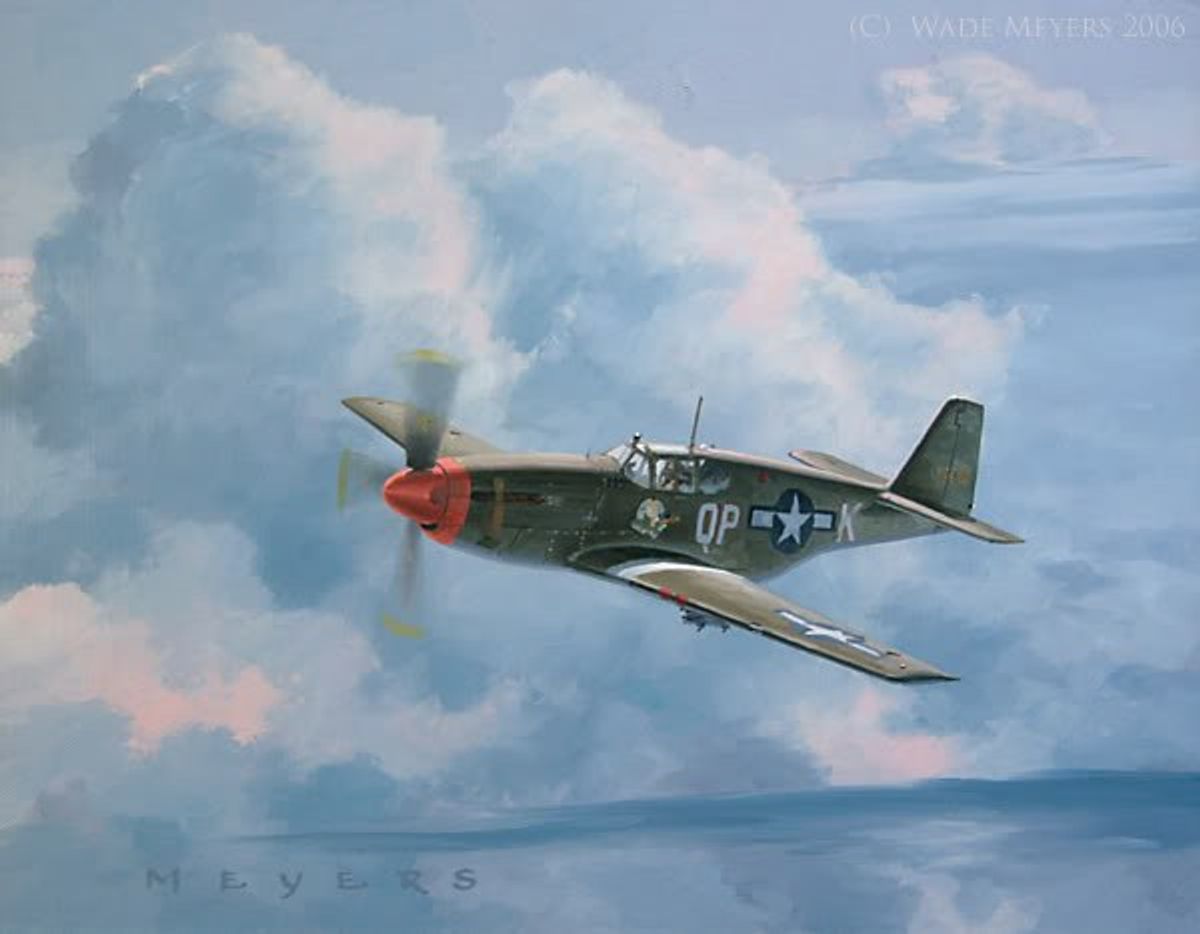
One night, before we were officially graduated as Army pilots, a large detachment of 15 German Messerschmitt BF-110 fighter-bombers began a night raid on our small airbase in southern England. The loud air raid siren woke most of us up and many ran out to see what was happening; my barrack was the first out to see. That was the biggest mistake we ever made while stationed in England. When we ran out, the full moon allowed the pilots above to see perfect soft targets below; they banked over and began their run. I stopped at the threshold and watched the whole event unfold. The planes above flew down at over 200 miles per hour and began firing everything they had at the men running around outside. Golf ball-sized holes were being pounded into the ground from the 20 millimeter cannons, and 7.92 millimeter machine gun bullets were zipping around everywhere. I jumped back into the barrack and watched as over half of the new recruits were wounded or killed in just one pass of the enemy. Once the guns stopped, I ran to the door again and quickly scanned the airbase. I immediately saw several P-51 Mustangs parked only about 500 feet from where I was standing; I made a break for it.
When they finished their second pass (this one being specifically a bombing run), I was already in the cockpit and closing the canopy. As I put the flight helmet on and strapped the face mask over my mouth and nose, I saw the bombers fly off and start to turn again. (In my opinion, this was a rather foolish move. Their payload was dropped; they should have headed home. Apparently, they wanted the satisfaction of shooting the personnel not killed or injured in their first two runs.) Once my mask and helmet were fastened, paused for a brief second and smiled as I realized how entertaining it would have been to a German pilot, should one have seen me, to see a Mustang pilot in nothing but his nightwear as he fought them off. Returning to reality, I disengaged the kill and safety switches and started the engine. The 12-cylinder, Allison V-1710, liquid-cooled engine barked to life and I taxied the four-ton behemoth out to the runway.

















