Better known by the nickname “Weegee,” Arthur Fellig learned basic camera skills by taking small photography jobs around New York City. However, in 1935, he decided to pursue freelance photography—police radio style. As his own boss, “[he] didn't wait 'til somebody gave [him] a job or something, [he] went and created a job for [himself].” Though never formally trained, Fellig captured intense images reflecting 1930s and 1940s New York City. He frequented local bars late at night, and listened to a police radio. When a call caught his interest, Fellig bolted to the crime scene, and often arrived before police officers. After a few shots, he then developed photographs in the back of his car with a self-made darkroom. He “picked a story that meant something,” and sold black and white images of murder, gore, crime, and poverty to the Herald-Tribune, Daily News, Post, and other newspapers of the time.
Fellig never relied on being at the right place at the right time. Rather, he stayed one step ahead of time, strategically scouting out opportunity, and promptly arriving at the scene of the crime. His fast acting intuition beat out the hesitation of his competitors, and his steaming off the press photographs sold well. He became a self-starter by transitioning to a freelance photographer, and jumpstarted his own career. Later, Fellig developed an entirely new style—another indication of his ability and willingness to keep up with the times. Using 16-millimeter films and photographs, he distorted images of popular figures of the time (including Marilyn Monroe). Once again, he stayed up to date with the world around him, but this time by utilizing the latest technological advances in photography.
Though relevancy remains an important aspect to his success, the emotion highlighted in his photographs primarily draws my attention to his images. Fellig recognized the psychology behind the human brain. An individual may initially turn away from the emotionally intense photographs, but return to the image for the same reason they left. Though no one desires to experience the harsh reality Fellig’s work reveals, the eyes are drawn by an emotional connection. Once emotionally attached to the photograph, curiosity kills the fear of reading a story with a sad ending.
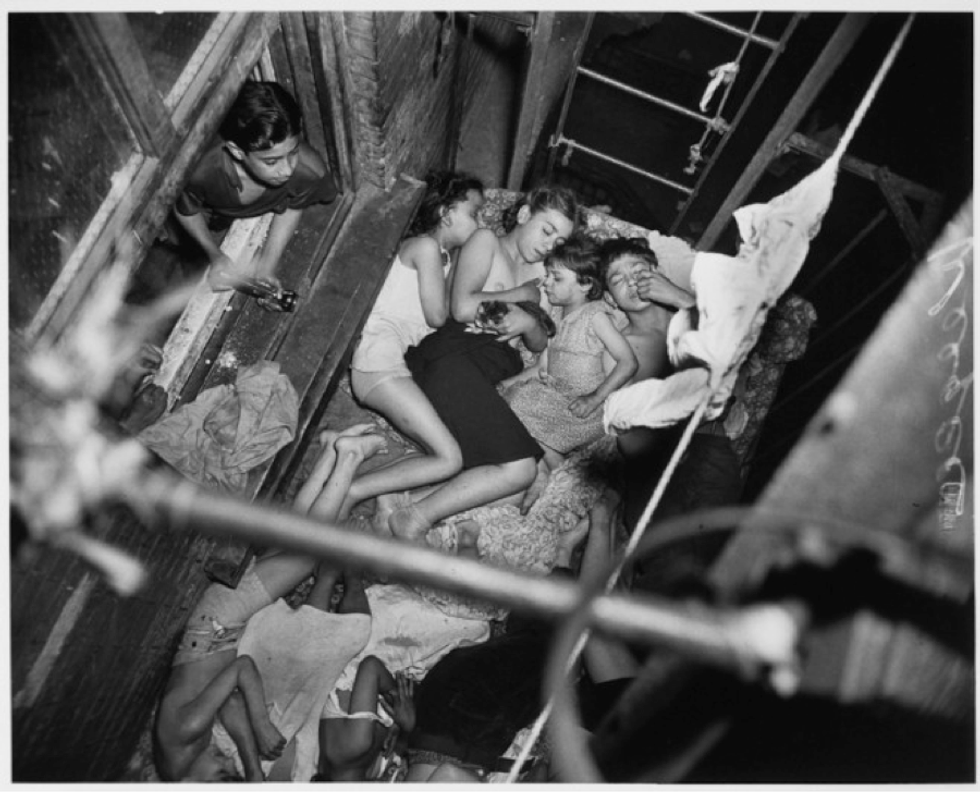
The picture featured with the headline features eight individuals packed into a twin size bed. A blurred rod frames one side of the bed, further emphasizing the tight space available for a large family. The angle of the camera points down toward the scene, giving the viewer a small peek of poverty. The poor feel trapped, weighed down, and exhausted, and the photograph’s elements literally visualize these concepts. A boy from the window looks in from the outside where he remains free from the pressure of poverty. The faces of those asleep on the bed illustrate the family’s only escape. Sleep is the only way to avoid living without dying.
Newspapers considered Fellig’s photographs valuable to maintaining and increasing readership. But the fine art community’s appreciation and support of his work proves its value runs deeper than a profit. The dark images reveal the artistic beauty of capturing raw emotions through a photograph.