
When I was younger, I was never really a kid that found an intense passion in anything around me. Sure, I played sports and tried to play different musical instruments, but nothing really popped out as something that I would want to constantly be doing. I was always jealous of people who had their passions come easily to them. This especially became a problem during my college application process when, every weekend, my father would ask me what I want to do with the rest of my life, and I just drew a blank. Even now, while I am still in college, I am not sure what I want to do with a career. However, I may not have found a career per se, but I have found a new love and passion: Philosophy.
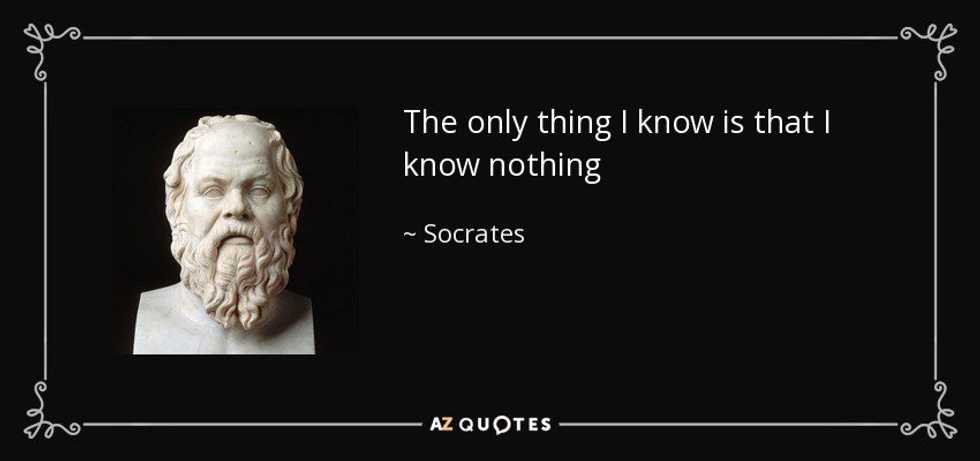
Philosophy can be a very intimidating subject to those who don’t have that much experience in it: Very dense reads and concepts that you sometimes can’t even understand in any way. Also, as my Intro To Philosophy teacher has said in class, philosophy is not about self-help. It is the process of questioning the unproblematic things and beliefs directly in front of us. There are going to be struggles and frustrations along the intellectual journey, and, almost all of the time, you will have more questions than answers. The more and more I study philosophy and its great thinkers in the past, one truth remains constant. It is that I only know one thing for certain, and it is that I know nothing. This can be quite strange and negative to many people, but it has only helped me in my discovery of what truth really is.
I find it quite interesting that, of all things for me to be interested in, philosophy and understanding is what stands out the most. I was never really exposed to the subject that much until my comparative religions class my senior year of high school. My teacher was a man of great knowledge and someone who I highly respect. Not only did he teach us about the different religions that have developed throughout the world’s history, but he also taught the class in a philosophical sense as well, something all of the other comparative religions teachers didn’t do. He taught us about different world views, Existentialism, Nihilism and Absurdism and philosophical problems such as the problem of evil, progress traps and metaphysical concepts. Throughout the class, which was very much based on open discussion, there were many times where I would become greatly frustrated and showed this distress openly. After all, if you’re taught something your entire life and then view them from a different perspective, things don’t always make sense. The world isn’t as black and white as people try to make it.
As much as I love philosophy and understanding things as they really are, it still can have its drawbacks to it. There have been many times in the past when I would read philosophy or be taught a new view on the world, and I would internalize it and become that idea. And, given that philosophy is, at many times, a dark, depressing subject (and given that I suffer from depression myself), it can easily spiral out of control. There have been times where I would become so fixated on these specific views of the world and think that there is nothing more, nothing to hope for and nothing to go for, and that everything is meaningless. Needless to say, these thoughts breed depressing moods and anxiety attacks as well, which can be very detrimental to one’s health. However, I was looking at philosophy in the wrong way. Sure, there can be many depressing ideas in the subject, but it shows the true variety in how people can view the world and reality around us, and that is quite a beautiful thing.
It is very important to find something that you are passionate about in your life. Find what you’re passionate about, what you believe in and something to work towards. It doesn’t matter what it is, because what matters is that that is important to you. Regardless of what anyone else says, go after that which you love, and you will not regret doing so.