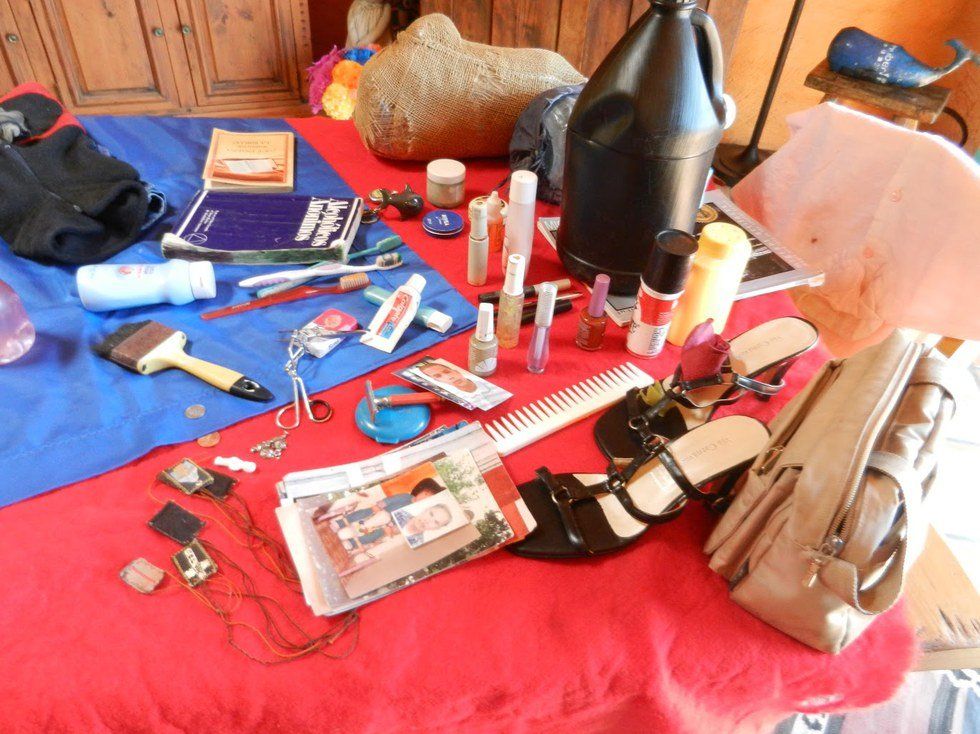
I am sitting in a humanitarian’s home right by the Arizona desert, around a table covered with artifacts that all look like personal belongings. Surrounding me are six other Santa Clara students and two chaperones, curious about the artifacts in front of us. We are spending our spring breaks on an immersion trip to Tucson, Arizona, to learn about border and immigration issues. And this is our first day of the trip—all of us have no idea what we are about to immerse ourselves into.
The humanitarian, our welcoming teacher and guide (whose name I do not wish to disclose), picks up the first artifact. It is a worn-out diary, filled with beautiful handwritten Spanish sentences. Our teacher found this diary left in the middle of the desert among a pile of clothes and backpacks. The diary, she says, most likely belonged to a young woman who was writing everyday to a significant other back in Mexico. The young woman wrote about her love for her significant other, and the fear she faced everyday while trying to cross the border. “It’s for our future,” the young woman wrote repeatedly.
I instantly realized where all of these artifacts came from. These are all beloved, most-treasured items belonging to people that attempted to cross the deadly desert that was the Mexico-America border. Furthermore, all of these belongings were stranded and found in the desert. Only the immigrants themselves know why they had to leave their most beloved items. And we can only imagine what happened to these desperate immigrants as they suffered through the severe temperatures of the desert and the dangers of trusting a coyote, the infamous people smugglers.
The next artifact is a small purse that our teacher found within five miles of the Mexico-Arizona border. She opens the purse and explains to us the significance of each belonging, painting an image of the woman that this purse most likely belonged to. Our teacher holds up a few items from the purse: an eyelash curler, a small mirror, a comb, lipstick, and a small tube of mascara. “Why do you think this lady, attempting to cross the border by foot through a gruesome desert, would bring such articles?” our teacher asks. We all shrug. Our teacher grabs another belonging from the purse: a pair of nice black shoes. “Any extra weight on this journey can determine a life or death situation. Why would she pack these shoes?” she asks again. Looking at our shocked and confused faces, she explains. “This woman was hoping to start over. She was ready to look presentable to the American people and seek employment. She was ready to work and become a part of society.” Our teacher passes around the small purse, and I find a few photographs, folded neatly at the bottom. They are pictures of a little boy, an elderly man, and an elderly woman, most likely the woman's son and her parents. Our teacher looks at my peers and I as we sit there, practically dumbfounded by the stories told by the artifacts. “Can you feel the hope filled in that little purse? In this little tube of mascara alone?” our teacher softly says.
The third artifact is a child’s backpack. The Bob the Builder print suggests that it belonged to a young boy, and judging from the extra pair of pants left in the backpack, he was around six years old. Our teacher pulls out an empty plastic water bottle, a plastic bag with three crackers left, and a pair of socks. She found the stranded backpack in the desert about 10 minutes away from her house. This boy was 10 minutes away from making it to civilization: kind civilization. “This little boy carried only the bare belongings—he couldn’t even take a toy. His childhood was robbed from him. Can you imagine?” our teacher says.
We will never know the real stories of the people these artifacts belonged to. We will never know the fates of the people these artifacts belonged to. But the emotions filled in these artifacts were real. And I know first-hand that the emotions I felt holding these artifacts were powerful and real.
This experience was before we learned more about the economic and political elements of the immigration problem, so I questioned why these people risked their lives to cross in the first place. I questioned what really happened to the people that didn’t make it, and what, other than environmental elements, hindered their journey. After my week long immersion, I learned that the immigration problem we face today is more complex than I had ever imagined and has quite the history—it’s so complex that it will take me several articles to fully lay out the critical elements of the border issue. But I dedicate this one to argue that we need to see and understand the immigration issue as a human rights issue. Why are humans needing to cross a deadly desert in the first place, and why is nothing being done to prevent all of the recorded deaths?
We toss around the term “illegal immigrant” or “illegal alien” so loosely. But take a moment and realize that no human is illegal. The United States is the only country where unofficial entry is a crime, and the extent the U.S goes to criminalize migrants is astonishing. Next time you use or hear someone else use the term “illegal” to describe a migrant worker, think to yourself this: What gives you the right to call another human being that happened to be born on the other side of a fuzzy line an “illegal” life?