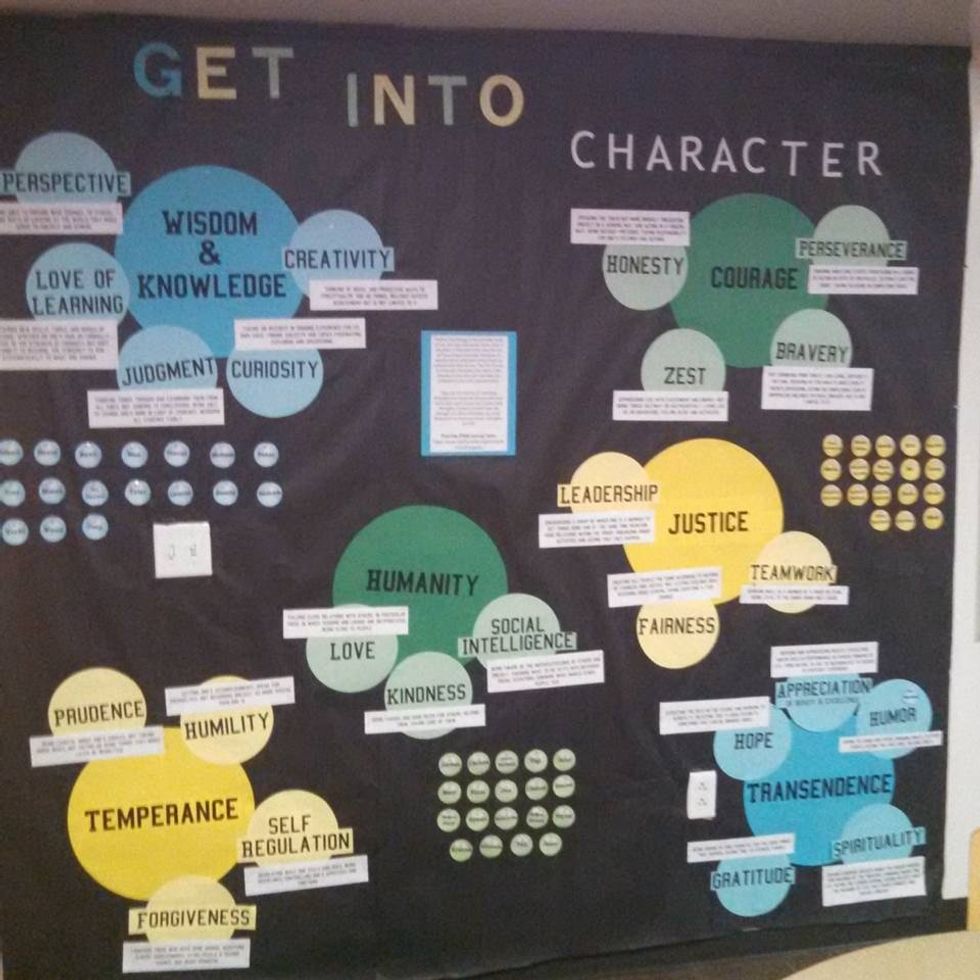
Paper bubble after paper bubble, me and my friends Emily and Christian tacked my residents’ names on the bulletin board. I was only a few weeks into my sophomore year of college and my first year as a Student Advisor (SA), a live-in peer guide for about 50 residents in my dorm. Every SA has to change their floor's bulletin board regularly, just to keep things exciting. As my friends and I put up the names, we placed colorful bubbles labeled with strengths across the board. The idea was that every resident would take an online personality test to find out their top strength, then move their name to their result.
I love diversity. My exposure as an SA to such a wide range of people has only made me love it more. Our unique interests, quirks, strengths and weaknesses are the seasoning of life. Through comparison, through our similarities and differences, we can use diversity to appreciate how we contribute to the blend of flavors in the world. I love personality tests because they provide a framework for self-expression, a language for discussing and celebrating diversity. In my role as an SA, I have seen firsthand what a valuable tool typology can be for empathy and personal growth.
One of my supervisors last year had a wonderful, infectious energy about her. She loved life, she loved people and she loved the Myers-Briggs types. With large eyes and a wide smile, she would gush to me about the power of typology for growth and understanding. Because both of us were INFPs, we talked regularly about our similar experiences.
We talked about our shared introversion, reminded each other how important it was to carve out time for ourselves. We vented about typical INFP disorganization issues, collaborated on specific strategies to organize our lives. We reveled in the benefits of being a "feeling" type, in our natural empathy that could be strengthened through Residence Life work. With the framework of our shared type, we found a language to communicate our struggles; we found connection through our similar way of looking at the world.
I recruited another SA and soon we were forcing all our coworkers to take the test. Although some of them fluctuated between types, the more people who took the test and shared their results, the more I understood the unique way we fit together as a team. People could say, “I fall somewhere between P and J,” and without much elaboration, I understood them more as individuals. I learned what could irritate them that wouldn’t frustrate me, what little disorganized, scattered things I did that might damage relationships. I started to appreciate my coworkers’ specific strengths, and to value the contributions every one of us made as SAs and as people.
I don’t think typology is perfect; people don’t always fit into every test’s confines. But I do think that typology can start a conversation, a journey of growth that fosters understanding. More importantly, though, personality testing could prove a powerful tool for crossing the ideological, philosophical lines that sharply divide our world.
When my friends and I tacked up the final paper bubble to my floor’s new bulletin board, we took a step back to look over our finished product. The colorful bubbles labeled with my residents’ names popped from their black background. Over the next few weeks, the names would spread from neat rows to every corner of the board. More than once I walked into my floor’s lounge to find someone staring up at the board, just taking in the diversity of our community. Despite their differences, and because of their differences, they could see what wonderful ways they contributed to that floor. Despite our differences and because of them, what wonderful ways we contribute to this world.