


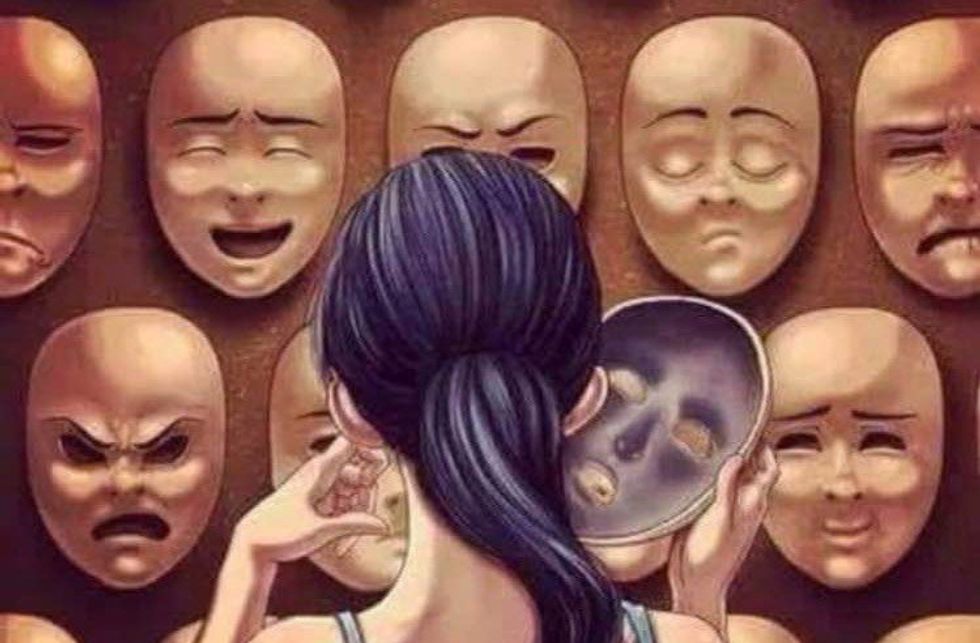
Before we begin, let us clear the air. I am not a psychologist nor a psychology major, but merely a critically thinking individual who is interested in theory, especially social ones, but in the art of full disclosure: I've taken PSYCH 101 and 201 with a bushy-browed professor who lacks a verbal filter. I'm pretty well versed. I know the basics.
What you see is what you get, right? Eh, not so much.
Perception is defined as our recognition and interpretation of sensory information and stimuli, and how we respond to the information we perceive. We can think of perception as a process where we take in sensory information from our environment and use that information to interact with our surroundings. Perception allows us to take this sensory information, for example, a visual, and make it into something meaningful.
Perception is instinctive to yourself as well as to others, and though there are other avenues to define and analyze perception, I am focusing on two ways: how you perceive yourself and how you hope others will.
Your self-perception is who you envision yourself being, and where on Robert Mccrae and Paul Costa's Big Five personality chart you may fall. When you ask yourself, 'who am I?' the answer may be clear-cut: You are an intelligent student, a dedicated athlete, rude sibling, trying child, patient parent, bad line dancer, flexible stripper, witty Cheesecake Factory waiter, whatever you self-identify as that is your self-perception. You see yourself as your personality, and to exhibit your unique self to the world, you demonstrate who you are through psychologist Albert Bandura's reciprocal determinism. You demonstrate who you are through this notion because different people chose to be in different environments, thus the one they've chosen directly correlates to their personality traits. In turn, these chosen environments continue to reinforce your semi self-constructed personality (because, in my opinion, we build off an initial, encultured base...but that is for another article).
So, when you see an individual who is engrossed in a murder mystery novel who looks generally anxious, we can conclude that person's personality type, anxious, is being influenced by the anxiety-inducing crime thriller that they're reading, hence the theory of reciprocal determinism: their environment that they've chosen is further influencing the ones they'll seek and reinforcing the personality traits they are exhibiting.
Once more, perception is based on outside stimuli being presented as information, which your brain interprets. Though we may have narrowed down our specific personality and true self, what we present to the world may be a reflection, but not a sure example of our true form, if you will.
Okay, so let's further analyze this concept. Can you change your personality? I don't think there is a concrete answer to this question, but you can publicly display a different personality from your own.
Many people are insecure about themselves and in the inevitable mainstream social acceptance journey we all eventually face; they will conform to social norms and society's view of the 'perfect personality', for which they will strive. In this is the potential to radiate a chosen persona. That anxious murder mystery reader can relocate to a different social group, say the tattooed hoodlums (of whom I depict judgment to paint a visual picture but hold no personal vendetta for the tattooed community) to display a different character than the one she intrinsically is.
Overall, perception is not always reality. Social perception is the 'you' you present to the world, and the 'them' they want us to see. We detect what others want us to discern and ultimately deduce through their projected lens, barely, if ever, glimpsing a person's true identity.
Perception is deception.
Understand that the 'you' you project is how others will perceive you. Often, that initial impression will stick, and as a word of caution: be true to yourself and do not be afraid to exhibit your true personality. As my favorite tattoo artist once said, "you get back what you put out." If you display yourself as an avid adventurer, but the largest adventure you've been on is living vicariously through The Hobbit, then the people you'll attract are other adventures whom may later deem you as deceitful. To avoid such a predicament, I challenge you to put your best self forward and take your personality in stride.
Yes, you may be a different person, and people do change, but in terms of honesty, just be real. If, on the inside, you are a bad ass biker, then by all means buy that Harley and roll down some quiet neighborhood asserting your audible dominance, but instead of hiding your sailor moon collection, adorn yourself in it. Push back on personality ideals.
Understandably, there are situations where you need to conduct yourself differently, such as presenting a patient and professional demeanor in, you guessed it, a professional environment, but that behavior does not warrant the concealment of your true disposition behind an expected manner. You're simply polishing up.
A person's essential being that distinguishes them from others is considered to be their 'self.' Being fake isn't fun, and, given time, others will see through a charade. So rev your bike down that boulevard, but do it with your trademarked and embroidered Sailor Guardians vest on with a matching Luna cat stuffed in your saddlebag. Be true to you and depict whatever parts of yourself you consider to be best. In the long run, you'll be glad you embraced your individual identity, and others will embrace the real you.















