


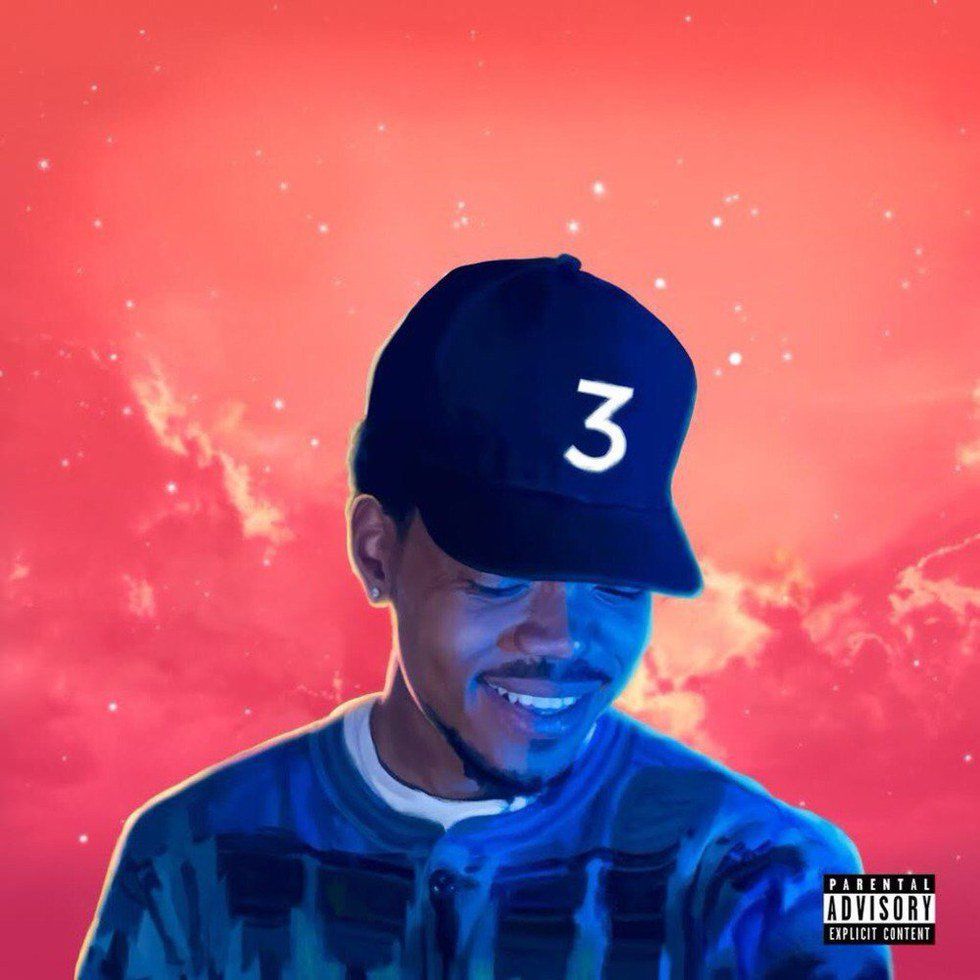
Over the last few years, Chance the Rapper has made quite a name for himself. His first two solo releases, two free mixtapes, received critical acclaim, but the rapper garnered more of a cult following than anything. He was relatively unknown to the mainstream until a few years ago with his “Acid Rap” release, which displayed his talents for creating infectious beats and lyrically dense songs.
This lead to becoming a type of prodigy for Kanye, endowing him with multiple features on hit songs, including a soul crushingly great verse on “Ultralight Beam” from Yeezy’s "The Life of Pablo," as well as being one of the main producers for the album. Chance now has many features to his name across the industry, and is viewed as one of the new, rebellious faces of hip/hop.
With his third official solo release (available to stream for free on Apple Music and soon to be on Spotify), “Coloring Book”, he is aiming to bridge the gap that divides the record labels and independent musicians, working to put the ‘art’ back in ‘artist’.
I’ve always been a fan of Chance the Rapper, but I would never consider myself a die-hard; I never listened to his first mixtape, and “Acid Rap” impressed me, but mostly left me with a feeling of ‘meh’. There were some great tracks, don’t get me wrong, but nothing that has really stuck with me. But I have always admired his style and apt for packing songs full of lyrical prowess and meaning.
On “Coloring Book”, Chance fully commits to the genre of ‘gospel rap’ without ever making you feel that you’ve been stuck in church all Sunday afternoon. He raps about his commitment to God and his respect for the Almighty, but not without admitting that he is only human - and that its perfectly OK to admit that.
He opens the album with “All We Got,” a powerful anthemic song featuring both Kanye West and the Chicago Children’s Choir, focusing on Chance’s life being surrounded by his work, singing “Music is all we got!” Next comes “No Problem”, which is Chance’s open letter of disdain towards the record label architecture of the music industry, demanding his freedom as an artist. Following is “Summer Friends”, which is like watching a slide show of his childhood, and it is as bright and detailed as you’d expect.
“Blessings” offer perhaps the album's most impressive moment, brilliantly blending gospel praise and Chance’s unique and punctual voice, rapping about the importance of respect and commitment for a higher power, pleading “When the praises go up, the blessings come down”.
I’m not a huge fan of the middle of the album, but my attention was reclaimed with “Juke Jam”, which even features Justin Bieber. Its a slower jam which only aids Chance’s blend of rapping and singing from the soul.
“All Night” offers the albums most energetic and club-ready jam, incorporating elements of hip/hop, funk. and gospel choirs. Its a chest-pounding beat that begs to be played loudly. “How Great” is the most blatant expression of the gospel elements, opening with a choir repeating “How great is our God?” It feels like Chance’s Sabbath; after partying “All Night” he has come to church to pay his respects for the Power that put him on this Earth in the first place.
The album rounds out with “Smoke Break”, “Finish Line”, and an alternate version of “Blessings”. The first two are incredibly down to Earth songs that feel like the best way to finish the album. First, Chance offers his family, friends, and fans a ‘smoke break’, and then preaches his own gospel, which is full of love for his family, city, and the hopes he has for both, as well as his hopes for his own personal future. But admittedly, after the roaring power of the first “Blessings” the alternate version doesn’t quite stack up; although musically barren, it does pack more of his lyrical prowess into the same space than before.
As a whole, this feels like Chance’s official coming out party; no longer will he only be known for mixtapes and following in Kanye’s shadow, but rather for shaking up an industry that is in desperate need of a changeup.
This isn’t an easy album to listen to, and there aren’t many radio-ready hits. Its lyrically dense, demanding your committed focus without distractions. At times it is sonically brilliant. It exemplifies his talent for writing and beat making, while also taking the audience on an incredibly personal journey into what made Chance the Rapper who he is today, and offering a glimpse into who he wants to become.
The notion of ‘gospel rap’ may be off-putting to people. But the album is more about painting a picture of his own journey from Chicago son, to mixtape king and Kanye understudy, all the way to the possibility of one day being the future of hip/hop as we know it.















