
PREFACE
When I saw how well my previous article was doing, I decided I would write several others, dividing the complex story of my experience with autism into four parts. But before I begin launching into my life story, I would like to dedicate this to a number of individuals. Obviously to God, and my parents, sister, and grandparents for being wonderful supporters, and also all the therapists, psychiatrists, counselors, teachers, dogs, and horses who have made me who I am today. You have been absolutely inexhaustible sources of love and comfort for the past 16 years. Yet I also would like to dedicate this to a person who has had impacts on me the likes of which few have ever witnessed.
This person is my mother. It seems quite silly to dedicate a piece of writing twice, but the experiences I have been through are unique enough to warrant it. These women have been some of the greatest influences, in particular, my mother. It was she who poured the better part of a decade and a half into making me who I am today. Sometimes, it drew tears; other times, it brought great joy. Yet her perseverance and her love have rubbed off on me, and that is why I write this: this is a story of how powerful love truly can be, no matter how happy, sad, or angry you feel.
PART 1: THE EARLY YEARS (2000-2008)
On April 24, 2000, in Grand Junction, Colorado, I entered the world blessed with a wonderful pair of parents. Both of them high school math teachers, my mom started staying at home with me. My infancy was, on all counts, very mundane and normal. But when I was around one year old, things started to change. I reacted negatively to almost any food. One of the first things I remember is being disgusted at the idea of putting anything in my mouth. I started to become very hyperactive and fidgety, overreacting to tractors, vacuum cleaners, motorcycles--anything that made noise. I had just moved to King George, Virginia because my father had taken a job as a statistician with the Navy, but my family knew that this was not just moving-induced stress.
These traits persisted during my toddler years; in fact, when my sister, Madeline (or "Maddie"), was born in 2002, I became obsessed with her navel; I remember always perfectly sounding out, "UM-BI-LI-CAL CORD" whenever I was near her. My parents tell me that they saw me do amazing things, like teach myself to read, memorize long paragraphs from commercials and movies, and uncannily know and recognize the tiniest details. However, they also noticed my lack of active interaction with other children my age, my inability to communicate well, and my hypersensitive fears, and they talked to my pediatrician who agreed it was worth exploring. We visited a neurologist at Mary Washington Hospital in nearby Fredericksburg, a half-hour away. Not long after, on the early morning of my third birthday, I was officially diagnosed with autism.
This came as a shock to everyone I knew. My parents ravenously prowled the Internet (or what skeleton there was of it--it was 2003, after all) and attended conferences throughout the DC-Baltimore area. They learned a lot, but one thing in particular--if they wanted the best care for me, they had to leave again to either Boston (which was not very appealing, especially in the winter), closer to DC or Baltimore (at the time, we lived about an hour and a half away, and my father hates long commutes), or to Atlanta, where my parents were both natives. So, in the summer of 2004, my father left his job, and we moved to the southern suburb of McDonough, Georgia, situated right where the suburbs of Atlanta end and rural Georgia begins.
While my father did what he loved, teaching and coaching wrestling at Woodward Academy, one of the best prep schools in the Southeast, my mother took me up to the city, week .a 45-minute commute, for several hours of DIR therapy a week. I remember little, except that I was in a room with a hodgepodge of different industrial-sized toys and played a lot with the therapists. What I do remember is that I loved it, and always looked forward to it. It also gave my parents and the therapists important clues into how I behaved and processed the world on a day-to-day basis. And these therapists were not just quacks, either. They were the likes of Mary Beth Stark and Drs. Mili Cordero and Barbara Dunbar, among the best in the world.
But DIR was not the only therapy I took part in. I also had my nervous responses stimulated by classical music in two different therapies called Sanomas and Tomatis. I would sit and listen to specially formulated recordings of pieces only classical music buffs would actually know, because my parents say I could not feel pain before, and thanks to the way these recordings were digitally edited, I became more self-aware and able to respond to basic stimuli, such as pain, motion and other things. My mom remembers vividly how during Samonas my sense of motion was awakened to the point that I wouldn't let anyone pick me up; I suddenly became afraid to climb! It took adjusting, but my body gradually acclimated, and I learned to process these stimuli that had previously gone undetected by my brain.
When we moved again in 2006 so my father could take another teaching and coaching job at another local prep school, I began a new therapy on top of all the others. Called "Brain Balance," it sought to use sensory stimulation and physical exercise to balance the two hemispheres of my brain in order to make me less impulsive and hyperactive (hence, the creative name). It took two six-week courses, but by the time I was done, virtually everything about me had changed.
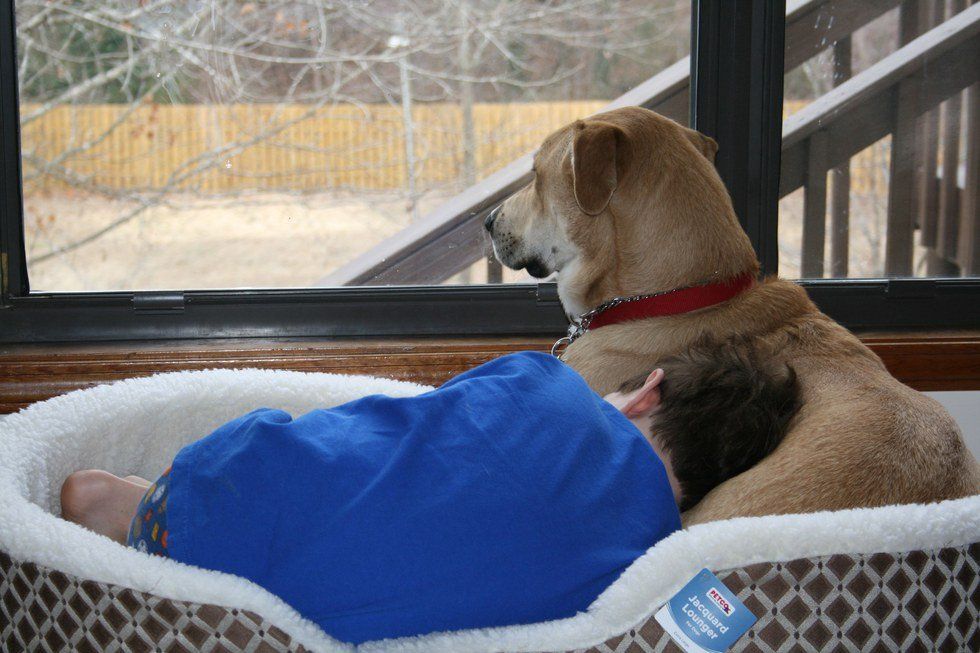
Another intervention that helped me out along with "Brain Balance" was having a service dog. I remember traveling up to Xenia, Ohio, in March 2007, to receive a Great Pyrenees-Boxer mix named Ajax. The animal weighed about 100 pounds, and for good reason; Ajax acted as an anchor for me - when tethered to him, I was calmer and unable to dart off. Also, Ajax would lay down on me to provide the calming pressure necessary to aid me. My mom says that deep pressure was often very calming and organizing for me, and Ajax was another conduit of this. Without Ajax, it is very likely that I would still be throwing tantrums and getting angry when something was just a little bit off. A few months after we got Ajax, we moved again to Norcross, where my dad took his third teaching and coaching job, at his third prep school.
In case you are wondering about my education, I spent several months in a regular preschool program, and then I was homeschooled off and on for several years. I never received a "formal" education until 7th grade. Usually I read nonfiction, "fact books" I called them--I read atlases of the world, field guides to local wildlife, books on snakes, sharks, whales, even dinosaurs. I am, for all intents and purposes, an autodidact in that regard. While my peers were reading "Green Eggs and Ham" and "The Little Prince", I was reading the captions to pictures of Bahamian sharks in "National Geographic". I was bored with learning how to add and subtract and why Martin Luther King, Jr., has a street named after him. I wanted to learn my way, not my mother's way. I boiled it down to this: Homeschooling is evil. I needed to go to a real school. My prayers were answered in 2008 in the form of a school specifically built for children on the autism spectrum, called The Lionheart School. It was there that the work of the previous eight years was multiplied and began to shape me into who I am. My next article will describe my life at Lionheart and what I learned there