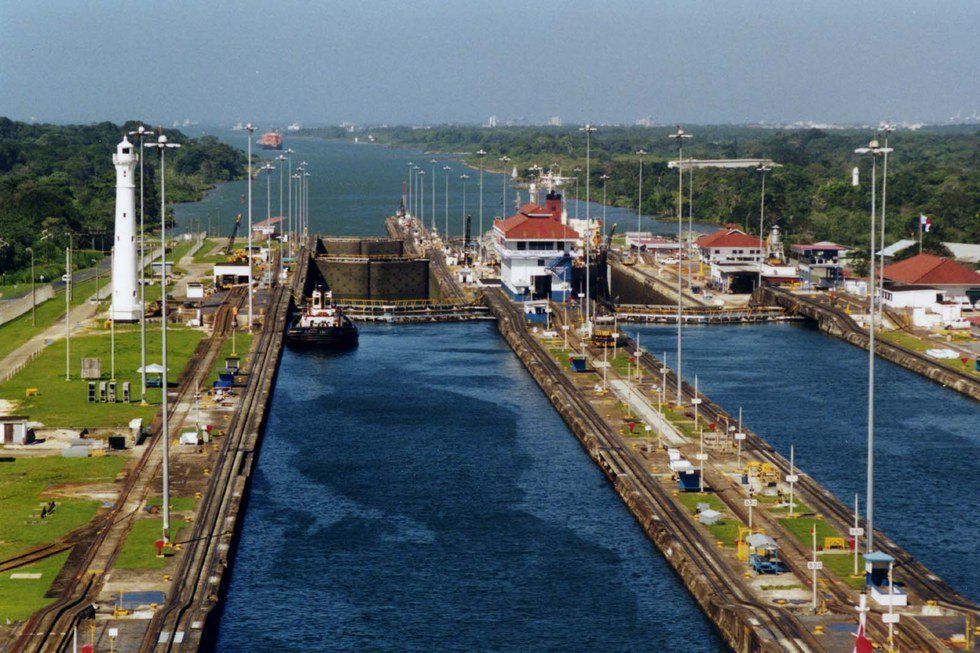
Panama has always been considered a strategic position. It is the thinnest point on the isthmus, making it an ideal place to transport between the Atlantic and Pacific oceans. The only other path was to sail around the southern tip of South America – a much longer and more dangerous route. Unfortunately, Panama’s transportation sector was often owned or under the control of another country. Panama’s independence from both Spain and Columbia led to Panama being controlled by foreign powers and an economy and culture centered on transportation.
Spain was the first foreign power to take control of Panama. It also held that control the longest. Until the eighteenth century, Spain traded with the west coast of South America almost exclusively by transporting goods by land. When business began to taper off, the people living in Panama started to embrace free trade, but they remained loyal to the Spanish monarchy.
Even after other colonies began declaring independence from Spain, Panama refrained from doing the same. In fact, Panama even sent soldiers to fight against the revolutionaries in other countries. However, after years of abuse from a military government and declining trade due to war, Panama finally declared independence from Spain on November 28, 1821. There was little bloodshed over the matter, and Panama annexed its land to the newly formed Gran Columbia.
Panama’s relationship with Columbia was rocky from the start. Panama may have had a monopoly on the shipping industry, but a large amount of that money was being sent to officials in Bogota. The leaders in Columbia allowed wealthy merchants from Panama free trade with friendly nations, but Panamanian merchants began to resent being looked down upon by them. Unfortunately, most of the negotiations with foreign powers about trade agreements were done with Gran Columbia on Panama’s behalf.
In January, 1848, gold was discovered in California, kicking off the California Gold Rush, and it wasn’t just the gold itself that was cause for excitement. For Panama, the gold wasn’t nearly as important as the mass migration that followed its discovery. Travel by ship was still the quickest and most reliable between the east coast of the U.S. and California, and the path through Panama was still faster than sailing all the way around Cape Horn. Miners sailed to Panama, then crossed the land by foot or riding mules, before finally taking a second ship the rest of the way to California.
Initially, it was the urban merchant elite that were most thankful for the gold rush. They hoped that the flood of miners passing through Panama City would make them even wealthier, and many owned property along the path between oceans that they would rent out. It didn’t quite work out that way initially. The people who did benefit were, in fact, those of the working class. It was them who provided mules and further assistance to travelers, and it was them getting paid.
In the 1850s, the United States began construction on the Panama Railroad, which would stretch across the entire isthmus, from one ocean to the other. This would cut off business to the working class, as people travelling through the region would take trains, a much faster means of transportation than riding a mule. The building of the railroad, itself, however, became the new opportunity for them, as well as the numerous immigrants that flocked to Panama in search of jobs.
Though Panama kept control over the railroad itself, the American and British investors made a substantial amount of money off of it, even after the gold rush ended and use of the Panama Railroad began to decline. Columbia also exerted its power over Panama for financial gain. Panama only received back 1/10th the amount of money railroad officials paid to Bogota to use the railway. Because of this, the already problematic relationship between Panama and Columbia became even more strained.
Throughout the second half of the nineteenth century, Columbia suffered from economic problems. The reforms the government implemented to combat this led to a reduced ability to govern outlying regions such as Panama. Left to themselves, Panamanian merchants were regaining their wealth and even the vast majority of the poor had jobs. Then, the Colombian government became more involved in Panamanian politics by implementing tax reforms and vagrancy laws. Between 1850 and 1902, the Panamanians revolted 53 times.
The United States had always had an interest in Panama, for the same reason every other country had an interest in Panama – its strategic position. Unfortunately, the alliance between the two countries was forced and unequal. Often, the U.S. would resort to using military intervention in Panama to protect its economic interests.
When the U.S. began their campaign to build a canal in Panama, they offered Columbia joint ownership and a share of the profits. The Columbian government, however, rejected the offer due to a low-profit margin and what they considered unreasonable demands from the U.S., such as wartime priority. With support from the United States, Panama declared independence from Columbia on November 3, 1903.
In the aftermath of Panama’s independence, a Frenchman by the name of Philippe Bunau-Varilla was appointed the diplomatic representative to Washington. Instead of representing Panamanian interests, however, Bunau-Varilla chose to line his own pockets. The U.S. was promised a 10-mile wide strip of land across the country to build the canal. No Panamanian was allowed to be present at the signing of the treaty in order to object to the conditions, and the United States maintained control of the Panama Canal until 1999.