
Demetri Martin has a special brain. If you have ever seen his stand-up, it’s pretty clear that he’s got certain neural wiring that sets him apart from the average comedian. His routine usually consists of a series of one-liners delivered one after the other. In addition, he incorporates aspects of drawing, puzzles, the occasional song, and palindromes. Demetri’s fascination with palindromes has resulted in a 224-word poem/palindrome called, “Dammit I’m mad” (Which is itself a palindrome!).
Demetri’s stand-up and books inspired me to start writing palindromes beginning in high school. Since then, many notebook margins and diary entries have scribbles of gibberish that have served as seeds for original palindromes. Beyond anything else, palindromes have served as both a writing exercise and a therapeutic perspective-changer, and I will explain why. But first, I will explain the palindrome process.
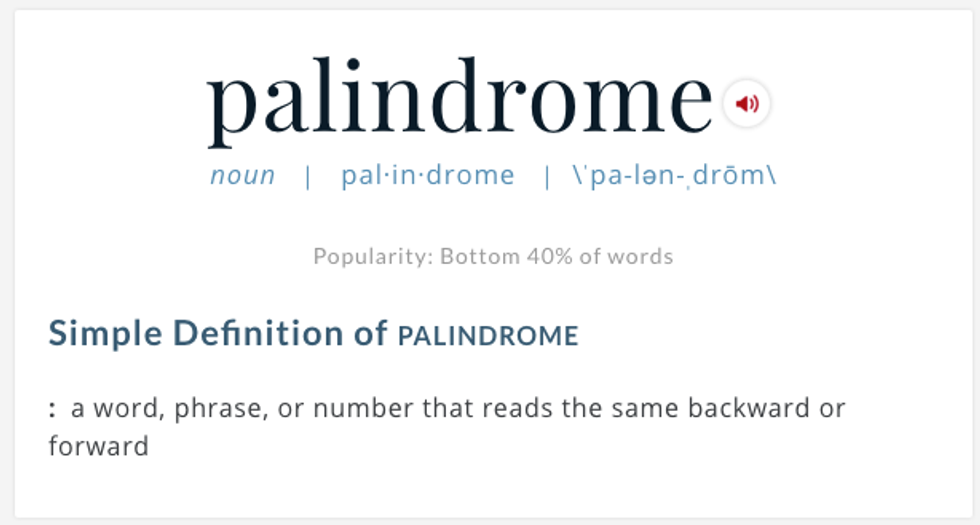
Palindromes follow a simple structure: The phrase must be the same going forward and backward. Punctuation may be used strategically to create infinite possibilities. However, the palindrome process is not the most graceful and takes practice. There is a lot of trial and error involved, and like any writing process, it can either be incredibly satisfying or incredibly frustrating. Here are a few basic steps to get started with writing a palindrome:
- Get yourself a notebook. I’m assuming that if you’re reading this article, you’re either my mother or you attend Wheaton College. And with that population, my B- skill set of statistics could infer that there is an 85 percent chance that you already have a Moleskine notebook in your back pocket. Awesome! Take it out and grab a pencil.
- Find yourself an “anchor word," which is a word that you want to be present in the palindrome. Write it out backwards and see what kind of words and phrases you can create from it. I find that if you are trying to impress someone, using the person’s name as an anchor word is a perfect way to start. For example, “Jo lives: evil OJ” is dedicated to my housemate, Jo.
- Start writing out small words. With every piece you come up with, the phrase will mirror itself. You will soon find a way to work from the inside out. At first, phrases will not make sense.
- Keep track of the words that work. “Evil” and “live” are palindromic to each other. And even phrases as simple as “if and “I” could be added to a palindrome. The more you work, the more you begin to recognize patterns. I learned the hard way that “Katherine” is no good for palindromes (though I will keep trying).
Hopefully, if you’ve followed these steps, you will have produced a beautiful little palindrome. It’s incredibly difficult to find strings of letters and words that work together to create these phrases, which is why most of the palindromes I write seem to be chopped up bits of out-of-context synopses of stories. I find that when I’m writing palindromes, I try really hard to come up with something that is poetic, meaningful, and follows the one palindrome rule. I think the closest thing I’ve come to in achieving this is: “no omen, one moon,” which, depending on how self-indulgent I’m feeling, is either really deep and poetic, or entirely arbitrary.
Another one of my own palindromes is “Defer a star, rats are fed.” I would imagine this snippet of words is either a metaphorical critique of the college admissions process, or a vague description of a pet store owner ignoring a celebrity that entered his shop. I don’t have an answer because there isn’t one.
I’m the kind of person that enjoys limitations and parameters because that is where creativity thrives. So in a way, while there is a huge obstacle of limitation with creating a palindrome, the final result can be incredibly silly and wonderfully poetic. Palindromes taught me that in context, the content does not have to be meaningful. Rather, the meaning lies within the process and evaluation of possibilities.
“Is it I? It is I.” Give it a shot.