


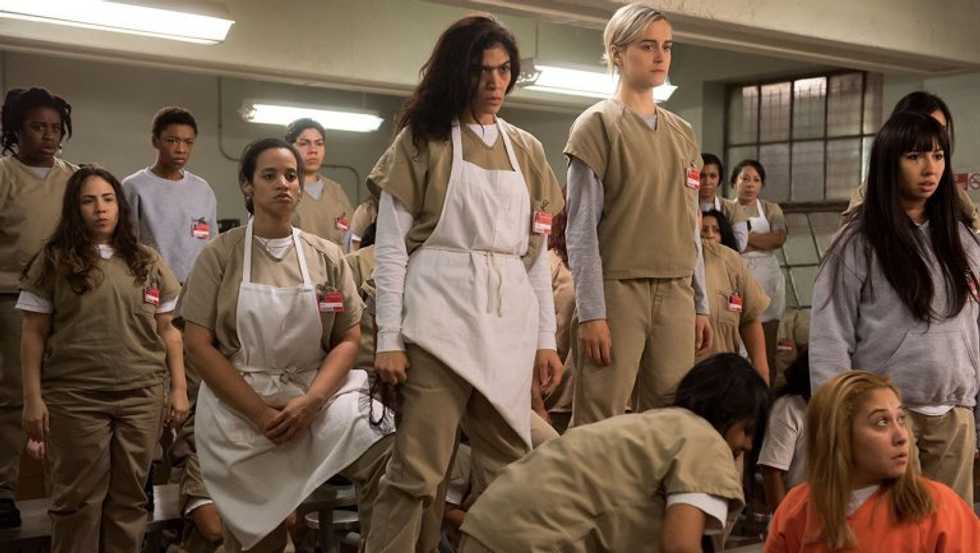
I’m not going to admit exactly how short of a time it took me to make my way through Orange is the New Black’s fourth season on Netflix, but let’s just say it was speedy. Like its preceding seasons, OITNB captivated me with its gripping backstories, appropriate political commentary, and humanization of inmates. Season four, while maintaining the ethos of the show, adopted a much darker tone; however, I couldn’t help but feel that it took too much on its plate.
Season four began by continuing the critique of for-profit prisons it introduced in season three while intertwining issues of power and authority with race, corporate infusion into government, and gender. For what it’s worth, I think the writers did an incredible job with the narrative condemning privatization, as they explored the nuances of hiring untrained guards, the dangers of overcrowding, and the careful line Warden Caputo must tread between pleasing the corporation and applying his on-the-ground expertise. It was sickening to see the corporation and new guard hires perceive the inmates as inhuman, and inhibit their agency and dignity, and this shed light on the often ignored issue of for-profit prisons. OITNB carefully juxtaposes the reality of life within the prison and the callous commodification MCC exercises, revealing the perverse way society perceives prisoners.
While OITNB writers prove successful at sharply criticizing private prisons, their foray into guard brutality and race dynamics within the prison became slightly murky. To their credit, their depiction of unapologetically racist stop-and-frisks and racially targeted attempts to undermine “gang behavior” (read: groups of Latinas congregating) did an excellent job reflecting implicitly racist structures. Watching the guards transform into merciless autocrats when given authority offered a poignant criticism of how power distorts reality and the dangers of dehumanization.
However, other viewers, myself included, still have problems with the apex of the season, when tensions coalesced into a peaceful protest turned grotesque. (Spoiler alert!) I won’t rehash the details of the heartbreaking scene when we lost one of OITNB’s most beloved characters; however, the scene was frustrating for more reasons than one.
My main problem with that particular scene was that I didn’t exactly know what point it was trying to make. Sure, it’s an obvious critique of police brutality, and echoed some aspects of Freddie Gray’s death. However, it seemed odd to me that the writers selected possibly the only “good guy” guard to be the killer, and his actions, while grossly irresponsible, were ultimately accidental. This thereby takes what could be a powerful critique of implicit racist structures, and instead makes it yet another black queer woman dead, as the scene ignores the purposeful persecution of people of color in America. That Poussey happened to be black seemed to be more of a convenient coincidence than a reason to target her. The scene was unfortunately tone-deaf, as it attempted to skim over the issues of guard and police brutality without addressing the numerous complex layers that play a role.
When Caputo asks Taystee if her friend lunged at the guard, charged toward him, or did anything to justify the attack, she exclaims in outrage, “Are you asking if she deserved to die?” This seems to be the sole sliver of reason within this scene. Desperate to paint the dangers of guard brutality as one-dimensional, OITNB writers carefully selected probably the most innocent, clean-cut, likable inmate to kill off. While this is successful insofar as it elicits emotion and perhaps incites outrage, it’s problematic within the context of our “victim blaming” and “respectability politics” in society. With this in mind, I feel that this story arc serves, probably inadvertently, to perpetuate the narrative that some black people do deserve to die. If this scene truly wanted to be a progressive critique, they ought to have made the victim of guard brutality an inmate who was causing problems. Make it someone who rebelled. Make it an inmate who was targeted for her race. And emphasize that, even when you take all these factors into account, she still does not deserve to die.
I think this episode did a decent job of showing the indiscriminate and perverse nature of police brutality and power dynamics, but it shows the shallowness of our understanding. It also begs the question: To what extent does political commentary justify the implicit media oppression of minorities? It may or may not be intentional that the character OITNB producers killed off was a queer black woman, yet remains frustrating in the face of reality, when black men and women, as well as the LGBT community, face constant persecution, that they lack the representation they deserve on TV. It’s upsetting to see Poussey, a dynamic, lovable black woman, face death while we have Piper, who just totally screwed up third season, end season four back on her feet, making some pathetic amends and finding herself a new niche.
So, let’s talk about Piper, the quintessence of white privilege.
I really am rooting for her, especially her relationship with Alex. Her constant whining, selfishness, and tone-deaf comments do make her a difficult character to like, but to be totally fair, if my suburban self landed in prison I’d probably be getting infinity sign prison tattoos and pretending to be "gangsta" too. Unfortunately, her character development over the course of season three was pretty despicable, and her season four actions were honestly sickening, as she played a crucial role in the racist structures that became increasingly manifest in the prison.
However, season four decided her character arc would be one of redemption, which was pretty tastelessly accomplished. I mean, if it takes smoking crack in a field and being branded with a swastika for you to reevaluate your life decisions, your redemption should be a little more challenging than reconnecting with your ex, and maybe take at least two episodes. It was disappointing to see the writers re-characterize the corrupt, calculated “gangsta” as a confused white girl who just didn’t know what she was getting herself into, in the prison system where she definitely doesn’t belong.
This is the pinnacle of white privilege. Contrasting Piper’s corruption within the prison system with Maria Ruiz and other characters, we see that the show characterizes Piper as someone who has fallen victim to imprisonment, whereas Ruiz and other Latina characters are complicit in creating the corruption. This reveals our failure to recognize implicit racism. Just as Piper disassociates herself from the white power group she accidentally creates (classic “I hate it when that happens” moment), thinking she’s in the clear because she’s not chanting “white lives matter,” so too do we as a society consider ourselves not explicitly racist, while ignoring how we contribute to the racism in our society.
In this vein, we have to apply a critical lens to the theme of “redemption” that drives forward the plot of season four. We see Bayley, the guard who inadvertently killed Poussey, struggle in the face of his actions. While I feel for him and understand he is a product of the system he is far too entrenched in, having him be the perpetrator of the murder just seems unnecessary. What point is OITNB trying to make? Forcing us to feel sympathy for the perpetrator of a murder, whether intentional or not, detracts from the fact that police brutality, as we see it in America, is a very intentional action.
Furthermore, in light of the Coates' actions, a guard who used his position to sexually assault Doggett during season three, OITNB jumped on the opportunity to discuss sexual assault, through exploring the relationship between the survivor Doggett and her attacker. This was a questionable decision. Not only does it apparently exonerate him for his objectively wrong actions, but it also serves to reinforce the narrative that rape accusations place an undue burden on the perpetrator, through ruining their life or making them feel guilt. To be completely fair, I do like the deepened understanding of Coates’ character. Characterizing him as emotionally complex and even fragile does, to an extent, dismantle our understanding of rapists as monolithic predators creeping through the night. That we are able to see Coates as a human who made a (huge, unforgivable) mistake emphasizes that rapists exist outside a specific archetype, and that they can take the form of friends, good guys who made a mistake, or someone who just didn’t know better.
However, I think OITNB stops short of truly hammering home the point that is far too often under-emphasized: Even though Coates “made a mistake,” or could even be a good guy, he is still a rapist. The writers seem to believe that, because he was unaware of the impact of his actions, and because this was simply an isolated incident discordant with his normal persona, he deserves a second chance. While it is okay for Doggett to forgive her attacker – it is her prerogative – it’s problematic to wipe Coates’ slate clean, and it’s only further debilitating for the survivors of sexual assault who are attempting to reconcile their attack with the “good guy” identity of their perpetrator.
I have been pleased with Orange is the New Black over the seasons. They have proven effective in giving complexity and depth to a diverse array of characters, while concurrently infusing their show with salient social critiques. Despite this, I think if a show is going to take on heavy, critical issues in our society such as police brutality, they need to be prepared to abandon some theatric appeal in order to explore the issue accurately and in depth. Unfortunately, Orange is the New Black failed to do so, and reveals why we can’t always have white writers writing the narratives of people of color.

















