


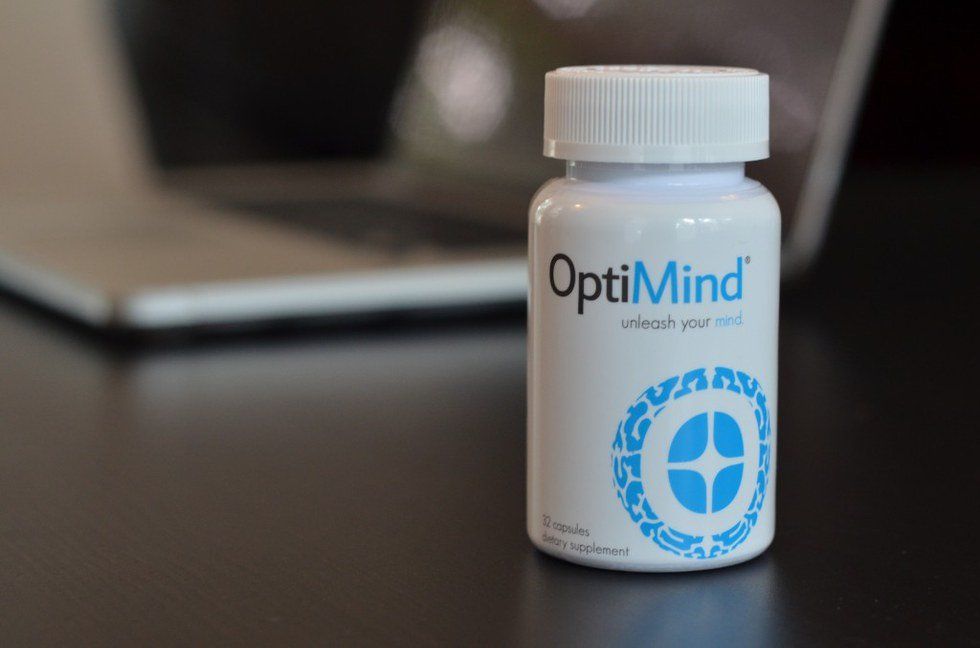
About a month ago, I was scrolling Facebook (as is my usual procrastination method) when I saw an ad for a vitamin supplement called OptiMind. Whenever I am doing something I am passionate about, I tend to get very animated and have a bubbly personality, but lately, I have been finding myself getting tired a lot more often and easier, particularly when I am stressed. It is like the ancient battle between good and evil going on inside my head. The Luke Skywalker of productivity battles Darth Vader of procrastination insisting I deserve to sleep and shut myself off, but who could sleep when the good name of a Jedi knight, Obi-Wan Kenobi, the galaxy and my GPA are being corrupted by the Dark Lord of the Sith that is my REM cycle?
Anyway, OptiMind’s promise is to “unleash one’s mind.” Now, being a cynic, my first thought was this was the legal way to get your hands on Adderall. I genuinely thought that this was some kind of scam. This was a drug push for me to, essentially, stop sleeping, and be more productive than I ever thought imaginable. So naturally, I did some research on the miracle that is OptiMind. Bear in mind that I do not take any variation of energy supplements. I do take a multi-vitamin other than coffee. I do not drink Rockstar or Monster, and I do not even drink soda. So, I looked it up, and it got a few great reviews, and Facebook was pushing a free sample — I took advantage. My cynical mind was going crafty drug lords, you win this round Zuckerberg, I’ll show you. Naturally, it came, and it worked.
I got a pack of maybe ten capsules in the mail. One Sunday morning I got up to go train and, being as how I did not sleep more than five hours the night before, I thought I could use an extra boost (not thinking anything of it other than taking them) before training. That would be when the pills would get their chance at really showing their work. I popped them at breakfast with food thinking it would dilute the effects.
I was supposed to take two capsules at the beginning of the day to increase productivity. My main concern was that it would rile me up, and make me unable to focus. This did not happen. I was able to focus, study, clean, everything else I could imagine. The only down side was at one point I started shaking uncontrollably. As it turns out, you should not take this vitamin with coffee. I went to the gym, as usual, and my poor team mates were figuratively peeling me off the ceiling.
“Good morning!” Andy greeted as usual, startling me out of my skin and probably causing a small heart attack.
“Fran, are you sprinting?” My friend Quinn asks me as I lead the warm up in Jiu Jitsu, which was supposed to be a light jog. Yes, yes I was. Full on knees-to-chest-wind-in-my-hair-catch-me-if-you-can-Usain-Bolt sprinting, leaving my fellow Main Chicks in the dust. I did not realize I was doing this, and I forced myself to slow down. I came home, wrote for a few hours, studied, and deep cleaned my laundry room. Regular Sunday stuff?
The next day I took one capsule, an hour after my coffee, with water. The result was a lot more manageable and left me feeling a lot less like I had just gotten a Superstar in Mario Kart. When I studied the pills designed to boost “cognitive function" (which it did), I was able to complete and understand, most of my assignments while on these pills. As it turns out, one pill has about as much caffeine as a cup of coffee. It was designed to replace coffee in the morning. Naturally, when I had taken it the first time, I essentially had duped myself into taking what amounted to three cups of strong coffee. I no longer wondered why I had morphed into the human equivalent of an atom bomb. Oops. Now that I have hopefully made you laugh, let me explain what is exactly is in these magic supplements.
I went straight to the website, and as it turns out, I was not the only one who was concerned that there was anything that could hurt me, or worse, cause an addiction. The website lists the ingredients as follows:
- Caffeine (Obviously): Caffeine kick starts your brain and essentially tricks you into thinking you are not tired.
- Tyrosine: This is an amino acid that your cells use to blend proteins. It is not essential so do not feel robbed if you don’t see it in any protein powder you are using. This amino acid can be found in seaweed. Most of the time, though, it is used to alleviate stress.
- Phosphatidylserine: This is a dietary supplement that can be found in soy beans. It has been used to improve memory and in experimental trials to treat Alzheimer’s disease. If memory is your biggest problem, you can find supplements like this on Amazon for significantly cheaper than an OptiMind supply.
- Bacoside A: This is usually found in Bacopa plants. This was usually used in Indian medicine for wound healing and can be ingested for more memory boost.
- Vinpocetine: This plant is a compound which can be found in periwinkle. This is another one designed for memory improvement.
- Huperzine A: Now, this one is interesting. You can find in a huperzia plant. It was an ancient Chinese wonder drug that was really big in the Tang dynasty days. They used it to treat ailments, from things as minor as bruises to as severe as Alzheimer’s disease and Schizophrenia.
These ingredients are used very sparingly, it really is just the effects of mental performance and a boost. While I enjoyed this supplement, I am having a hard time wondering if it is worth it. Looking at the back of the bottle, I realize that 99 percent of this “wonder drug” is a vitamin B12. When I called and asked how much it was to prescribe to it, they politely informed me that it was $45 a month. OptiMind works, but you might want to take advantage of something cheaper. If it were something like $10 a month, and a bit more intricate so it was not just a fancy packaged coffee capsule, I would urge you to run out and get it. But if you are like me, and you are a college student who needs to watch the pennies (who is still a bit jittery I might add), it is just not worth the cold hard cash.
References
drugs.com. 1 January 2010. website. 15 April 2016.
getoptimind.com . 1 January 2015. website . 20 March 2016.
Glenn Smith, Ph. D. mayoclinic.org. 2 June 2014. website. 20 March 2016.
http://www.wellcorps.com/Therapeutic-Effects-of-Ba.... 1 January 2011. web site . 15 April 2016.
ncbi.nih.gov. 14 May 2003. web site . 15 April 2016.
Young, Simon A. ncbi.nih.gov. 30 May 2007. Tyrosine. 20 March 2016.















