


Note: This article contains a few movie spoilers! Read at your own risk!
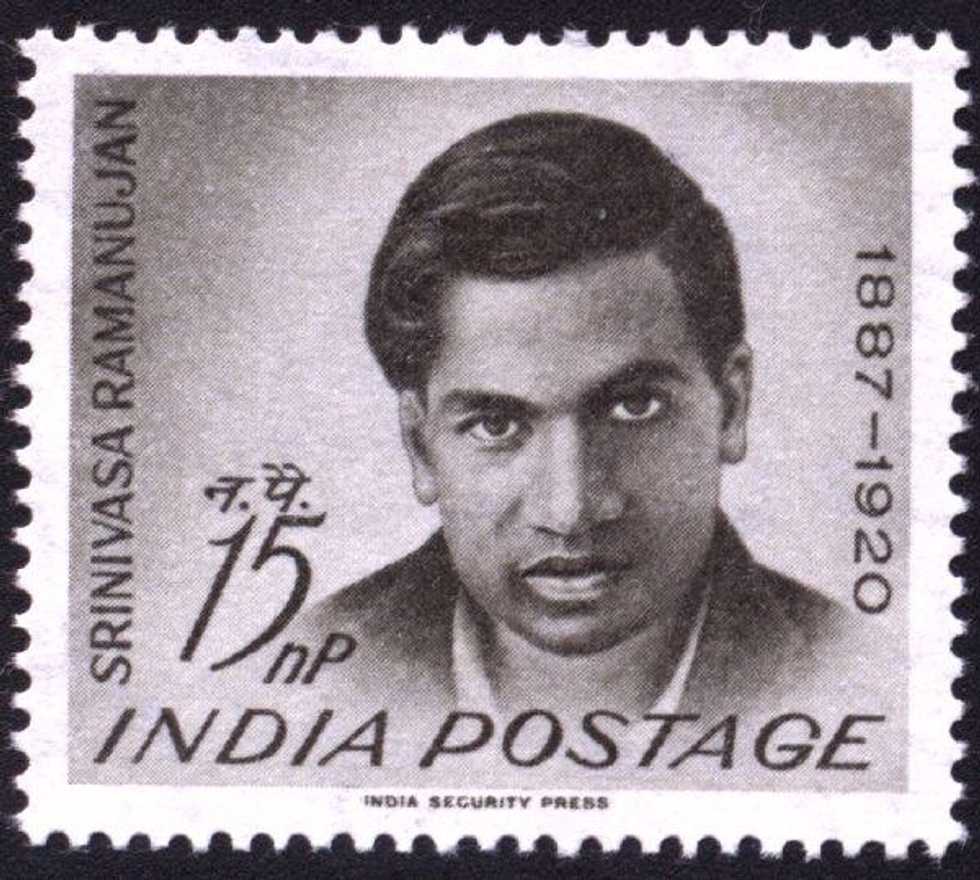
I remember growing up hearing the name Srinivas Ramanujan quite often when I was doing my math homework. It was all a wonder to me how one person can achieve so much in such a short period of time and with a modest educational background. While I am aware of his life and work, I was excited to know that a biographical movie on one of India's greatest mathematicians was going to be released. And, I am happy to say that the movie did decent justice to Ramanujan and his life work.
The film is based on Robert Kanigel's biography of Ramanujan which has the same title as the movie. Though I have not read it personally, it is now definitely on my list of to-read books (and it is supposed to be a very good source on Ramanujan's life. Here is a good little blurb on the book.). Also, as a side note, there was another movie released about Ramanujan's life called Ramanujan in 2014, though the language is Tamil. The two movies do not seem to have any connections to one another than the subject being the biography of the mathematician.
The emphasis on the cultural differences between colonial India and the U.K was respectful and very well done to the point where the audience can understand the cultural shock Ramanujan would have faced in traveling from his home country to a foreign one.The fact that the filmmakers were able to use actual temples and villages as settings truly added to the cultural value. It was also nice that the filmmakers were able to shoot scenes at Trinity College, Cambridge, for it let the audience actually follow, as if in real-time, Ramanujan in his experiences at the college starting back in 1914.
There may be questions as to why Ramanujan was not allowed to travel out of the country. As a little cultural note, yes, it was generally not looked on favorably for an individual to travel outside India, unless the individual was a trader and was born and raised in a line of traders. This was because individuals belonging to other professions or professional lines were expected to remain in the country and serve their people for the welfare of the nation. On the same cultural aspect, the goddess Namagiri Ramanujan keeps referring to is Goddess Lakshmi who is present in the temple in Nammakal, Tamil Nadu, India. And yes, he did attribute his genius in mathematics to Her.
Regarding the math presented in the movie, I was surprised to know that the facts were as accurate as possible. Instead of passing over the details of the mathematical musings between Ramanujan and Hardy, the filmmakers took the guidance of mathematicians Ken Ono and Manjul Bhargava. They made sure that the mathematics discussed were correct but, at the same time, did not overwhelm the audience too much with technical terms. In a sense, the movie strived to (and it achieved it) create a meaningful balance between Ramanujan and mathematics.
The facts of Ramanujan's life and his collaborators' presented at the end of the movie and before the credits nicely completed his biography and provided additional information not provided in the movie. For instance, the blurb about Ramanujan's lost notebook (compared to Beethoven's tenth symphony) and its current use in researching black holes was fascinating.
Overall, the movie covered all the major facets of Ramanujan's life and presented his struggles and achievements close to the truth as possible. I cannot help but be proud to be part of a country with great thinkers like Ramanujan and I really hope others can experience Ramanujan's passion for numbers in "The Man Who Knew Infinity."
















