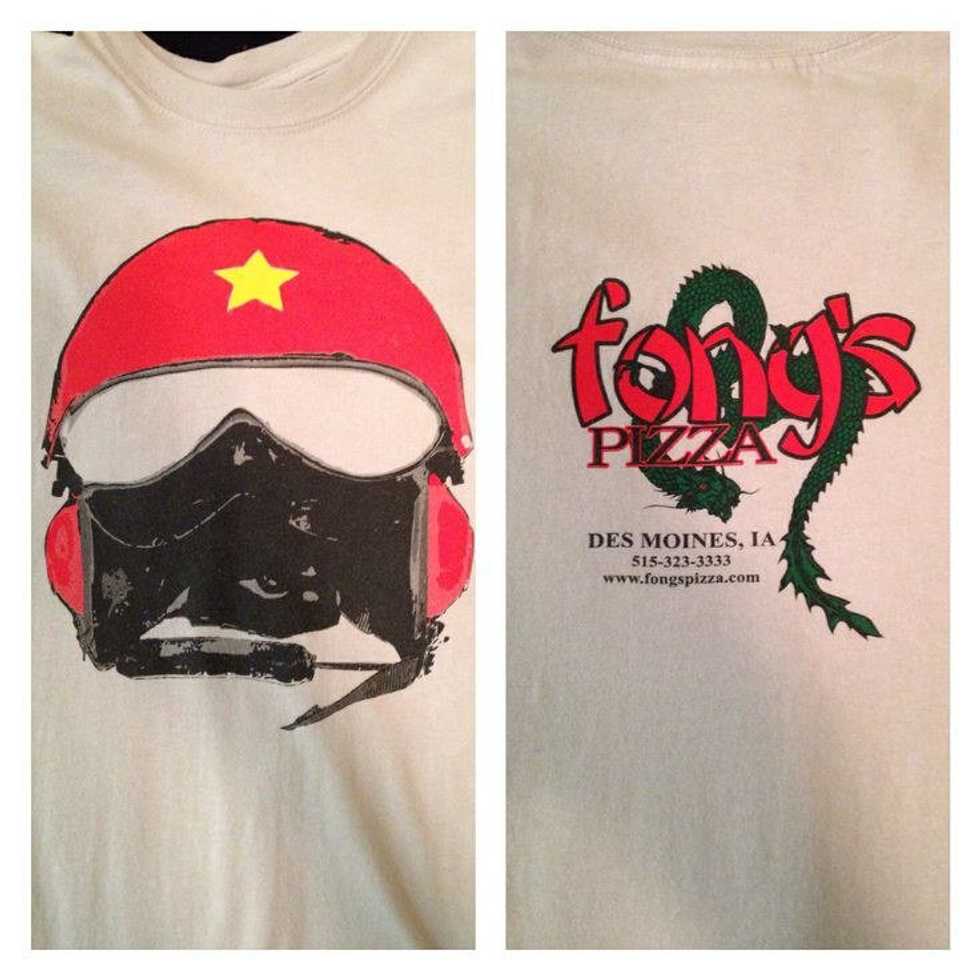
Dear Fong’s Pizza,
Had it not been for the television series "Pizza Paradise" on the Travel Channel, I most likely would have never heard of this establishment at all. However, at around 3 p.m. some two weeks ago, you so graciously made a presence on my screen as my sisters and I were flipping channels. Even though so many days have past, I haven’t been able to get you out of my head.
In the five minute spot that highlighted all of your greatest attributes, none of us could utter one word. Maybe it was the saturated color scheme of your restaurant or the loud exclamations of “Banzai!” from the helmeted patrons seated at your bar, but there was something about you that put the three of us in awe‒the same kind of awe that someone might have while viewing the aftermath of a trainwreck.
Before I go any further, I do want to make something clear: I am not angry at the restaurant. I can say, however, that I’m curious and open to know more about it. There is a good chance that the television spot didn’t do you as much justice as you deserve, or that I’m missing something integral about the “Fongolian” experience. With that in mind, I do have a few questions for you that I’m hoping you can answer for me and the readers:
What makes the decorations of the establishment “quirky”?
How and why did you choose the name ‘Fong’?
Did you mean to insinuate that the phrases “Chinese-inspired” and “Asian-inspired” were synonymous?
Is it the same thing if one uses the phrases “Italian-inspired” and “European-inspired” interchangeably?
In what way did you mean to honor the “Chinese history” of the restaurant by offering Japanese kamikaze pilot helmets for your regular customers‒I’m sorry, the Fongolians‒to wear while drinking “Asian-inspired” drinks?
What exactly makes your alcoholic drinks “Asian-inspired”?” Are there slices of ginger lined at the bottoms of the shot glasses? Do you like to spoil your customers by importing Japanese sake or Korean soju?
Likewise, how familiar are you with the meaning and history behind the words “banzai” and “kamikaze”?
Did you know that, despite what you may see in many Chinese markets, the golden, waving maneki-neko figurines are actually of Japanese origins?
Why did you decide to make Thai- and Polynesian- style pizzas although neither are remotely Chinese?
Doesn’t Polynesian culture seem rather far removed from Chinese culture, especially considering the 12,600 kilometers between the two countries?
If we’re thinking simply in terms of proximity, what would you think of a new Mexican restaurant that served food and had decor inspired by places in Guam, which is only about 11,600 kilometers away?
Do you think those same standards can be said for the relationship between Thailand and China?
Even though both are on the same continent, would you feel the same way about going to an Ethiopian restaurant only to see “Egyptian-inspired” food, with the assurance that both countries are in Africa?
Are you aware that although countries may be in the same continent, their cultures, gastronomies, traditions, languages, and histories may be vastly different?
Before I end my letter, I would like to reiterate once more: I am not angry at your restaurant. But, I never said that I wasn’t at least a little bit upset and confused when I first learned of your existence. After all, I would be very, very puzzled if I learned that a trendy Filipino restaurant decided to serve “Indonesian-inspired” cuisine and were allowing patrons to shout Taiwanese phrases before gulping their drinks.
As I’ve said earlier, maybe you can enlighten me on the subject. After all, I’m sure that the numerous Fongolians in Iowa could be great representations for the “Fong” way of life.
Yours truly,
A Puzzled Outsider