


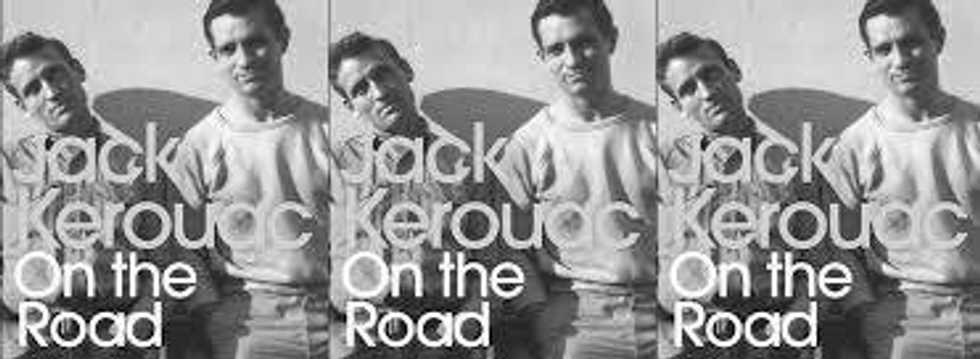
I first read On the Road by Jack Kerouac when I was about fifteen. I was enthralled by everything unfolding before me on the pages and left wanting to experience, myself, the Bohemian lifestyle of those who actually have the balls to reject the traditional social institutions. It made me want to go on some great adventure. And it wasn't about having to leave the country or spending a ton of money -- it was about the adventure of roaming the backyard of our enormous, strange and wonderful American landscape.
The story is told in the first person and is essentially and obviously autobiographical. It tells the story of Sal Paradise (a thin cipher for Jack Kerouac) and his adventures and the people that meets on the road. I consider its existence to be as much a story as the novel.
Kerouac, returning from his trip and needing to get it down, typed the whole novel out in a frenzy on to a single scroll of paper, 120 feet long. He aimed to write in as immediate and spontaneous a way as possible. As a result, sentences roll over one another and burst at the seams with excitable descriptions of even the more banal episodes that occur.
The book can be best understood and enjoyed as a representation of the Beat Generation, who rejected the traditional social values of the generation before them. The Beat Generation was considered the group of youth that had survived the Depression and World War II. They came home to find that their faith in humanity and the traditional values seemed damaged beyond repair.
Millions of people had died horribly, and for reasons they didn't particularly care about, and through no choice of their own. It's about a young person who's rejecting the life that he's supposed to lead: military service, duty to country, marriage, career, etc. He finds himself wandering, not just through life, but throughout the country, in and out of social and romantic relationships.
Exploring a generation disconnected from its past and seemingly facing an uncertain part in their country’s future, On The Road ends up not being about very much in particular other than its generation’s own rootlessness. They travel back and forth all over the states. There are parties and women and drugs and alcohol. There are cars and there is jazz.
If you were to google reviews of On the Road, you would find those who dislike this American classic for his dullness and seeming lack of plot. But Kerouac knew what he was doing with this work. The story was great at capturing a movement and moment of time in America that represented beauty, self-expression (flaws included), spontaneity and going against the white-collar grain. Maybe today, it isn't as revolutionary, but the ideas in it are still very much embraced by youth culture today.
At the end of the day, it is a book for people who like the journey more than the destination. The type of person that will leave their life behind to find something new. People who like meeting strange people in strange places. Those are the type of people, I’ve found, that like Kerouac and the whole Beat thing.
On the Road is a love poem to the simple joys of life. Living free from the chains of traditional social constructs, free from duty to anyone other than himself. That's what Kerouac and his friends do. They go out in search of simple joys. It's a book about a constant yearning for life and for love, and about trying to find that in non-traditional ways. I think a story like this, a reminder of all that there is to be experienced and explored, is one that is and will always be relevant.

















