
March, 2015: Three American girls trek through the deep Australian jungle on a dark and stormy day. Terrestrial leeches fall from the trees and grab hold of their exposed skin, while their not-so-rainproof rain jackets become soaked with water; sacrifices must be made as they search for the elusive musky rat-kangaroo. Having little knowledge about the musky rat-kangaroo before entering the rainforest in Northern Queensland, Toria, Tess and Tlalli do their best to spot the terrestrial marsupial.
"What does it look like?" asked Toria.
"Well," said Tlalli, "I think it has brown fur and walks on all fours."
"And," Tess added, known for her interruptions, "it feeds on many rainforest fruits -– it's a key seed disperser!"
"Is that it?!" Toria exclaimed, pointing to a log.
"Silly Toria, the musky rat-kangaroo has syndactyl toes! That means that some of their toes are fused together. That log doesn't even have toes," Tess explained.
"No, not the log! There's a hollow in the log, and aren't hollows good environments for rainforest species?"
"Oh my gosh, Toria you're right! We can check inside." Tess ran toward the log and lifted it up, sticking her head inside of the hollow.
"Aw man, I don't see anything but remnants of eaten fruit. But, oh wait! What was that?" Tess exclaimed, dropping the hollowed log on the ground and racing down the trail at full speed until OUCH! she was stopped short by a wait-a-while's grip, a thorny palm plant with clinging, spikey vines. Tlalli and Toria rushed in to help Tess untangle herself from the abrasive flora, and with enthusiastic resilience, the girls hiked on.
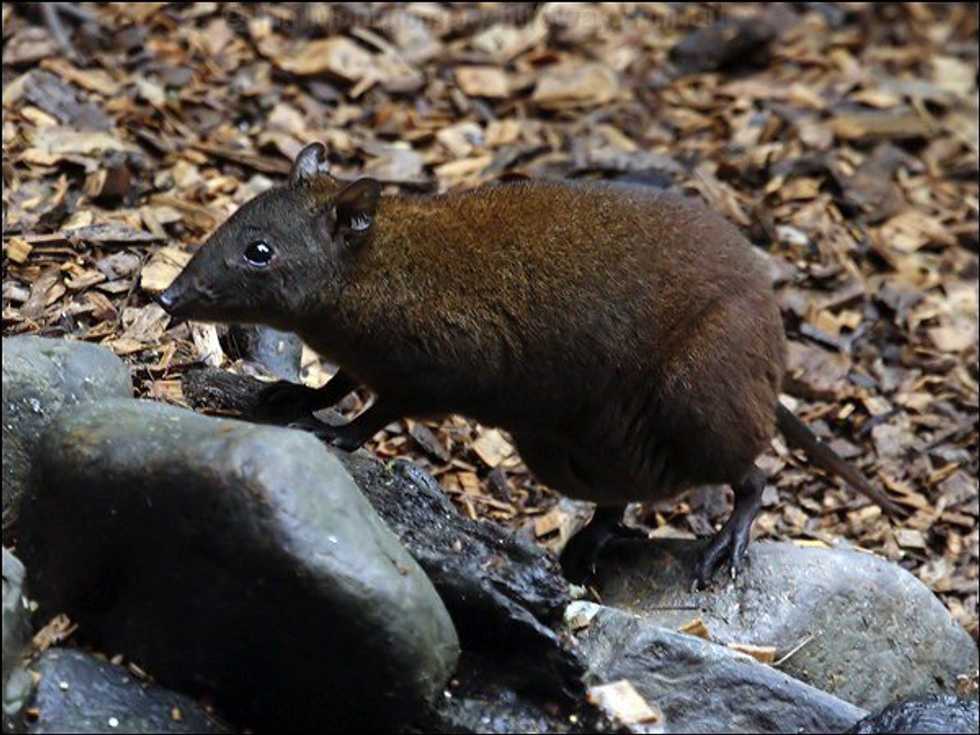
For the past three semesters, the School for International Training's Rainforest, Reef and Cultural Ecology program has embarked on a quest to collect data on the abundance and distribution of the musky rat-kangaroo at four sites. This study of musky rat-kangaroos is the first of its kind. The Chihuahua sized marsupial evolved from a possum-like ancestor, and is the progenitor for modern day kangaroos. Looking like a very large brown rat with a long, scaled tail (hence its name), the musky rat-kangaroo is a macropod, a member of the marsupial family including wallabies and kangaroos. The musky rat-kangaroo hops along the ground in a very odd manner, pulling its hind legs up to its front legs much like a kangaroo.
The musky rat-kangaroo is endemic to the Australian Wet Tropics, meaning it is found only in the Wet Tropics rainforest region of Northeastern Australia. SIT students surveyed their numbers in four different sites: Gillies Range and Gadgarra, which are continuous rainforest areas; and Lake Eacham and Lake Barrine, which are rainforest fragments. It is important to survey musky rat-kangaroo numbers in different sized rainforest areas in order to get an idea of how fragments can affect the livelihoods of species unique to the Wet Tropics. As the amount of rainforest dwindles away due to logging and global climate change, these fragments preserve species, like the musky-rat kangaroo, that can survive only in the Wet Tropics. Recording the fluctuations in musky rat-kangaroo sightings over the semesters is also useful in assessing the activity level of these creatures during different seasons and in varying sites.
In the wet season of 2014, SIT students spotted 48 musky rat-kangaroos along the fours sites. And yet Toria, Tlalli, Tess, and the fifteen other SIT students only spotted 21 musky rat-kangaroos in the wet season of 2015 while surveying the same areas. According to trends observed over the past three semesters, more musky rat-kangaroos were found during the morning than during the afternoon, probably because they are diurnal (awake during the day) and sometimes sleep throughout the afternoon. More musky rat-kangaroos were found during the dry season than the wet season, possibly due to the breeding times of these animals. The musky rat-kangaroos breed and conceal their young in their pouches during the wet season, and in the dry season, these same young have matured and can be observed at the sites.
The most interesting finding for Toria, Tess, and Tlalli was that more musky rat-kangaroos were found in rainforest fragments than in continuous rainforest areas. Because many scientists studying fragmentation -- such as William Laurance -- argue that fragmentation can negatively affect the numbers of Australian mammals, the three T's predicted that fewer musky rat-kangaroos would be observed in the rainforest fragments than in continuous rainforest. A possibility for why the opposite was found is that both Lake Eacham and Lake Barrine have very fertile, mostly basaltic soil, whereas Gadgarra and Gillies range have less fertile, metamorphic and granite soil with some areas of basalt. Fewer fruiting plants were observed at Gillies Range than at Lake Eacham, so perhaps the rich soil of the two lakes can support a wider variety of fruiting plants and thus a larger population of musky rat-kangaroos.
Also, the fact that both fragments contained large bodies of water, whereas both of the continuous rainforest tracks did not, may be another reason why more musky rat-kangaroos were found at the lakes. Perhaps evaporation from the lakes provides the surrounding forests their own moister microclimates. This would be more favorable for the musky rat-kangaroos than the continuous rainforest tracks because they tend to live in the wettest areas of the rainforest. But what could be the cause for the discrepancy in the spring 2014 and spring 2015 musky rat-kangaroo sightings? The three T's thought about many possibilities, and here are some of the ones they thought were most plausible.
According to the Australian Bureau of Meteorology, the year 2014 was the third hottest year on record in Queensland, and with this onslaught of high temperatures came floods, cyclones, and other natural anomalies. Perhaps when the SIT students of 2014 went out to do their spotting, the omnivorous musky rat-kangaroos had been drawn out to eat the earthworms that had been uncovered by recent flooding.
Another food-related theory is that the musky rat-kangaroo uses the scatter-hoard technique, where they collect fruit and burry it so that when scarcity strikes, they can have a backup food store. Perhaps in spring 2014, recent flooding had washed away important ground fruit, and the musky rat-kangaroos were more active in order to collect more fruit to compensate for this loss.
Another possibility is that the wet season arrived earlier in 2014 than in 2015, and an earlier wet season would lead to an earlier fruiting season. According to musky rat-kangaroo expert Andrew Dennis, the abundance of musky rat-kangaroos has a direct relationship to the abundance of rainforest fruit. If the spring 2014 SIT students were conducting their study when the wet season had already caused the fruiting season to begin, while the spring 2015 students were conducting their study on the brink of the wet season, then the greater abundance of fruit in spring 2014 could explain why there were more musky rat-kangaroo sightings than in spring 2015.
As the study continues through future SIT semesters, we hope that these theories can be tested. Because the study is new, more data is necessary before any conclusions can be drawn. The musky rat-kangaroo has not been closely examined in this way before, and we are eager to contribute knowledge of the species to the scientific community.
Two wait-a-whiles and seventeen leeches later, the girls made their way back to their remote campsite (with color TV and Wi-Fi access from their double beds), disappointed and dejected about the lack of musky rat-kangaroos in their day.
"I hope habitat fragmentation didn't completely eradicate the populations," said Toria sadly.
"They are very unique to this particular North Queensland area and can be found nowhere else! If we can't see them here, then we never will," Tess worried.
All of a sudden a great gust of wind blew through the trees and a branch came crashing down next to them as they ducked and panicked.
"I SAW ONE!" Tlalli exclaimed, pointing beyond the fallen branch. "It ran away when the branch fell! I saw it! They're still here!"
The girls frolicked with joy, having successfully spotted the shy musky rat-kangaroo.