Introduction
A few years ago my dad and I went to see my brother at a tailgate for a football game in Stillwater, OK. Like most college game day tailgates, my brother and his friends were poorly prepared and asked for my dad and I to help, so we went to go get charcoal. After we got the charcoal at the Lowe’s on Highway 177 we started driving back south. On the side of the road there was a sign for a restaurant called Sirloin Stockade, and on top of the sign, there was a fake steer. It caught my dad's attention and reminded him of something. He pointed it out to me as we passed it. He told me that those had been a very popular restaurant chain when he was growing up, at least until one in Oklahoma City became the scene of a grotesque homicide. The story went, according to him, that during a robbery the employees were all murdered in the restaurant's freezer by a guy named Roger Stafford. “After that,” he said, “the restaurants didn’t last for very long, not a lot of people wanted to eat there anymore.” My father told me this in an almost matter of fact way, as if he was sharing with me a story that he had heard over and over again to the point that it had lost some of its gravity. I grew up in Oklahoma City and was always aware of the horrors experienced in April 1995 when Timothy McVeigh murdered 168 people with a truck full of explosives at the Murrah building downtown. But this story was somehow different, even from the little that I had heard from my father, it scared me to imagine such an event. To be robbed at gunpoint, thinking that if I just give them the money I could go home and everything be all right, only to be lead into the freezer and shot dead in the blink of an eye. I never forgot about it. And now I have decided to research the crime and those who committed it.
This is not a very well known event outside of Oklahoma. Information online is scant and hard to rely on. The lack of attention might be because the nature of the crimes are too much to handle personally or aren't evil enough to earn it like other serial killers. There isn't a twist or a gimmick about these murders. Roger Stafford didn't come up with it because of the Beatles like Charles Manson, he wasn't a cannibal like Jeff Dahmer, he didn't do it as a sacrifice like Herbert Mullin, he wasn't a sadist like BTK and he wasn't instructed to do it from a talking dog like Son of Sam. Roger Dale Stafford didn't write letters to newspapers, or get a catchy nickname. He killed for neither passion nor revenge. And even the idea that he killed for greed isn't entirely true. In fact, the reality is probably scarier than other killers, Stafford killed for no reason.
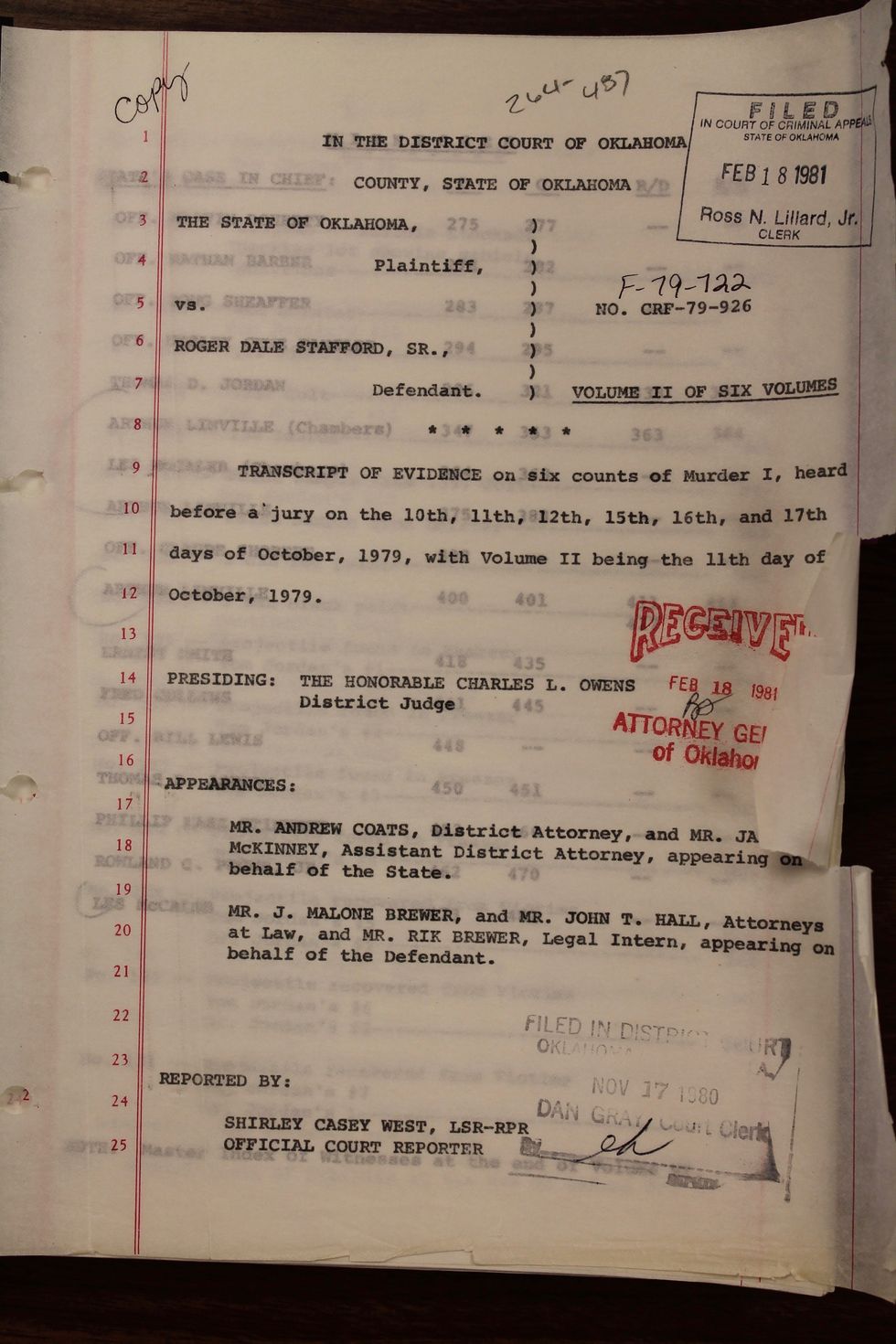
The most accessible information is from the online archives of the Oklahoman, the local newspaper in the OKC metro area. Even then, that information doesn't give the full picture. Not the same picture that the jurors saw in the trial. In order to get the full story more had to be done. My friend and I got a hold of transcripts, court files and trial exhibits from Court Clerks and the Oklahoma Department of Libraries. Photographs of the crime scenes, investigative reports, sketches, photo linen ups, and transcribed confessions all found in the public record.
There isn’t a memorial, there isn’t a movie about it or an exhibit at a museum. Even though an entire generation of Oklahomans was shocked by this event, it appears as if many of us are trying to keep it in the past. Crimes like that just don’t happen in Oklahoma. But it did happen, and it changed everything for us. The victims should be remembered, not forgotten. The perpetrators should be known, not ignored. That is why I am writing this multi-part story for my series known as The Oklahoma Files. In each part of the story I will exam a different aspect of what happened and bring it all together. Backstory, the killers, the victims, the crimes, the investigation, the manhunt, the confessions, the trials, and the punishments. I write this not to glorify the criminals or to harass the victims, but in the hopes that this tragedy will no longer be hidden.
Prologue
July 16, 1978 the Sirloin Stockade on southwest 74th St and Pennsylvania Avenue in Oklahoma City, Oklahoma was the scene of one the most violent crimes in the history of the city, if not the state. It was a quiet Sunday evening, and the six restaurant workers were in the process of closing for the night. When one of the employee's boyfriend and the co-manager showed up, they found six bodies in the restaurant’s walk-in freezer. They called the police. The five men were pronounced dead at the scene, the man's girlfriend was the only survivor. She was taken to the hospital, where she would eventually succumb to her injuries. All of the victims had been killed by gunshots to the head, they were executed. It was robbery that had gone terribly wrong. The police had little to go off of, and the lazy dusty city was sent into a panic.
A few weeks earlier, in June, three bodies were discovered near Purcell in McClain County, Oklahoma. A husband, a wife, and a young son had been shot dead and left on the side of Interstate 35. Their car, their belongings, and their lives had been stolen by somebody. Police found the stolen vehicle later in Oklahoma City. Guns and money had been taken from it.
Law enforcement thought that the two crimes were unrelated, having taken place weeks apart and many miles away from each other. They were independently investigated until the two stories converged. What came out of it would be the story of a group of three desperate individuals who drifted across the country, one of whom was an impulsive man with a bad temper and cold blood. They stayed in Oklahoma, like every other place they stayed, for only several weeks. They were poor and homeless, trying to provide for their children while staying out of trouble. By the end of their brief stay in Oklahoma they would be leaving nine people dead, not including one of their own. Two of them, a husband and wife, would come back to Oklahoma a few months later, never to leave the state again.