

"How are you?"
We hear this phrase more times in the course of a day than we realize, desensitizing us to its true meaning. How are you? Really. Skip the lies and cut the charades. I really want to know.
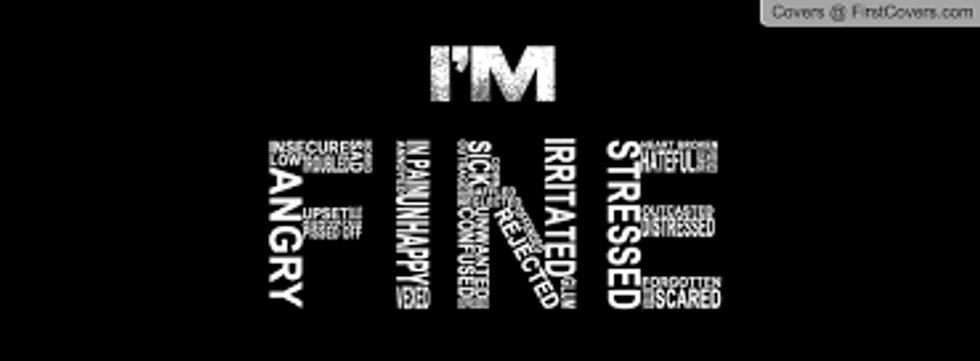
"I'm fine."
This is one of the simplest, yet most profound lies we tell as human beings. And for what? Out of courtesy? Out of fear that being truthful with others will scare them away? Or is it that deep down, we are most terrified of the concept that we do have a spectrum of emotions other than "fine."
We are afraid to be weak. We are afraid to be vulnerable. We are afraid of our own honesty and truth.
We are afraid of being seen.
We, with the simple utterance of two syllables, are caging ourselves. Putting the emotion that makes us complex and compelling behind bars and praying no one finds the key.
Perhaps there are gendered factors at play. I know that as a woman in this day and age, one my worst fears is being seen as weak. For centuries women have been told their emotions make them crazy or fragile or somehow less capable of managing their own affairs than men are. Therefore it makes perfect sense that the "empowered" women of this era have to shove down their feelings to compete with men for respect. Men face the same issue from a different angle. Our concept of stoic masculinity is limiting and simply put, unhealthy for men and women alike. When we allow people of all genders to be just that- people—with all the emotions that entails, just imagine the possibilities that will unveil themselves.
Therein lies an enigma: what do we have to gain from eschewing the confines of this damaging habit? Several of my dear friends have been through tough times of late, and sometimes the most effective therapy is to give them your shoulder to cry on and reassure them it's OK not to be OK. You don't always have to be fine. You don't need to put on a brave face. Your feelings are valid and take your time to heal. These are the things I have to tell myself when sh*t hits the fan, as it seems to keep doing. So, my dear friends, when I ask you how you are, please, I beg of you, tell me the truth. Because that is when we can begin to help one another. I wish I could fix all of the problems that the ones I love are facing. I wish I was Superwoman. And although reality says I'm not, I think that letting the truth out of its iron cage is as good of a place to start as any.
So how do we hope for a better solution in the day to day drudgery of terse greetings and polite social niceties? I find there is hope in the asking. There is hope in the wondering. Our innate and genuine concern for those around us is one of humanity's best qualities. Ask your fellow man "how are you?" And want to hear the answer.
When you hear that age-old question, as I'm sure you will often, dear reader, don't just be fine. Be confused, be ecstatic, be angry, be in mourning, be confident, be all of the many things that make this life worthwhile. Most of all, be OK to not be OK.

















