

There is a problem in College Park, Maryland. It's not the academia, it's not the student experience and as we learned this year, it's not our athletic prowess as newcomers in a 119-year-old conference.
Despite lying on the Route 1 corridor sandwiched between D.C., Baltimore and Annapolis, the college town has struggled to provide the adequate resources, housing and overall appeal for anyone not currently enrolled in classes.
There are three types of people in College Park. Students who attend classes and depart after graduation; faculty, staff and business owners to who commute to and from College Park; and those who pass through via Route 1.
Drawing students back after graduation, faculty beyond their normal work hours and passing commuters to the college town has become difficult.
Enter Wallace D. Loh, former University of Iowa provost and, as of Nov. 2010, president of the University of Maryland. In the decade or so before Loh's entrance, former president C. Daniel Mote, Jr. heightened the university's research capabilities drastically, launching the school into the rafters of worldwide rankings.
In 2004, under Mote's leadership, M Square Research Park was opened, now hosting facilities for the Food and Drug Administration, the U.S. Department of Defense and the National Oceanic Atmospheric Administration.
Two years later, the university unveiled their Great Expectations Campaign aiming to raise $1 billion. One economic downturn, over 124,000 donors and one deadline extension later, the university joined roughly 30 other institutions in Dec. 2012 in tackling such a feat.
In 2008, a 10-year strategic plan was launched. Its focus was to make the university a destination for intelligent students, to become the “state's door to the world" through international initiatives and to create the vibrant community necessary to attract students, faculty, and visitors.
Construction to build the Physical Science Complex, a state-of-the-art science facility, began in 2010, creating an area specifically tailored for the collaboration of scientific minds. The facilities include a quantum physics laboratory.
Mote lit the fuse for Loh to exploit the college's pristine location and academic success by attracting students, staff, and commuters to the location beyond their normal daily routines.
Most notably, higher-quality housing — both on campus and off — has popped up throughout the city. The University View, voted best place to live off-campus by The Diamondback four years in a row, and The Varsity, which opened in 2011, lie adjacent to campus on Route 1. Despite a slow opening in 2013, the new Domain College Park reported it was fully booked for the fall of 2014. A city economic development coordinator deemed the lack of openings in the new, more upscale apartment building attractive for future developers. Amidst the Domain's initial successes, another apartment complex, Landmark, will open next fall. Housing for more than 800 students will reside above one of the nation's first TargetExpress locations — developers took notice after the first TargetExpress location proved successful on the University of Minnesota campus.
College Park has rightfully been deemed a food desert. Downtown lacks a single place to shop for groceries. No, CVS does not count. TargetExpress will provide shoppers with convenient access to groceries and health and beauty products. That sound you just heard was the collective sigh of every student who has put off their trek down Route 1 to Shopper's or Giant several weeks too long.
For good measure, Insomnia Cookies — a late-night cookie and ice cream joint that provides both in-store and delivery accessibility — aims to open on Route 1 before the school year ends. That sound you just heard was wallets emptying from every drunk student upon leaving the bar.
For its first four years, the Chipotle on Route 1 was the highest grossing location for the global franchise. There is no reason Insomnia Cookies shouldn't see marked success as well. Nearly every Insomnia Cookies location serves a college town from Kalamazoo, Michigan to Athens, Georgia.
Just off campus, 22 of 29 Knox Boxes — a staple of off-campus living, but not necessarily cleanliness — have been demolished to make way for Terrapin Row. The multi-purpose complex will hold nearly 1,500 beds, 500 parking spaces, 12,000 square feet of retail space and all the necessary amenities for students in an open, outdoor concept that includes bike and pedestrian-friendly paths throughout, aiming to “usher pedestrians toward the main academic centers of campus."
In an effort to bring faculty to the area, a new charter school in nearby Adelphi will provide college-preparatory credits for its students. College Park Academy provides a potentially lucrative draw for students of professors.
The university purchased a recently closed bar on Route 1 in hopes of partnering with Philadelphia-based Milkboy to open a restaurant-bar concept based around a live music venue. Although in line with the university's goal to transform the area into a culturally alluring area, students and faculty raised concerns that an investment in the art house will draw resources away from educational ventures in the School of Theatre Dance and Performance Studies.
Coinciding with the recent move to the Big Ten, the former home of the national champion men's basketball team will be re-purposed into a $155 million indoor-outdoor football practice facility.
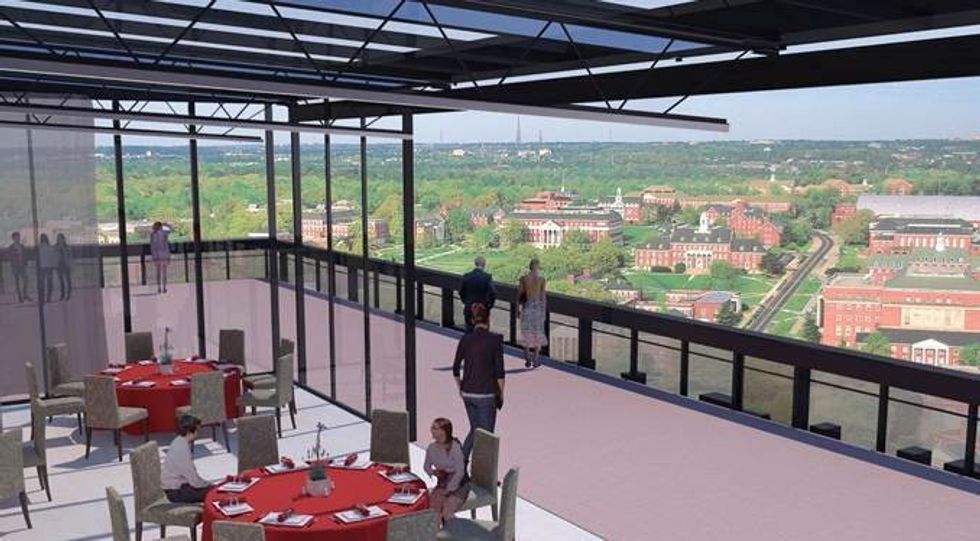
The building across from the main entrance to campus may present the biggest catalyst in turning the college town into a college metropolis. Painfully creatively named, The Hotel is estimated to boost economic activity by over $60 million per year when it opens by fall 2016. The luxury hotel will include conference centers and innovation incubators, and Loh hopes it will serve the entire region, not simply the immediate College Park community.
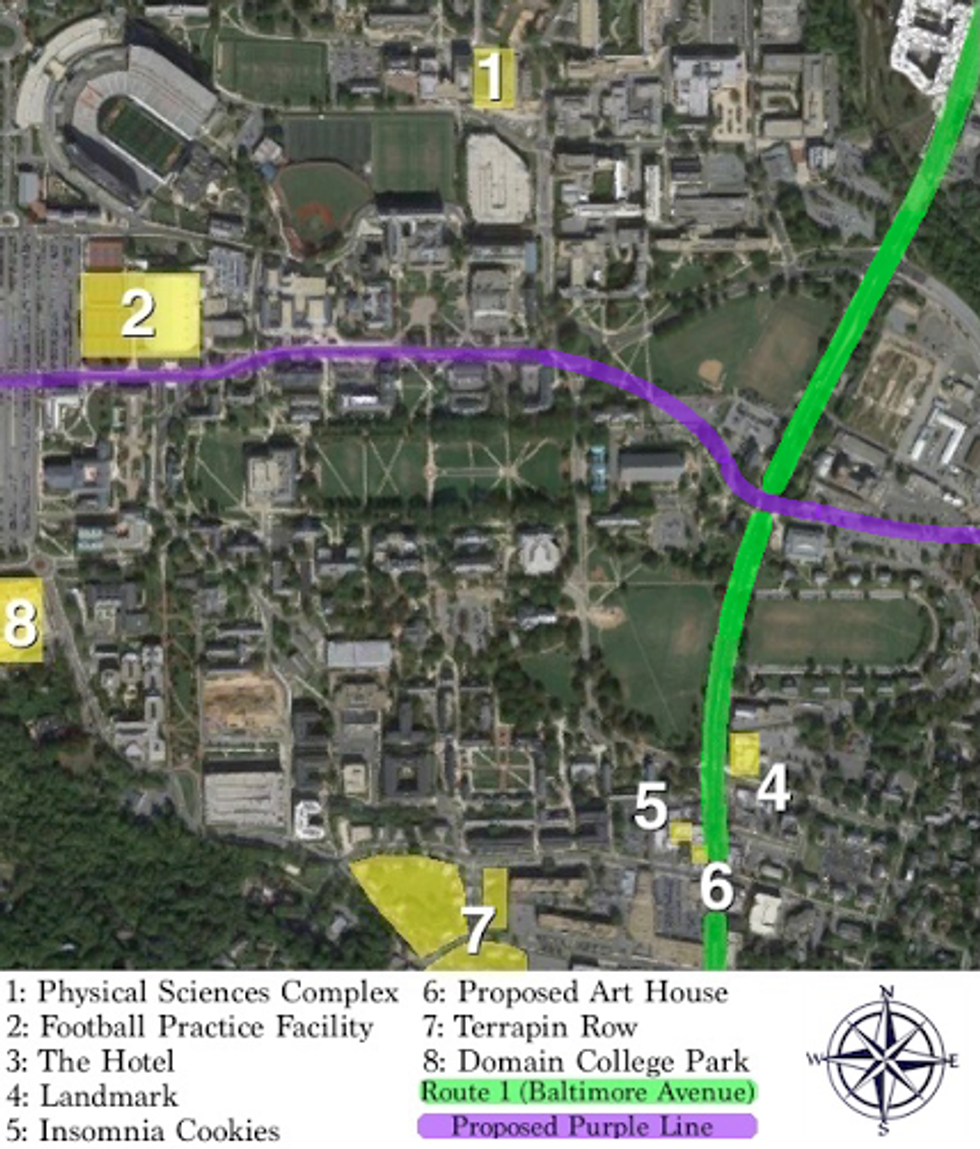
If The Hotel does not provide the final piece to the puzzle, it may be the Purple Line, a proposed 16-mile light rail that would run through the heart of campus, displacing the famed "M" Circle seen upon entering campus, connecting New Carrolton — the east end of the Orange Line and the train station most commonly used by students — with Bethesda on the west end of the Red Line. The university and Loh continue to push full steam ahead on all fronts: housing for students, attractions for faculty and graduates, new athletic facilities, retail space and increased accessibility to the campus and surrounding cities through the proposed above-ground light rail.
Expect this trend of growth and expansion to continue on all fronts. The university is in partnerships with Lockheed Martin and ride-sharing company Uber, and it recently received $31 million, the largest donation in its 159-year history, from Oculus VR CEO and former student Brendan Iribe.
Think quantum computing, virtual reality and warm cookies delivered to your dorm until 3:00 a.m. I know where I'm sending my kids. By then, maybe they'll even be calling it, "Not your old man's College Park."
(Correction: The original map showed the proposed Purple Line continuing down Campus Drive and exiting campus through the main entrance. The proposed track will turn right near "M" Circle and continue across Route 1 via Rossborough Drive. -BH)

















