

Warning! SPOILERS within.
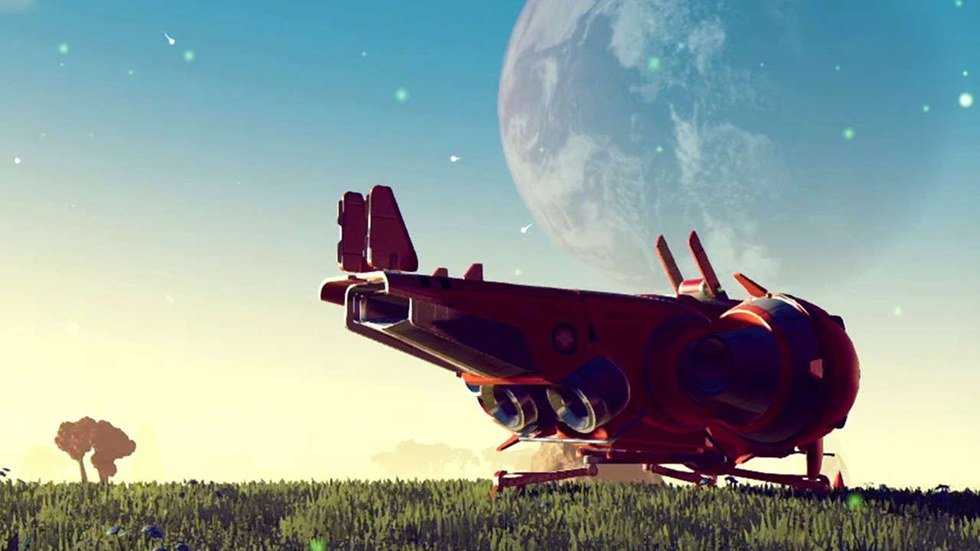
The sky is darkening. A volatile radiation storm packed with high-velocity green winds approaches. The low energy beeping on your Life Support further riles your fear. Frantically, you dock your Starship and run into the nearest chrome-plated radar building to seek shelter. As the winds roar outside, you give it a minute before you’re able to sigh with relief under the glow of the computer module beside you. Thankfully, this structure will hold until the weather calms. You’re safe.
For now.
This, for video game players, is just one of several quintillion scenarios that can occur while playing the new space exploration release No Man’s Sky by Hello Games, which landed on shelves for Xbox One and PS4 owners this past Tuesday. And speaking of quintillions, that sheer aforementioned quantity, there are actually 18,446,744,073,709,551,616 in-game planets that exist for players to roam, to trade on, to fight on and, in a cosmically grueling sort of way, to survive on. Now if it’s difficult to wrap your head around the vastness of that many planets, that many scenarios, that many anomalies and space stations and systems within a shared gaming universe, you are not alone in this confusion; one of the biggest hooks, and simultaneously one of its biggest, most hyped mysteries, for No Man Sky’s release has been precisely this unfathomably enormous space-scape of virtual opportunity.
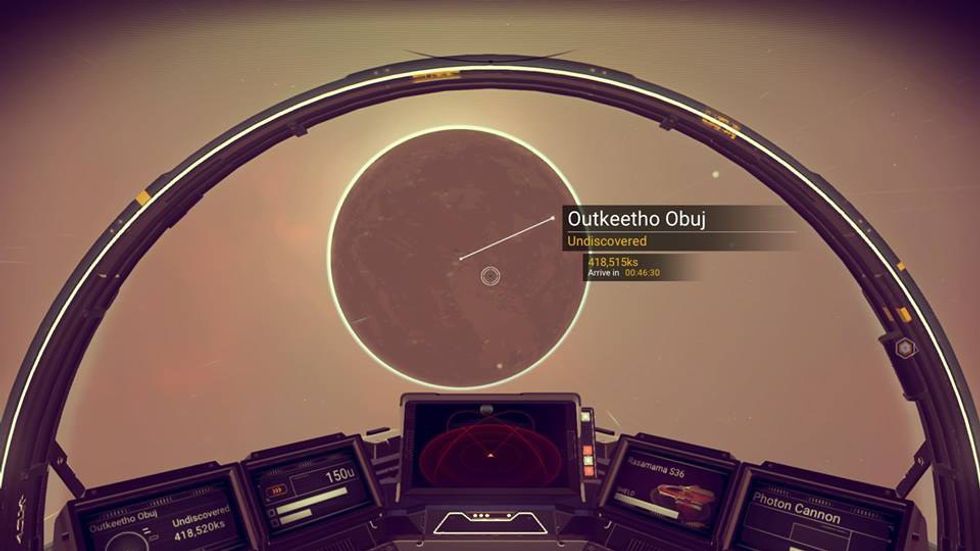
Except, ironically enough, you also kind of are alone in another sense; considering it would take approximately 584 billion years in real-time for diehard completion-ists to fully explore and intricately map out everything Hello Games created-- the odds of running into another player are so far out that it will be rare, if at all, that those stars align.
And still, even with zero human-to-human contact, the game is extraordinary.
No Man’s Sky, for those unfamiliar, is a sandbox game. Like the popular 2011 title Minecraft, for instance, a sandbox game is an open-world setup, allowing players the most non-linear options and freest choices possible. And as far as the number of accessible planets and galaxies available are concerned, Hello Games achieved this feat by creating a determinate algorithm through which everything (everything meaning the stars, asteroids, the planets themselves, the on-the-ground flora and fauna of each planet, etcetera etcetera) is actually procedurally generated, which means it doesn’t fully exist in-game until a player gets closer to encountering it. Once you’re there, it’s there.
This, to many, is considered to be nothing short of incredible. So far, no game has hit such a grand universal scope like that which awaits in No Man’s Sky. Now fair warning, I’m admittedly the direct opposite of a math enthusiast, so that info regarding complex algorithms and procedurally-generated hoozie-whatsits took me a bit to understand. But truly, once you’re there and you’ve got your hands around the controls as your Starship revs its Hyper Drive, thus breaking free of all planetary interference and zipping into the voids beyond…Let’s just say it all speaks for itself as you shoot between cosmic realms with an arsenal of the future at your disposal.
However, despite all this, the game is not perfect; many, going into it, expected more traditional PvP (Player versus Player) alternatives. No Man’s Sky is also wildly impossible for one person to finish, and this frustrates many. But on the other hand, for players like me, this was great; it lifted the veil of feeling like I needed to finish everything. So in a weirdly relieving way, because I can’t, the pressure is off. There are pros and cons to each side of this, depending on how you feel personally, but either way it is undeniable how far-reaching and awe-smashing No Man’s Sky is for this generation of optimistic gamers.
Suffice it to say, just like one person cannot wholly do everything between each and every star system, one writer cannot hope to cover everything about the game in one singular review. Because when it boils down to the nuts and bolts of the game’s outer space, there are so many other aspects worthy of explanations: how to discover and name outposts, learning entire engineered alien languages word by word, regaling marvelous tales about said alien species Hello Games conjured up, (the robotic Korvax, the scaled warriors of the Vy’keen, the surprisingly cute frog-looking-things called the Gek) and so on and so forth. Figuring out how to effectively mine on-planet minerals with your Multi-Tool, how to star-jump by harnessing the pull of a black hole, how to build and upgrade every Starship, and the processes behind securing new Exosuit schematics…It’s all, in my opinion, very worth your time if you hanker for this sort of adventure, but in no way can it all be so simply summed up. Hello Games has created an almost encyclopedic tablet that players have and will continue to pick up for around $60, and indulging the universe of No Man’s Sky inside them is worth the pretty penny.
Overall, to stilt further nerdy gushing on my part here, this gamer rates it at a strong 9.4/10. And even if No Man’s Sky isn’t everyone’s cup of tea, it’s sure to be remembered as iconic in its own right.
After all, it’s not just no man’s sky. It’s all of ours in the final frontier, should we choose to boldly venture out.