
I hate Father’s Day. I spend weeks leading up to it watching commercials that feature grinning fathers celebrating with their happy children and touching episodes of my favorite TV shows showcasing that special “daddy-daughter” bond. Somehow the latter seems to exist in every household but mine. My blood boils at every heartwarming image of a loving “whole” family flaunting their love.
I did not by any means grow up unloved: I have a strong support system full of role models and parental figures on whom I can rely. My father just does not number among them. He once celebrated Father’s Day as another day during which he could be with his little princess; the trouble was, his idea of a princess was the medieval, fairy tale sort. Demure, quiet, doting, obedient, trapped in a tower, waiting for a prince who meets the king’s approval. So I let down the hair that he insisted was sinful, and I decided to rescue myself and leave my father’s home in Israel. My escape may have taken strength, but I have felt weak in its wake, unable to even feel comfortable in my own mother tongue since it ties me to him. Unsurprisingly, I have not celebrated Father’s Day since and greet the end of June with dread each year.
Or, rather, I did, until last week when I stepped out of my local movie theater.
[WARNING: "Wonder Woman" spoilers ahead!]
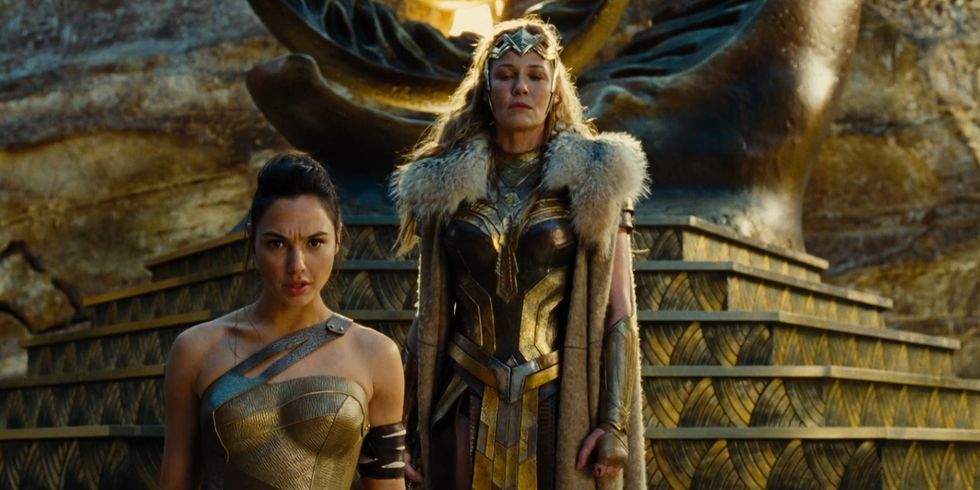
"Wonder Woman" is the story of Amazonian Princess Diana of Themyscira, an Eden-esque island populated, defended, and ruled by women. The movie follows the titular character’s journey into the world of Man and her fight for justice and peace amidst the carnage of World War I. The armor-clad heroine tears through No man’s land, liberates a village, stops an attempted mass murder, and defeats the god of war, all while announcing herself as “Diana of Themyscira, daughter of Hippolyta, Queen of the Amazons.” She dons the coronet of her fallen aunt Antiope, known as “the greatest warrior who ever lived,” general of the Amazon army, and Diana’s relentless military trainer.
Diana fights under the name of these brave, strong women and devotes her loyalty to them. Though Hippolyta and Antiope are absent for a good portion of the film, their words and deeds are echoed in Diana’s. The three share a bond that traverses all physical bounds. Even miles away from Themyscira and her mothers, Diana is proud of her Amazonian heritage and ties her identity to the women warriors who came before her, despite the fact that her father is none other than Zeus himself. These women raised her, and they motivate her as she saves the world.
"Wonder Woman" changed the face of the film industry in more ways than one by shattering box office records, blazing the trail for female-driven superhero movies, and boasting a female director. However, I most appreciated the variance in the parental bond that drives the heroine. Even when we are graced with the rare female-led film, the leading lady is often driven by her desire to prove herself to her father or live up to him, regaining the coveted title of “daddy’s little girl.” From Disney’s "Beauty and the Beast" to "The Princess and the Frog", from "The Hunger Games" to "Mamma Mia" and even "Gravity", the highest grossing female-driven films seem to always find their fuel in the heroine’s bond with a father or father figure, demonstrating that female strength is apparently dependent on male support or inspiration. "Wonder Woman" liberates us from that mold.
The new bearer of the Lasso of Truth, star Gal Gadot herself, is the real-life embodiment of that liberation. A veteran of the Israeli army and no stranger to combat herself, Gadot is also the mother of two daughters (one of whom was in utero during some of the "Wonder Woman" filming process, but pregnancy was no hindrance to the real-life Amazon gracing our screens this month). In an interview with News Corp, Gadot stated that she was motivated to take on the role of Themyscira’s princess by her desire to inspire her daughters and other women by introducing more strong female figures into the male-heavy media. Gadot asserted her belief in the importance of having a powerful female role model for young girls (and boys) and the requirement of educating in order to empower in this quest for equality.
The timing of the film’s release does not feel accidental. On the eve of the day that lauds fathers for their positive influence on the world and support of their families, we have been gifted with a film that reminds us that the father-daughter bond is not the be all end all, but rather one of many sources of motivation. Diana is a hero for the ages, rightfully placed among the leaders of the Justice League and living up to her Amazonian predecessor’s powerful examples. Gadot shakes the walls of the movie theater with her impassioned speeches in her Amazonian/Israeli accent and her Antiope-inspired action, setting the stage for her daughters and countless others to fight for what is right. I hope to count myself among them. Thus this Father’s Day, I will not rage at the world for its insistence I don the mantle of “Daddy’s Little Princess” once more. I’ll slip on my gauntlets, let my own Israeli accent slip through, and celebrate the strong women in my life who have shown me what it means to be a true hero, with or without powers endowed by Zeus or any other man.














