

With the presidential campaigns and elections, the topic of immigration continues to be a major focus, but the subject has been represented very negatively by the media.
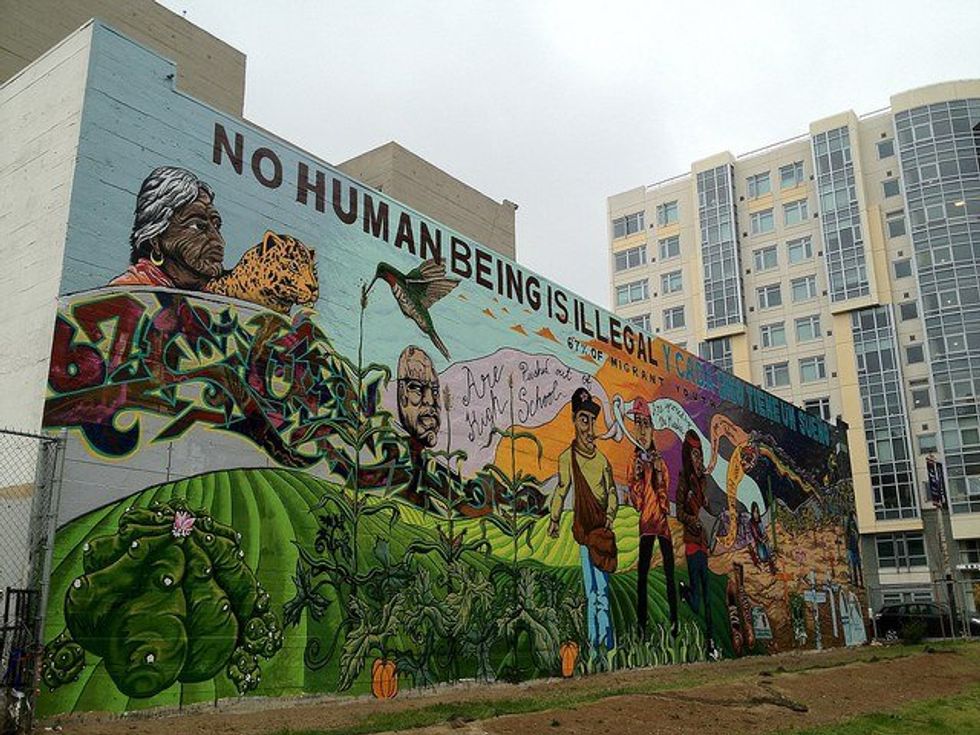
In a collaboration between the National Association of Hispanic Journalists, the Public Relations Student Society of America’s inclusion committee and the Student Government Association’s department of inclusivity, a panel discussion was held called No Human Being is Illegal in Gaylord College to talk about the difficulties surrounding immigration.
One of the issues raised was the negative terminology used in the media when referring to immigration. Journalists often choose to use the word “illegal” when referring to immigrants. However, it’s argued that they should opt to use words such as “undocumented” instead to avoid derogatory terms. Even a term like “alien” can be seen as offensive.
Dr. Melita Garza, an assistant professor of journalism at Texas Christian University, believes that journalists should be accountable when describing people and should use bias free language.
“As journalists, we have a lot of power and a lot of responsibility in defining others,” said Garza. “And with that power should come humility.”
Aside from the terminology of the media, Pamela Ortega, a junior dual major in journalism and political science, found the panelists to be very informative about the issues related to immigration.
“No Human is Illegal enabled so many people, including myself, to know more about immigration and the struggles people face firsthand,” said Ortega.
In addition, the panelists were able to dispel any untruthful information about undocumented immigrants and hear the stories of students willing to share their experiences.
“This day in age so many rumors can spring up about any group, including immigrants,” said Ortega. “This panel shed light on the immigration issue, its setbacks, it's strides and enabled students to listen to the story of undocumented students.”
Even though people often refer to immigrants as illegal, that is not how many immigrants born in America view themselves. Heily Maldonado, a freshman majoring in chemical engineering, shared how she is more connection as an American rather than any other nationality.
“Sometimes you feel more American than Guatemalan and Mexican because you’ve been here your whole life,” said Hailly. “This is the culture that you know, then you walk out into the street and you have people telling you, you don’t belong here. This isn’t where you should be. You’re a criminal. You should go back to where you’re from. You don’t have the right to be here. You don’t deserve the privilege to be here. I’ve been told that personally. I think that it’s hard but it’s something that has made me become a stronger person. We’re fighters definitely, and we’re going to continue fighting for what we want and for our dreams.”
Samantha de la Rosa, a freshman psychology student who was born in Ciudad Juarez, Chihuahua but was raised in Oklahoma also spoke about how she doubts she would even be accepted if she was to return back to the country she was born.
“Some people tell you 'why don’t you go back to your country and get an education there,'” said de la Rosa. If I were to go back to my country, I wouldn’t even fit in. They would be like 'oh she’s too white or too American. She’s not like us as all.' We’re so fortunate to be here that to go back is not even in the picture. It’s just to go forward here in the U.S.”
De la Rosa wants to emphasize the message that you can go against the negative stereotypes.
“You don’t have to be in that cycle where people think you’re nothing but an immigrant and you have to be a construction worker your whole life,” said de la Rosa. “You may not be a U.S. citizen but at the end of the day you’re in the United States and it’s the country where dreams come true.”
Both Maldonado and De la Rosa are members of Aspiring Americans, a nonprofit organization that aims to provide scholarships and opportunities for undocumented students in Oklahoma to attain a college education. Both young women hope to inform and inspire other college students about their journey.
“We stay connected to Aspiring Americans because without them we wouldn’t be here,” said de la Rosa. “We take a lot of pride in that and we like to help students kinda know our stories and also talk to students who are undocumented a well. And tell them you know, you can do it as well.”
















